

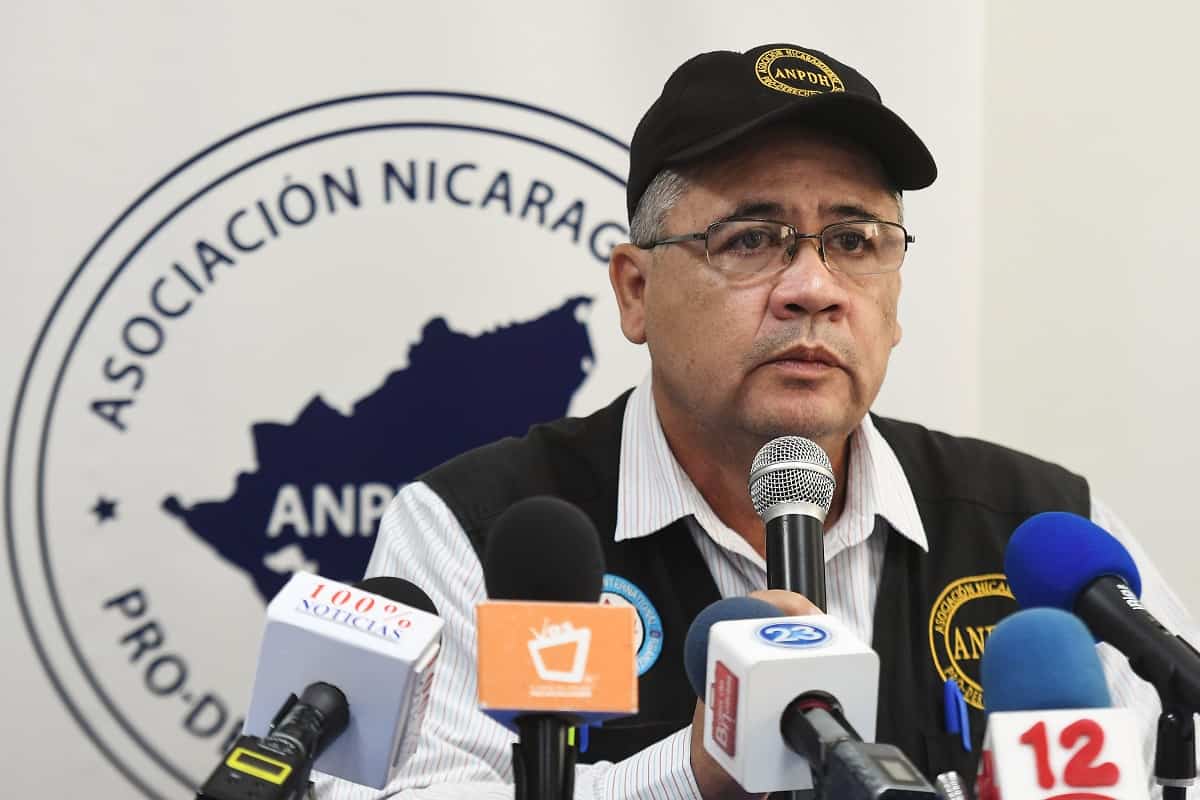
When Alvaro Leiva took the stage at a recent fundraiser for Nicaraguan refugees and immigrants in Costa Rica, all eyes were on the short man in the black HUMAN RIGHTS vest. In fact, when this reporter stepped out of the room for an interview with the renowned human rights defender, one of the Nicaraguan university students sitting nearby followed close behind for an opportunity to greet a personal hero.
“Don Alvaro,” said Marcelo, 20, whose family put him on a bus for Costa Rica months before because of the ongoing violence in Nicaragua, “I just want to thank you for everything you have done for Nicaragua. Everything you are doing for my family.”
There on the balcony of the lush Costa Rican Country Club in Escazú, Leiva offered a warm embrace and some words of comfort for a young man fearing for the safety of his family, back in his native Jinotepe.
Leiva is the secretary of the Nicaraguan Association for Human Rights (ANPDH), which closed its offices in Nicaragua in August after alleging serious threats and harassment of armed groups related to the administration of President Daniel Ortega. After the shutdown, the human rights defender fled to Costa Rica, where he was recently granted refugee status.
The fundraising event Leiva attended last month benefitted relief efforts being carried out by SOS Nicaragua and the Ticos and Nicas: We Are Family Association. (For more information on the association, visit this donation page.) The human rights defender sat down with The Tico Times just outside the dinner at the lush Costa Rican Country Club in Escazú, spoke about his ongoing work within and outside of Nicaragua and the future of his country. Excerpts follow.
What have you been able to do to continue your work from Costa Rica?
The crisis of human rights violations today in our country has direct consequences [including] immigration that has begun to affect our sister country of Costa Rica and others in the region, as well as other parts of the world. It’s unfortunate that today, we have to be outside of our country, working in conditions that create new challenges for us in our humanitarian work.
We are working in Costa Rica with Nicaraguan victims and refugees, and we are also still working within Nicaragua through our local human rights defenders – brave men and women who are committed to human rights and working in very difficult conditions. They allow us, through our national monitoring center, to continue our work and send a message to the world about the human rights crisis in our country.
Those defenders are the people who are carrying out the work of continuing to monitor the numbers of victims, casualties and other incidents, contradicting Ortega’s claim that calm is returning to the country?
That’s right. You have to remember that we always have pointed out a pattern of inaccuracies on the part of the state when it comes to human rights. We are very aligned with what the Mission of the United Nations, expelled on August 18, has demonstrated, and the work carried out by the Inter-American Commission on Human Rights, and the reports from other organizations that promote human rights in a serious way… What’s happening today in Nicaragua is a crisis of human rights violations in the face of a government that does not demonstrate any will to improve [the situation], and is hostile to human rights defenders.
In Costa Rica today we are coordinating humanitarian attention to our Nicaraguan brothers and sisters who are entering the country as refugees… We are being protected in a way we have not been protected within Nicaragua, nor have our families. Simply because we defend human rights, our fundamental rights to be alive, we have experienced persecution, threats – we have been under siege, but this has been permanent over many years.
We are hearing reports of some Nicaraguans who are afraid of facing repercussions from Ortega and the Sandinistas here in Costa Rica. Is that something that worries you on a general level and in your particular case?
We feel very grateful to the Costa Rican authorities, because this is a government that has been very committed to and aligned with the human rights of the Nicaraguans who have come into the country. We are very confident that they will continue to work hard to analyze the three fundamental points: to support the victims of human rights violations legally, socially and through humanitarian [aid].
But this is a process. It takes place in phases, and we’re aware that there’s a willingness on the part of the government and Costa Rican society to carry out our compatriots’ stay in this beautiful country in the best possible way… We want to contribute during our stay to the socioeconomic growth of Costa Rica. We want Costa Ricans to feel sure that we [are here to] give the best we can as Nicaraguan citizens.
Have you seen any evidence that suggests that the government of Ortega is tracking the activities of Nicaraguan refugees here or that they could be in danger in that sense?
There could be some signs of that. I’m fully confident that the Costa Rican government, through its security organizations, is working day and night to guarantee that fundamental right of the refugees to safety and their right to life.
When you think about the future of Nicaragua, what do you see?
Today in our country there is a permanent darkness. However, I want to reiterate what has been said by our priests in the Catholic Church: in every darkness there is a light, and that’s the light of hope that all Nicaraguans should have. Hope that one day we can recover the social peace we have lost, and that most of all we can be in a society where the three fundamental pillars are respected: our institutions, our democracy, and an absolute respect for human rights.
I am confident that one day, one day very soon, we will be back in our society and happy to be back… That’s the desire and the dream of all Nicaraguans who today are victims of human rights violations.
Tico Times Assistant Editor Alexander Villegas contributed to this report.





