

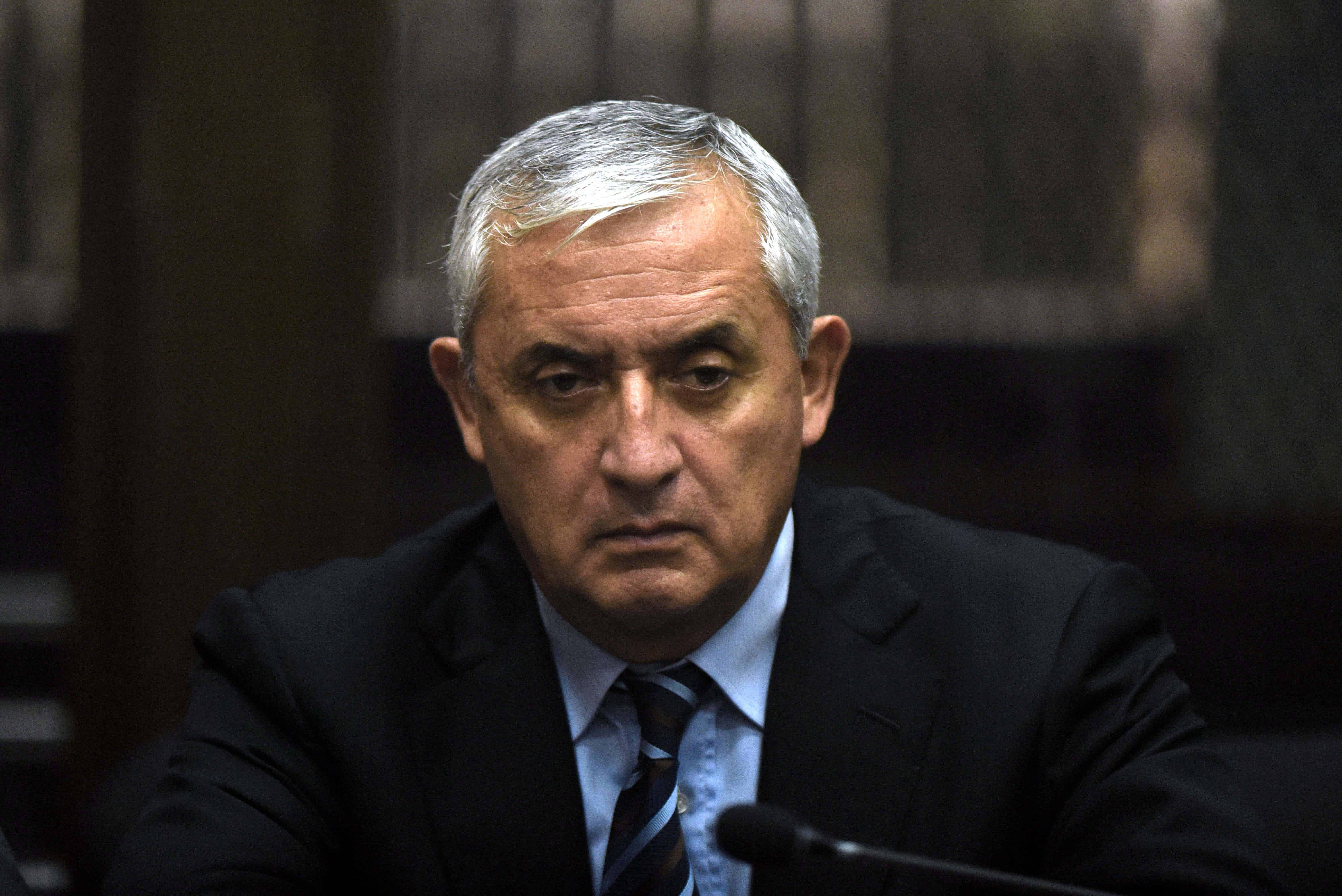
GUATEMALA CITY – Guatemalan President Otto Pérez Molina was a high-ranking military man during Guatemala’s bloody 36-year civil war, and human rights activists previously have accused him of committing human rights abuses. But on Thursday, a retired soldier testifying by videoconference at the genocide trial of former dictator Efraín Ríos Montt said Pérez Molina supervised and participated in massacres of indigenous villagers in 1982-1983.
In the village of Xalbal in northern Guatemala, and “on the orders of Major Tito [Pérez Molina’s former rank], known as Otto Pérez Molina, and other officials, they coordinated the burning and the rounding up of people to later execute them,” a former military specialist, Hugo Leonardo Reyes, testified, referring to Pérez Molina’s nom de guerre.
“The villagers in Xalbal weren’t found in the mountains, they were captured in their homes” and later transferred to the region’s military outpost, were they “were executed,” he said.
Reyes and other witnesses under a protection program granted by prosecutors testified via videoconference from within the same Guatemala City court building where the trial is being held.
Presidential spokesman Francisco Cuevas denied “emphatically what this person [Reyes] is saying,” adding that, “I should recognize that there is freedom of expression, but President Pérez never participated in these acts; it has never been documented.”
“We suspect this case has a political motivation with the goal of smearing [the president],” he said, adding that the president would not comment on the allegations.
Reyes testified that at three other military camps in the region soldiers assassinated indigenous Mayans during the war, which lasted from 1960-1996.
Pérez Molina previously had been accused of the disappearance of an ex-guerilla fighter, but that case was dropped earlier this year. As a high-ranking official, Pérez Molina has immunity from prosecution, Reuters reported.
The president also has denied that genocide occurred during the armed conflict, which left more than 200,000 dead and thousands of others disappeared.
Ríos Montt and former military intelligence chief José Rodríguez are on trial for the massacre of 1,771 Ixil Mayan villagers from 1982-1983, the bloodiest years of the war.
The trial began on March 19 and is expected to last two months.
Using heads as footballs
“They used a head like a football. I’ve never forgotten that and I never will,” one survivor testified at Thursday’s trial.
“They cut the head off an elderly woman with long hair and they brought it to the dining room of the [military base]” as a warning to the women cooking in the kitchen, Julio Velasco, another protected witness, said via videoconference.
“On the same table, they put coffee because of the cold, and I passed by and didn’t want to drink it because of the magnitude of the head that was there,” Velasco, who was 8 at the time and had been captured by soldiers, testified.
He added that at the military base, “there was no mercy for the elderly, children or pregnant women.”
“Sometimes, the children were thrown into the graves in their mothers’ shawls. When the graves were filled with victims, they buried them,” he testified. “They [soldiers] grabbed them [the victims] by the hair and stabbed them in the chest. Then they pushed them into graves.”
One soldier, named García, “killed [victims] by cutting off their heads with a knife,” Valesco said.
The young Valesco eventually escaped the camp, hidden in a tractor tire by a soldier. That soldier was Hugo Leonardo Reyes, who named Pérez Molina in his testimony before the court.
“In all areas there was genocide. I cried for my mother because of the commanders who directed the army,” said Pedro Herrera Bernal, a former member of Guatemala’s notorious civilian paramilitary patrols.
During the war, the army used civilian paramilitary groups for counterinsurgency operations. Members of the groups also have been linked to human rights abuses.
“The army forced us to patrol because he barely had anything to eat,” Herrera Bernal said. “I was on my community’s committee, and I went out to look for people to patrol.”





