

RIVAS, Nicaragua — The fog of war sometimes leads to the fog of history, and Rivas is a case in point. It was the site of Costa Rica’s most famous battle, in which, as legend has it, a drummer boy from Alajuela named Juan Santamaría lost his life setting fire to a house where the U.S. adventurer William Walker and his mercenary army were holed up in 1856 after unwisely invading Costa Rica.
But wait. A year earlier, in the same city but a different house, Walker’s army also lost a battle when a different hero, a Nicaraguan schoolteacher named Enmanuel Mongalo y Rubio, also set fire to a house where Walker’s men were holed up.
Little wonder that the two events are confused and conflated.
I went to the Museo de Rivas (often called the Museum of Anthropology and History) believing that it was the site of the second battle, in which the semi-mythical Santamaría covered himself in glory, and in an earlier version of this story I wrote that this was the place it happened.
I got it precisely wrong. This was the site of the first battle.
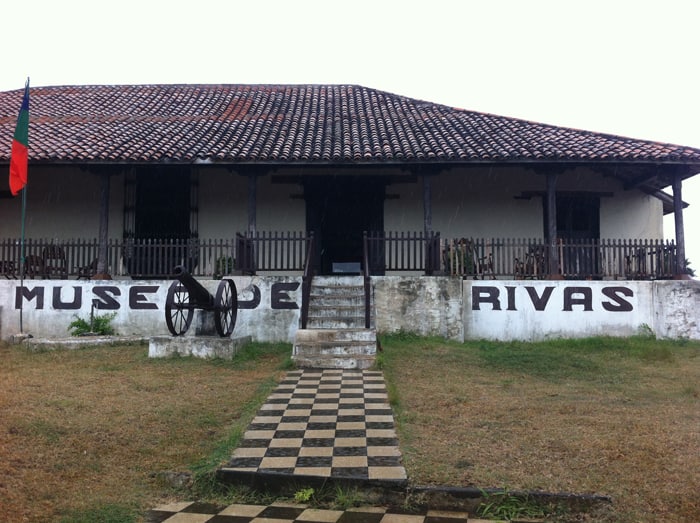
The museum, which displays timeworn stuffed animals and pre-Colombian artifacts from the region, is in a picturesque building 200 years old with a cannon in front called Hacienda Santa Ursula. A woman working there pointed to some old homes adjacent to the hacienda and said that was the building that was burned — by Mongalo and Santamaría, she said (conflating the two events). In fact, it was the one burned by Mongalo in 1855.
LonelyPlanet.com also has the story wrong, saying: “The building itself, Hacienda Ursula, is an 18th-century architectural treasure and the site of William Walker’s decisive defeat. After his troops, limping home following an embarrassing rout by the Costa Rican military, took control of the hacienda, school teacher Emmanuel Mongalo y Rubio set the fortress on fire. Most of the men were shot or captured as they fled the burning building.”
Not so! It was the site where Mongalo set the building on fire, but this was before Walker invaded Costa Rica and was pursued to Rivas by Costa Rican troops, according to Jaime Marenco, a former director of the museum who says he has been studying this history for 40 years. Marenco’s Facebook page addresses the confusion between the battle of June 29, 1855, and April 11, 1856.
It doesn’t clarify things that there is a plaque on a wall at the museum contributed by Costa Rican President Rodrigo Carazo in 1982 that alludes to the second battle, saying, “Peoples do not have borders between them, although countries do. The blood of Costa Ricans covered this land, and they became liberators of America….
“Rivas, the hostel, Santamaría, the torch, [Costa Rican Gen. José María] Cañas, [Costa Rican President Juan Rafael] Mora, nor the filibuster nor cholera could destroy you.”
This plaque unfortunately doesn’t tell what happened. And there is no other display in the museum that alludes to what occurred on this spot.
“We’re in the process of restoration, and once that’s done we’re going to make use of the other room, and so we have to prepare exhibits on all the history,” said Eliethe Romero, a curator at the museum.
Here’s the real story, as far as I can reconstruct it.
Walker, a lawyer, physician and, well, crazy Gringo, thought it would be a good idea to invade Nicaragua with U.S. mercenaries known as filibusters in 1855 (siding with Nicaragua’s Democratic Party against the Legitimist Party in a civil war). Walker hoped to set up a U.S.-style government under his control that would allow black slavery, which was then still practiced in Southern states.
Nicaragua was the Panama Canal of its day, as ships from the U.S. East Coast would steam up the San Juan River and cross Lake Nicaragua; then goods were transported by stagecoach via Rivas to the Pacific, where they were taken by ship to San Francisco.
Walker and a small force of U.S. soldiers of fortune attacked the Legitimists in the First Battle of Rivas on June 29, 1855, advancing into the city and seizing Hacienda La Ursula (today’s museum) and the mesón of Don Máximo Espinoza next to it. (Mesón is often translated “hostel” or “inn,” though it may have been a family home.)
Mongalo, a young schoolteacher, succeeded in torching the mesón, and Walker called for a retreat. He escaped with most of his men and went on to defeat the Legitimists in a battle in Granada on Oct. 13, whereupon he effectively seized power in Nicaragua.
Not content with having captured one country, Walker set his sights on others. This alarmed Costa Rican President Juan Rafael Mora, who declared war on the usurper regime in Nicaragua.
In a preemptive strike, Walker ordered his men to march into Guanacaste, Costa Rica, under an inexperienced commander, and they were routed in the Battle of Santa Rosa on March 20, 1856.
Walker’s men retreated to Rivas, pursued by the Costa Ricans, and they engaged in the Second Battle of Rivas on April 11, 1856. Walker’s men were now holed up in a different mesón, belonging to the Guerra family, at the corner of a town park near a church, where they were effectively supported by sniper fire from the church towers.
This is when Santamaría, the drummer boy, is said to have volunteered to set the mesón on fire — an extremely dangerous mission, as he proved when he was shot to death. But first he managed to throw the torch onto the thatched roof, setting the house on fire. Walker’s men poured out of the house and fled.
The weary Ticos were unable to give chase, and Costa Rica was later decimated by a cholera epidemic said to have started when the troops threw dead bodies into the wells of Rivas. (This story is disputed, as some say that water and food contaminated by fecal matter was the origin of the epidemic.)
Walker was not yet defeated, but his days were numbered. He organized a fraudulent election and was inaugurated as president of Nicaragua on July 12, 1856. He ended up doing battle with Honduran, Guatemalan and Salvadoran troops, was captured twice by the U.S. Navy and finally by British naval forces, and he was executed by firing squad in Trujillo, Honduras, in 1860.
I visited the people living in the homes below the museum that survived the 1855 fire, and residents were vaguely aware of the history but said the people who really knew the story were not there.
Editor’s note: An earlier version of this story, mistakenly said the Rivas Museum was the site of the key battleground of the Second Battle of Rivas in 1856, when in fact it was the First Battle of Rivas in 1855. Readers familiar with the history are invited to write the author or leave comments below.
IF YOU GO
Getting there: If you have a car and speak Spanish, you can find the Museo de Rivas asking for directions (or using Waze). If not, you could take a bus to Rivas and then a taxi. Ask for the “Museo de Rivas,” also known as the “Museo de Historia.”
Hours: Monday to Friday, 8 a.m. to 5:30, though there are different answers to this question; it’s best to avoid lunchtime, when curators may be absent.
Cost: Free, according to the security guard, though nominal prices are widely quoted online





