

Have you heard that if you install solar or hydro power on your home in Costa Rica, you can generate more than you need and sell the rest back to the grid?
You heard wrong.
With this year’s grid-tie law expected to allow homeowners to trade power with the grid, Costa Rica is poised to blossom with decentralized alternative energy generation at the residential, commercial and industrial levels: solar, hydro, biomass and wind.
The coming law is based purportedly on wisdom accrued during the Costa Rican Electricity Institute’s (ICE’s) 4-year “distributed generation” pilot program. Reaching its 10-megawatt project limit, the program was concluded in February 2015. Since then, the nation’s grid-tie future remains in limbo.
The anticipated law will NOT allow excess power sales to the grid, but will use a billing mechanism ICE is expected to call “simple net metering.” It will allow homeowners to offset consumption and trade mostly even-steven with the grid nationwide.
The bill’s take-backs may be less than ideal, but still digestible to the three players affected: 1) private generators, 2) power companies and 3) grid-tie installation companies like mine. With Costa Rica’s relatively high cost of power, the economics of home generation are expected to carry a 10 to 20 percent return on investment.
But the “simple net metering” paradigm is a big deal in the forthcoming Grand Strategy. It means tying the engineering and design of new systems to the power demand of the facilities served and not overdesigning them.
In simple terms, this means that if you need 20 kilowatt-hours per day and thought you could generate 30 kw-hrs and and sell 10 back to the grid, that’s not going to happen. So systems should be designed for only as much electricity as needed.
At the pilot-project stage, distributed generation was offered by ICE only, and not regional cooperatives. The forthcoming grid-tie law applies to all power distributors across the land and across the entire spectrum of demand, from simple residential to industrial.
Costa Rica is mostly electrified, though there will always be off-grid homes and ecotourism destinations in nooks and crannies. In a nation of mountains and prolific rain, hydroelectric potential is widespread and solar potential ubiquitous.
Where hydro resources are present on a property beyond the grid, the first question for an alternative-energy-conscious developer is how hydro relates and competes with solar. With the approaching grid-tie law the math is no longer for off-grid folks only. Grid-tie law is expected to offer a return on investment on modest capital investments superior to any legal alternative investment and to stimulate all homeowners nationwide to do the simple math.
So, how does hydro compare with solar?
What you need to know
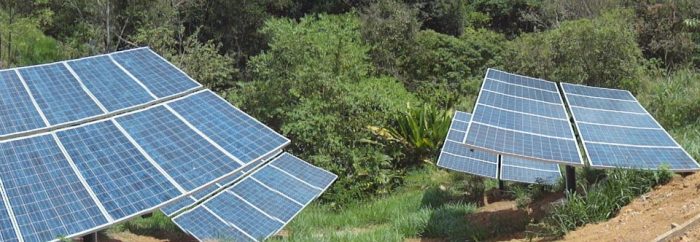
Small-scale hydroelectric power generation, for all its bareback economic upsides north of 2- to 3-kilowatt capacity, has a major downside: permitting. It takes two to three years to nurture a hydro concession through its permitting process. Solar power entails no such demands.
And a concession in hand is a requirement for grid-tie hydro. While there is an ample record of institutional negotiations to streamline this process, it remains the single biggest logistical barrier to routine hydro grid-tie. Independent hydro generators have historically not bothered much with permits, so far without widespread regulatory recoil.
Setting aside permitting considerations, confirmed hydro tends to outcompete solar usually only for installations larger than an average home. For single homes, solar can be modularly calibrated and dialed in.
Hydro has a one-time pipeline to install, and it’s a larger commitment, both in up-front costs and in maintenance and upkeep, than a roof-mount solar system. But for large energy demands, hydro outcompetes solar by margins that grow in geometric proportion to generation capacity.
Kiddie-school rules apply for hydro and solar, two dramatically different alternative energy technologies:
Hydro
You need flowing water and an elevation drop (head) for hydro.
For sole-source independent hydro, your maximum generation capacity is limited by the extractable flow during the driest month of the year, April, in Costa Rica.
Hydro potential (watts) = Head (feet of elevation) x Flow (gallons per minute) x 0.18 x e (efficiency of turbine: use 50% if you don’t have better information).
Solar
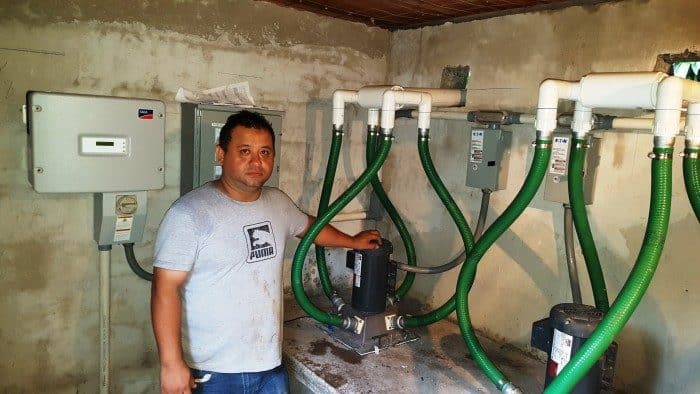
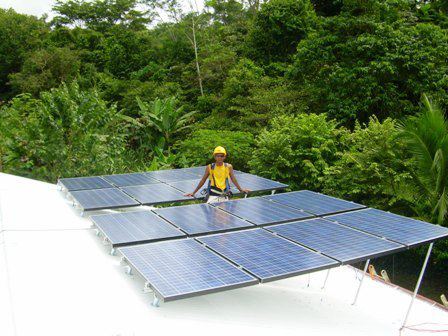
In Costa Rica you can expect a year-round average of three to four hours of fully rated, 100 percent production of your panel array, assuming optimal orientation and inclination.
The ideal orientation is due south. The rule of thumb is an inclination in degrees equivalent to latitude. But dust does not slide dry off glass well beneath 12 degrees, so 12 degrees is the best inclination to use for an installation you don’t plan to tinker with.
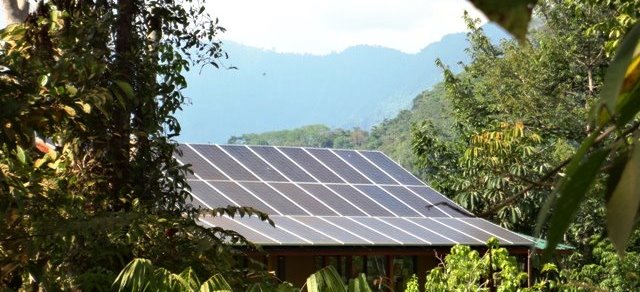
Roof-mount is the traditional configuration. Pedestal and ground arrays are alternatives.
Grid-tie
Simple net metering means grid-tie clients are not compensated for power produced in excess of demand. This means that grid-tie production should be engineered to approximate facility demands and not exceed them, since there is no economic benefit in so doing.
Grid-tie is applicable to individual service connections only. For facilities with multiple service connections, only one of these can be grid-tie. Large facilities have historically split consumption across multiple meters to offset peak billing scales. So, it may be necessary to rewire internal circuitry to be targeted by a grid-tie generation source into a single service connection.
Excess generation is banked for up to a year to offset excess consumption at periods of net demand. So a large-output seasonal hydro can fully offset year-round power demands, despite standing dormant for dry-season months.
Case study
For a detailed comparison of the pros and cons of solar vs. hydro on a hypothetical property, see case study.
Conclusions
Every property’s case is unique, but here are a few rules I have found hold up pretty well in Costa Rica.
If your power needs are large, proven year-round hydro usually out-competes solar.
If your power needs are large, grid-tie usually out-competes independent even if a sizable investment is required to extend the primary grid.
If your power needs are modest, solar usually out-competes hydro in both independent and grid-tie applications.
While colorful and evocative, hybrid systems are rarely competitive against sole-source solar or hydro.
Biomass is an agricultural grid-tie thermal application. It allows for timed power generation to offset peak power demands in agro-industrial processing applications with abundant biomass resource and high power bills — think sugar cane.
In the doldrums wind is an inconstant and fickle resource. Orographic effects along ridgelines make it competitive in places, and the summer blow in Guanacaste makes it a reliable dry-season resource there. But by and large, most of Costa Rica can write wind off for home-power generation in any capacity.
Paul Collar is a civil engineer and geologist and is the owner of Osa Power and co-owner of River Run Hydro. Contact him at solutions@osapower.com or at 8704-0027.





