

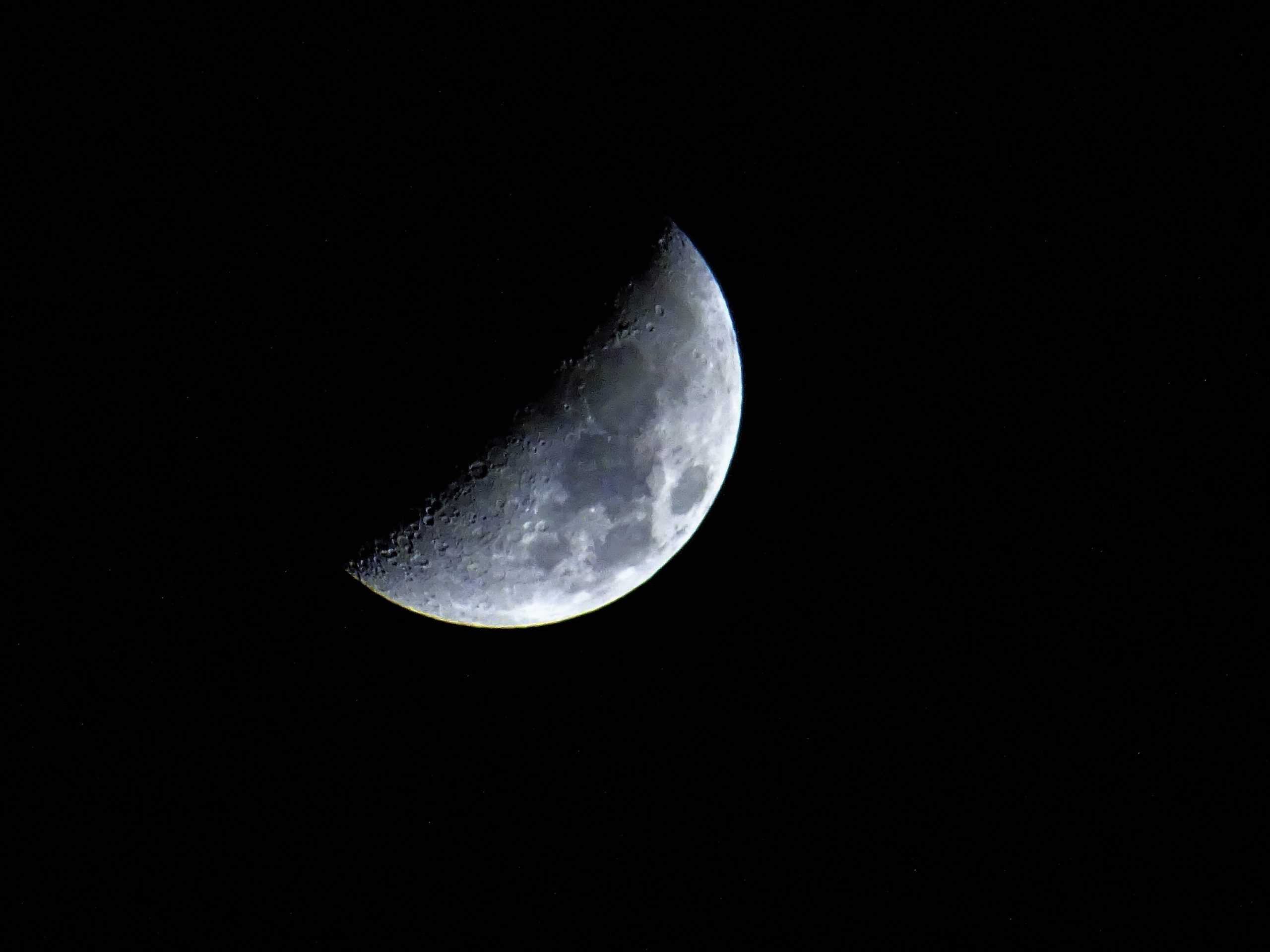
Anyone in Costa Rica will have the chance to watch a dramatic lunar spectacle tonight, as a deep partial lunar eclipse will be visible across from start to finish. At its peak, 93 percent of the Moon will be swallowed by Earth’s shadow, leaving only a thin sliver of light along one edge.
According to the National Science and Technology Center foundation (Cientec), the eclipse begins at 7:23 p.m. and runs for five hours and 38 minutes in total. The early stage, when the Moon passes through Earth’s outer shadow called the penumbra, is subtle and difficult to notice with the naked eye. The more dramatic change arrives at 8:33 p.m., when the partial eclipse begins and the Moon starts moving into the umbra, the darker inner shadow.
Maximum coverage hits at 10:12 p.m., when 93 percent of the lunar surface will sit inside Earth’s shadow. Cientec described this as a particularly deep eclipse, noting that only a small edge of the Moon will remain outside the darkest part of the shadow at that moment. From there, the process reverses, with the partial phase ending at 11:51 p.m. and the final penumbral stage wrapping up at 1:01 a.m. Friday.
No special equipment is required to watch since unlike a solar eclipse, a lunar eclipse is completely safe to view directly, so no filters, telescopes or binoculars are needed. Anyone hoping for a good view should simply look for a spot with a clear sky, away from artificial lights, and wait for the show. Binoculars can help viewers pick out craters and surface features as they slip in and out of shadow, and the eclipse is easy to photograph with a phone camera, especially one with zoom.
As the Moon nears its deepest point in Earth’s shadow, it can take on reddish, copper or orange tones. This happens because sunlight bending through Earth’s atmosphere still reaches the lunar surface even when direct sunlight is blocked, casting the characteristic colors associated with a blood moon. Tonight’s event will remain a partial eclipse rather than a total one because the Moon will not fully enter the umbra, though at 93 percent coverage the difference will be barely noticeable to the eye.
For anyone wanting a more guided experience, the University of Costa Rica’s Planetarium in San Pedro is hosting a free public viewing with telescopes from 6 to 9 p.m., no reservation required. Because the event ends before the eclipse reaches its deepest point, visitors will be able to see the start of the partial phase but will miss the 10:12 p.m. peak. The planetarium is located in the Ciudad de la Investigación on UCR’s Rodrigo Facio campus.
Cientec noted that this is the second lunar eclipse of 2026, and that stargazers who miss tonight’s show will have a long wait for the next one, since the following partial lunar eclipse visible from Costa Rica will not occur until January 2028.





