

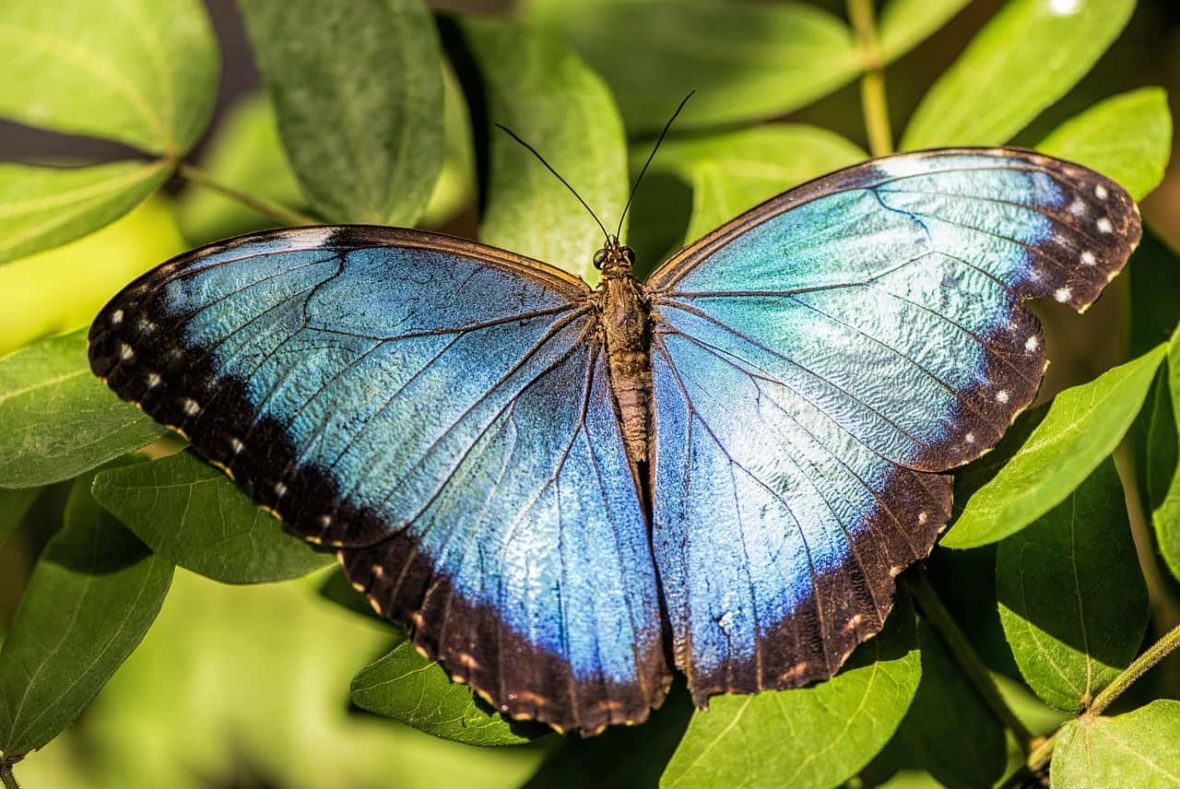
One of Costa Rica’s most recognizable butterflies could become a little less brilliant as temperatures rise. A new study found that unusually hot temperatures during development can change the tiny structures that give Morpho butterflies their striking blue wings. Butterflies exposed to the hottest conditions emerged with noticeably duller colors, suggesting climate change could alter more than where these insects live or how well they survive. It could change how they look.
The finding is especially relevant to us in Costa Rica, where Morpho butterflies are common in forests and have become closely associated with the wildlife here. The Morpho helenor was declared a national symbol within Costa Rica’s butterfly fauna in 2022. Researchers with the Smithsonian Tropical Research Institute studied Morpho helenor, exposing butterflies during the pupal stage, when a caterpillar is transforming into an adult, to three different temperature conditions.
The normal tropical group was kept at about 28 degrees Celsius, or 82 degrees Fahrenheit, day and night. A cooler group experienced 28 C days and 14 C, or 57 F, nights. The hottest group faced daytime temperatures of 35 C, or 95 F, and nighttime temperatures of 28 C. Researchers said that hotter setting was designed to represent the upper range of temperatures tropical butterflies could face under a high-warming climate scenario.
Butterflies developing under the hottest conditions were less likely to survive. Those that did survive generally took longer to emerge and had wings that reflected less light, making their famous blue color appear less brilliant. In one of the populations studied, the hot conditions delayed emergence by about four days.
The blue on a Morpho wing does not work like ordinary pigment or paint. Instead, its color comes from incredibly small structures on the scales covering the wings. Those structures manipulate reflected light, creating the shimmering blue that can seem to change depending on the angle from which the butterfly is viewed.
Under the microscope, researchers found that heat changed those structures. The spacing between tiny ridges became smaller and some wing scales became narrower. Those physical changes appear to be at least partly responsible for the loss of brightness.
The difference was not simply something detectable by laboratory instruments. Computer models designed to reproduce the eyesight of birds and other Morpho butterflies indicated that some of the color changes would likely be noticeable to them as well. In certain viewing conditions, the iridescent effect could become significantly reduced.
That could matter in the wild, although scientists do not yet know exactly how. Morphos flash between bright blue upper wings and much darker undersides while flying. Scientists believe that sudden change may help confuse birds trying to catch them. Their brilliant coloring may also play a role in recognizing or choosing mates.
If hotter temperatures alter those visual signals, butterflies could potentially interact differently with predators or with each other. But the researchers stressed that those consequences have not yet been demonstrated in wild populations.
There is also an important limitation to the Costa Rica connection as the experiment did not use butterflies collected in Costa Rica. Researchers worked with one Morpho helenor population originating in Panama and another from Ecuador. Morpho helenor is also well documented in Costa Rica, including in Guanacaste and Limón.
That means the study does not prove Costa Rica’s Morpho butterflies are already becoming duller, or that the Costa Rican population would respond to heat in exactly the same way. What it does show is that the microscopic machinery responsible for one of the tropical forest’s most spectacular colors is sensitive to temperature.
For Costa Rica, where the blue Morpho is both a familiar sight and an official national symbol, that raises an unusual possibility as the climate warms: some future butterflies may still be blue, just not quite as brilliantly blue as the ones people recognize today.





