

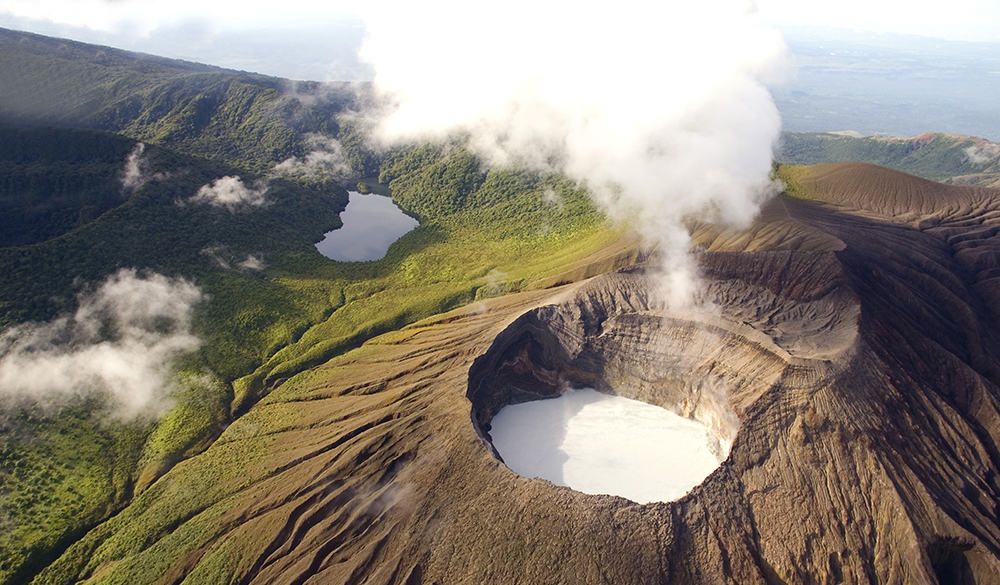
The Rincón de la Vieja volcano erupted twice today and the Observatorio Vulcanológico y Sismológico de Costa Rica (Ovsicori-UNA) reported no ashfall and no lahars from either event. The larger of the two came at 7:38 a.m. and lasted under a minute. Ovsicori classified it as moderate. A smaller eruption had already occurred at 12:30 a.m.
Neither eruption was visible on the observatory’s webcams. Cloud cover sat over the summit all morning, so nobody got a look at the column. That happens often during the rainy season, and it is one reason the seismic and infrasound networks matter more than the cameras this time of year.
The volcano stays at caution, which is level 3 on Ovsicori’s four-step scale. Ovsicori moved it up from level 2 in early August after counting 48 eruptions in roughly a month, including 23 in a single week. Volcanologist Cyrill Müller said at the time that a volcano at level 3 can produce eruptions, lahars and ashfall — a plain description of the range, not a forecast that any of those will happen on a given day.
Several dozen phreatic eruptions have hit the mountain this year. Some of them sent primary and secondary lahars down the slopes in July and August. Phreatic is worth understanding, because it explains why this volcano behaves the way it does. Groundwater seeps down until it meets hot rock, flashes to steam, and blows out through the crater carrying mud, rock fragments and gas.
There is no fresh magma rising to the surface. That is why these eruptions are usually short, usually small, and almost never announced in advance — the trigger is water, and water moves fast.Lahars are the part that reaches beyond the crater. They are slurries of volcanic debris and water that run down river channels, and they are far more likely when heavy rain falls on loose material the volcano has already deposited. Ovsicori has repeatedly flagged the rainy season as the higher-risk window for exactly this reason.
That matters right now as the Instituto Meteorológico Nacional forecast gusts reaching 80 km/h (50 mph) in northern Guanacaste today, with afternoon downpours and thunderstorms across the region. Rivers draining the massif, including the Pénjamo and the Azul, have discolored after past eruptions as material washed downslope.
If you are near those drainages during heavy rain, move away from the channel and onto higher ground. Do not wait to see the water rise. Lahars travel faster than people expect and arrive without warning. The summit trail has been closed for years and remains closed, and SINAC will keep it shut until eruptive activity drops enough for access to be considered safe.
That route climbs about 8 kilometers (5 miles) one way with roughly 1,000 meters (3,300 feet) of gain, and it ends at the active crater — the single worst place to be standing when a phreatic eruption fires with no warning. The rest of the park operates on its own schedule.
Rincón de la Vieja National Park covers 14,300 hectares (35,300 acres) and splits into two visitor sectors, Las Pailas and Santa María. Las Pailas takes most of the traffic and centers on a 3-kilometer (1.9-mile) loop past mud pots, fumaroles and steam vents, well below the summit. Entry tickets must be booked through SINAC’s online reservation system before you arrive.
Tomorrow is National Parks Day, and entry to Costa Rica’s national parks is free. That comes from Decree 16847-MAG-MEP, signed in 1986, which waives admission for every visitor on 24 August regardless of nationality. SINAC has confirmed the waiver applies countrywide this year, with the national celebration centered in Puntarenas. Free does not mean the volcano rules change, and there are two things worth sorting out before you drive to Guanacaste.
The first is the calendar as Rincón de la Vieja normally closes on Mondays — the park runs Tuesday through Sunday, and the Monday shutdown exists so crews can maintain the Las Pailas trails. This year 24 August lands on a Monday. SINAC has not published whether it is waiving that closure for the free-entry day, so do not assume the gates open just because admission is waived. Call the Las Pailas sector or check sinac.go.cr before you commit to the drive from Liberia or the coast.
The second is the summit trail, and this one is not ambiguous. Free entry does not reopen it and that trail is closed on volcanic grounds and stays closed until Ovsicori’s activity level supports reopening it, which is a separate decision from anything to do with ticket prices. You still need a reservation even when the ticket costs nothing. Parks inside SINAC’s online system, and Rincón de la Vieja is one of them, release free tickets through the same platform and cap them the same way.
The cap is about how many people the trails can carry safely, not about revenue. Free days draw crowds, and slots go. Nothing Ovsicori reported today changes the park’s status on its own as the volcano sat at level 3 before those two eruptions and it sits at level 3 after them. What changes access is a closure decision, and those arrive on their own schedule — rain on a mountain that has been shedding loose material for two months is the likelier trigger.
Check the park’s status the day you go rather than the week before since sector and trail access shifts with volcanic activity and with weather, and a closure decided on Saturday will not appear in a tour operator’s brochure. The volcano rises to 1,916 meters (6,286 feet) roughly 25 kilometers (16 miles) northeast of Liberia. Ovsicori monitors it continuously through seismic, gas and deformation instruments, and publishes updates as events occur.
Costa Rica lives with six active volcanoes, and Rincón de la Vieja has been among the busiest of them for the better part of a decade. Level 3 is not an emergency but it is a standing instruction to pay attention to where you are and what the sky is doing.





