

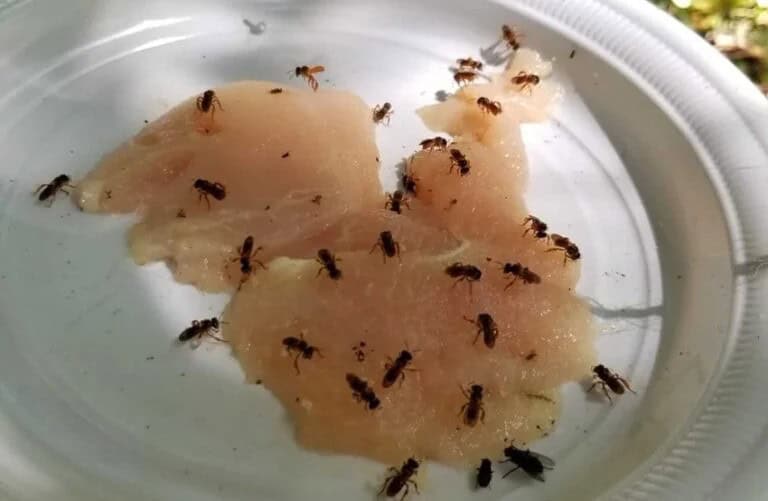
In the forests of Sarapiquí, Costa Rica, some bees are drawn to something far different from flowers. They visit decaying animal remains, feed on carrion, and in some cases cut small pieces of meat to carry back to their colonies. Known as necrophagous bees, or vulture bees, these insects are changing how researchers understand bee behavior in tropical ecosystems.
A recent study in northern Costa Rica documented at least 13 species of stingless bees that use decaying animal tissue as part of their diet. The research is part of the project Vulture Bees in Costa Rica: Detection, Ecology, and Behavior, led by Carolina Esquivel Dobles of the School of Biological Sciences at the National University, with Laura L. Figueroa Amaya of the University of Massachusetts Amherst.
The study was carried out in the San Juan–La Selva Biological Corridor, one of Costa Rica’s most important biological corridors. Researchers worked across 20 sites, including primary forest, secondary forest, and agricultural areas. They placed raw chicken bait to record which bee species visited the carrion and how often.
More than 200 individual bees were recorded at the baits. Researchers also documented visits to natural carrion, feces, and flowers, showing that the behavior is not limited to experimental conditions.
The findings point to a group of bees with far more flexible diets than many people would expect. Some species consumed the meat directly at the bait site. Others removed small fragments and transported them back to their colonies. Several species also continued to use floral resources, combining pollen, nectar, and animal-based food depending on conditions.
That distinction matters. Only three species of obligate necrophagous bees are known worldwide, meaning bees that depend on carrion rather than pollen. The Costa Rica study recorded one of them, Trigona necrophaga. The other species observed in Sarapiquí were considered facultative or omnivorous, meaning they use carrion but do not fully abandon flowers.
Several of the species had never before been recorded visiting carrion, making the findings important new records for science. The behavior also raises an evolutionary question. Bees evolved from wasps, and wasps are carnivorous. Researchers still do not know if obligate vulture bees retained an ancestral meat-eating trait or if they first became pollen specialists, like other bees, and later evolved back toward animal-based food sources.
Earlier studies have found that vulture bees have unusual gut bacteria that help them process carrion. Their microbiomes contain acid-loving bacteria more commonly associated with animals that feed on decaying meat. That gives the bees a biological tool for consuming food that would be dangerous or unusable for many other insects.
The Costa Rica findings also challenge one simple explanation for why bees visit carrion. Researchers initially considered the possibility that carrion might serve as a backup food source when flowers are scarce. But flower abundance did not significantly affect how often bees visited the chicken bait.
The highest diversity of carrion-feeding bees was found in forested areas, not in more disturbed sites. That suggests intact forest remains important for these species, likely because it provides nesting sites and other resources that agricultural areas cannot fully replace.
The study comes at a time when pollinators face growing pressure from habitat loss, forest fragmentation, agricultural expansion, and climate change. Vulture bees offer a rare look at how some species adjust their feeding behavior in changing environments, but the findings also show that adaptation has limits. Even bees capable of using carrion still appear closely tied to forest habitat.
For Costa Rica, the research adds another unusual chapter to the country’s biodiversity story. The country is already known for its tropical birds, frogs, monkeys, and marine life. Sarapiquí’s vulture bees show that some of its most surprising wildlife can be found in smaller, stranger places.
The project also includes collaborators Quinn McFrederick of the University of California, Riverside, and James Crall of the University of Wisconsin–Madison. Fieldwork is taking place in Sarapiquí with support from the Lapa Verde Refuge, where Randall A. Montoya Solano assists with research activities. Student support was also provided through residency grants from Lapa Verde Refuge and the Organization for Tropical Studies at La Selva Biological Station.





