

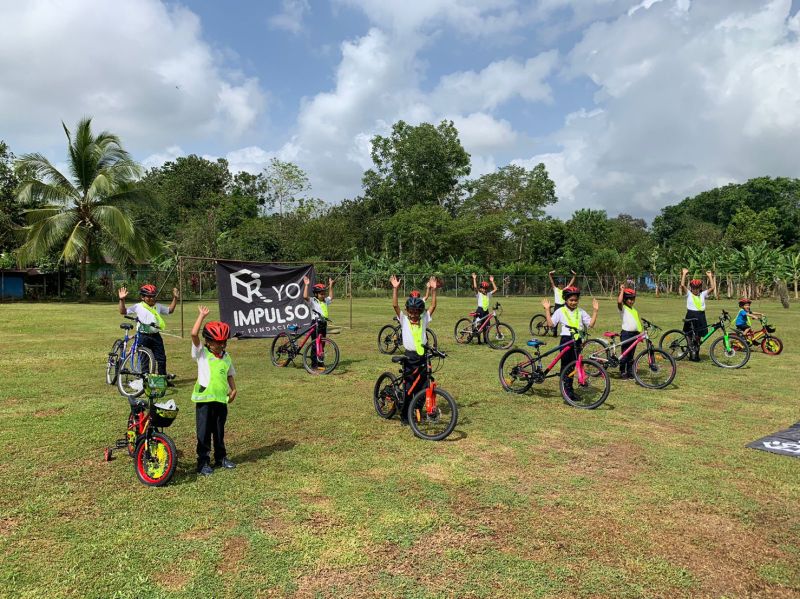
For children in Costa Rica’s most remote communities, the distance between home and school is not measured in minutes. It is measured in hours of walking along dirt paths, through hills, and across rivers, with no guarantee of arriving on time, dry, or safe. For many, that daily reality becomes the reason they stop going altogether. A bicycle can change that calculation entirely.
Fundación Yo Impulso, the nonprofit founded by Costa Rican Olympic mountain cyclist Andrey Fonseca, announced on June 3 the return of its signature program for 2026. The initiative, known as A la Escuela en Bici, is back with its most ambitious goal yet: delivering 500 bicycles, complete with safety equipment, to rural students across the country before the year ends.
The program is not new. Fonseca, who represented Costa Rica at the 2016 Rio Olympic Games, launched the foundation and the cycling initiative nearly a decade ago with a handful of bicycles and a straightforward belief that a child who can get to school reliably is a child more likely to stay in school. Since 2017, the foundation has reached approximately 400 students across some of the country’s most isolated communities, including indigenous territories in Cabagra, in Buenos Aires de Puntarenas, schools on the Osa Peninsula, and rural classrooms in Sarapiquí. Each delivery has come with a bicycle sized to fit the child, a helmet, and reflective safety gear.
The 2026 edition sets a new target. The foundation is seeking to benefit 500 children, prioritizing communities where school dropout rates are highest and distances to the nearest classroom are greatest. The estimated cost per beneficiary is 150,000 colones, approximately $290, which covers the bicycle, safety equipment, and the logistical costs of transporting everything to communities that are often difficult to reach by road.
Organizers said not every donor needs to cover the cost of a full bicycle. Every contribution, large or small, goes directly into the fund and accumulates toward each beneficiary. The program will run throughout 2026 in partnership with businesses, local school communities, and community organizations across the country.
The model has drawn support from notable partners over the years, including Grupo Purdy, the World Olympic Athletes Association, and the Costa Rican Olympic Committee, which helped the foundation secure international recognition and funding from the International Olympic Committee’s athlete grants program. That backing reflects how seriously the program has been taken beyond Costa Rica’s borders as a model for sport-driven social impact.
What makes A la Escuela en Bici particularly effective is its simplicity. There are no complex dependency structures, no bureaucratic distribution systems, and no intermediary layers between donor and recipient. A bicycle goes to a child. That child gets to school faster, more reliably, and with more energy than they arrived on foot. Attendance improves. Dropout risk falls.
Fonseca has spoken in previous years about the emotional weight of the delivery days, describing moments when children’s eyes conveyed what words could not. For a former Olympian who built a career on the power of the bicycle, giving that same power to a child walking two hours to class every morning is as purposeful as anything he has done in sport.
Those interested in supporting the 2026 campaign can reach Fundación Yo Impulso through its official social media channels.





