

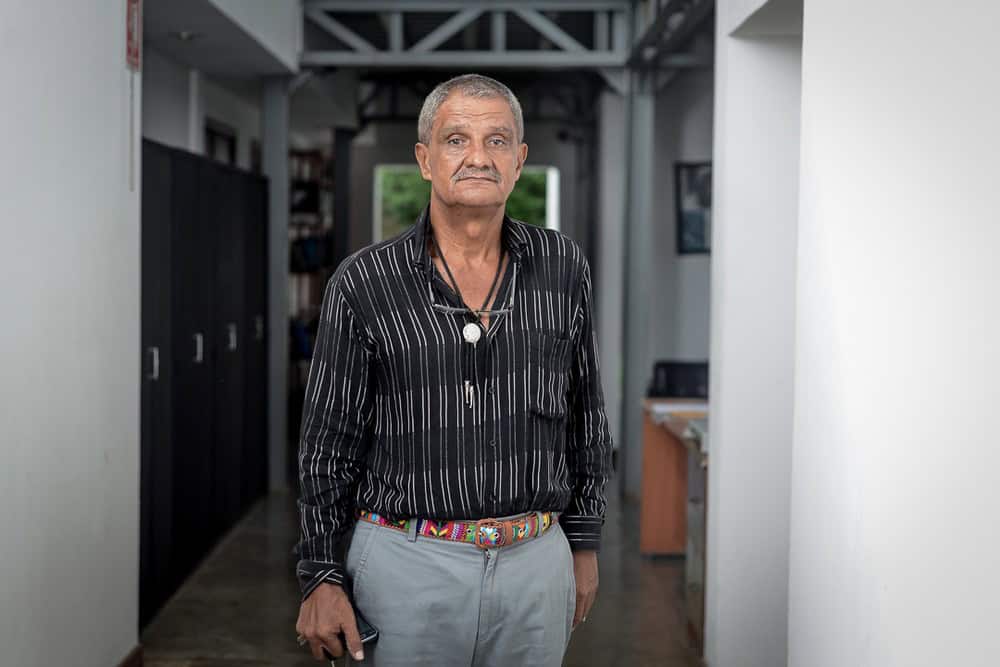
Nicaraguan Indigenous leader Brooklyn Rivera Bryan, one of the most recognized Miskito activists in the country and a former lawmaker, has died while in state custody, Nicaragua’s Health Ministry confirmed Sunday. He was 73. The confirmation came only days after the Nicaraguan government publicly acknowledged that Rivera was critically ill and released hospital images showing him bedridden, severely thin, and connected to mechanical ventilation through a tracheotomy.
The Health Ministry attributed his death to a bacterial infection following a case of COVID-19, which officials said caused severe physical and neurological deterioration. Human rights groups, Rivera’s relatives, and international observers have rejected the government’s framing, saying his collapse occurred after more than two years of detention, isolation, and lack of independent medical review.
Rivera had been detained since September 2023, when he was arrested in Bilwi, in Nicaragua’s North Caribbean Coast region. For months, his family and rights organizations said they had no reliable information about his location, health, or legal situation. His death now turns what had been an urgent demand for his release into a broader call for accountability.
Rivera was the longtime leader of Yatama, the Indigenous political movement whose name in Miskito means Sons of Mother Earth. He spent decades defending Indigenous autonomy, territorial rights, and political representation for Miskito and other Indigenous communities along Nicaragua’s Caribbean coast.
His public life was closely tied to the region’s long fight for self-government and land rights. During the 1980s, he became a central figure in Indigenous resistance to the Sandinista government. He later helped push for limited autonomy for Indigenous communities in the Caribbean region and went on to serve in public office, including as a lawmaker.
Rivera’s relationship with Nicaragua’s ruling Sandinista movement shifted over the years, but he eventually became a strong critic of President Daniel Ortega and Vice President Rosario Murillo. His detention came during a wider crackdown on political opponents, civic groups, religious figures, independent journalists, and Indigenous leaders.
Human rights organizations had warned before his death that Rivera’s condition reflected a serious risk to his life. Amnesty International had called for his immediate and unconditional release, saying he had been exposed to extreme danger after more than two years of enforced disappearance, arbitrary detention, incommunicado detention, and lack of regular access to his family, legal counsel, and independent oversight.
The Federation for Human Rights and the World Organization Against Torture also raised alarms over his condition, noting that the government’s own medical disclosures described bacterial pneumonia, respiratory failure, tracheotomy, invasive mechanical ventilation, liver disease, and signs of multiorgan failure.
The images released by the government last week drew immediate outrage. Rather than calming concerns, they appeared to confirm the worst fears of Rivera’s family and supporters: that one of Nicaragua’s best-known Indigenous leaders had been held in conditions that left him near death before the public was allowed to see him.
The United States had called for Rivera’s release shortly before his death, after the hospital photos were made public. The Organization of American States also called for an immediate, independent, and transparent investigation into the circumstances of his death.
Independent Nicaraguan media reported that Rivera died Saturday night at Fernando Vélez Paiz Hospital in Managua, where he had been hospitalized under state custody. Confidencial reported that the government waited hours before publicly confirming his death and that his family wanted his body released so he could be buried in his home community in the Caribbean region.
The government has not accepted responsibility for Rivera’s deterioration and has presented his death as the result of medical complications. Rights groups argue that the central issue is not only the final cause of death, but the conditions under which he was held, the lack of transparent information, and the absence of independent medical access while he remained in custody.
Rivera’s death is likely to deepen international scrutiny of Nicaragua’s treatment of political prisoners. It also leaves a major void in the Indigenous rights movement of the Caribbean coast, where land conflict, political repression, and pressure on communal territories remain central issues.
For Rivera’s supporters, his death is not only the loss of a political figure. It is the death of a leader who spent much of his life pressing Nicaragua to recognize the rights, identity, and autonomy of its Indigenous peoples.





