

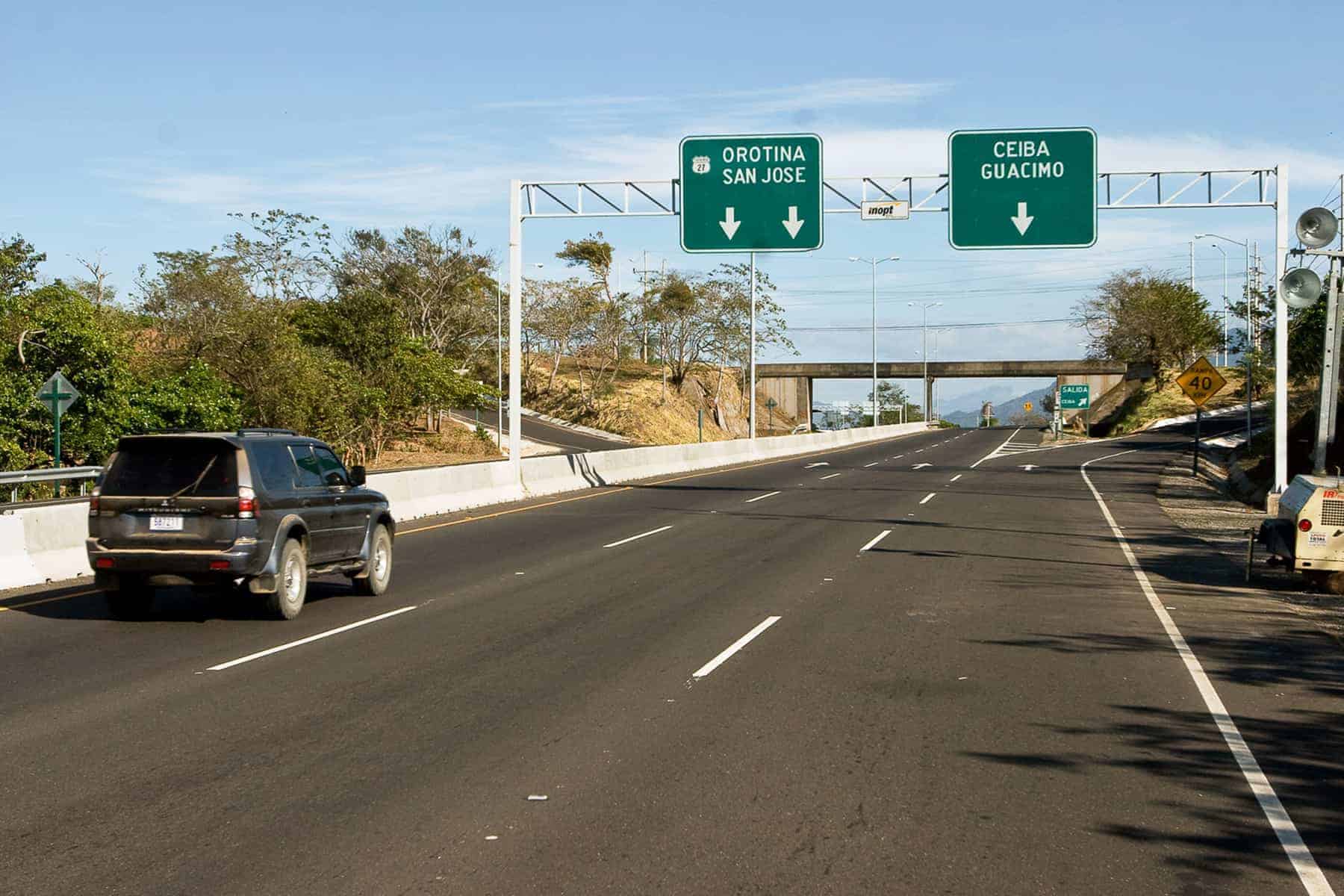
The Ministry of Public Works and Transport (MOPT) has reduced the planned expansion of Route 27 to roughly half its original scope, with works now focused on the highway’s most congested section between Escazú and Atenas rather than the full corridor to Caldera. MOPT Minister Efraím Zeledón confirmed the revised plan this week, saying initial progress had been made in negotiations with concessionaire Globalvía.
“Initially we would not be talking about an expansion of the entire highway, which was estimated at around US$600 million, but rather an expansion of the most critical part, which would be from Escazú to Atenas, the section that has the highest traffic volume,” Zeledón said. “That expansion would be in the range of US$300 million.”
The decision effectively halves both the scope and cost of a project that drivers, the tourism sector, and the freight industry have awaited for more than a decade. Route 27, also known as the Autopista José María Castro Madriz, is the main link between San José and the central Pacific coast, including the port of Caldera and beach destinations such as Jacó and Manuel Antonio.
The original plan, drawn up under the previous administration, divided the 77-kilometer highway into four sequential sections: from the Gimnasio Nacional in San José to the Siquiares interchange, then Siquiares to Balsa de Atenas, followed by Atenas to Orotina, and finally Orotina to Caldera. At the time, authorities said negotiations with Globalvía were roughly 80% complete, with only the financial structuring still pending.
Those talks stalled for more than a year after the current administration took office and pushed for alternatives that would avoid extending the concession contract. Former MOPT Minister Luis Amador publicly floated the idea of “breaking” with the concessionaire and explored a possible US$600 million loan from Saudi Arabia to finance the works independently. None of those alternatives advanced.
Route 27 opened in 2010 under a 25-year concession contract and has long exceeded its design capacity. A recent report from the Comptroller General’s Office identified at least 17 stretches operating at congestion levels above 70%, the contractual threshold that obliges authorities to intervene.
By focusing the first phase on Escazú to Atenas, MOPT is targeting the segment that carries the heaviest daily traffic and generates the bulk of toll revenue. The remaining sections to Orotina and Caldera have not been ruled out but would be addressed in later phases that have yet to be defined or financed.
A toll adjustment is still expected as part of any final agreement, with earlier projections from the National Concessions Council (CNC) pointing to increases of around 30%. Authorities have said the state may consider contributing additional funds to soften the impact on users.
Any final accord between MOPT, the CNC, and Globalvía will still need to be ratified by the Comptroller General’s Office before construction can begin.





