
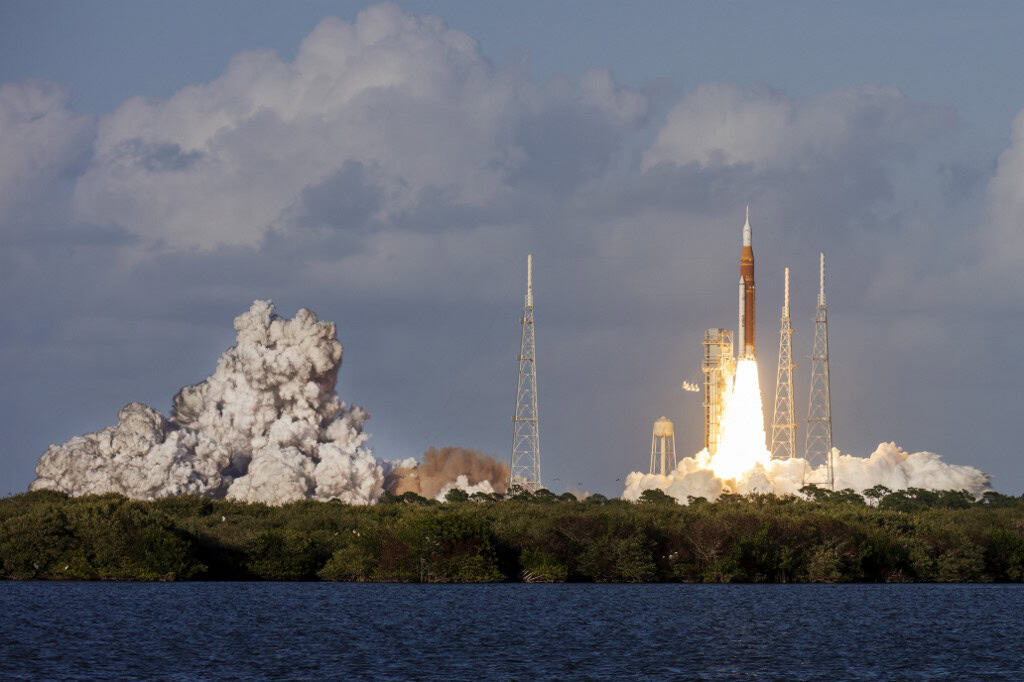
Four Artemis II mission astronauts blasted off Wednesday aboard a massive NASA rocket on a journey that will take them around the Moon, the first crewed lunar flyby in more than 50 years. With a thunderous roar heard far beyond the launch pad, the orange-and-white rocket lifted off carrying three Americans and one Canadian from Florida’s Kennedy Space Center at around 6:35 p.m. local time (10:35 p.m. GMT).
NASA officials and spectators alike celebrated the spacecraft’s launch as it climbed away from Earth, a milestone that finally became reality after years of delays and enormous cost overruns. The space odyssey is expected to last about 10 days.
The crew includes Americans Reid Wiseman, Victor Glover and Christina Koch, along with Canadian Jeremy Hansen. “We have a beautiful rise to the Moon. We are heading straight toward it,” said Wiseman, the mission commander.
U.S. President Donald Trump congratulated “the brave astronauts” and the NASA team on the “successful launch” at the start of his national address devoted to the war in the Middle East.
Early checks in orbit
The astronauts are now in orbit around Earth, where they will remain while checking the reliability and safety of a spacecraft that has never before carried humans. They also tested their manual piloting capabilities. Astronaut Victor Glover took control of the Orion capsule to simulate a docking with another spacecraft, which went perfectly.
“Great flying with you, Houston. Nice vehicle,” pilot Glover said. Teams also identified several issues to resolve. These include “a controller problem with the toilet when they put it into operation,” NASA associate administrator Amit Kshatriya said at a post-launch press conference.
NASA chief Jared Isaacman also noted a temporary communications issue with the spacecraft that has already been resolved.
Repeated setbacks before launch
If all goes well, the Artemis II crew is expected to begin its three-day journey to the Moon on Thursday, around which it will make one loop to capture new images and make observations. The trip marks a series of historic milestones: the first Black person, the first woman and the first non-American are taking part in a lunar mission.
If the mission goes as planned, the astronauts will set a record by traveling farther from Earth than any human being before. It is also the first crewed flight of NASA’s new lunar rocket, called the Space Launch System (SLS). The giant orange-and-white rocket is designed to allow the United States to return repeatedly to the Moon, with the goal of establishing a permanent base that will serve as a platform for future exploration.
The mission had originally been scheduled to launch in February. But repeated setbacks delayed it and even forced the rocket to return to its hangar for analysis and repairs. According to local authorities, some 400,000 people were expected to gather near the so-called Space Coast to witness the historic launch.
Pressure on the Artemis program
The Artemis program has been plagued by delays and huge cost overruns. It is also under pressure from President Trump, who accelerated the pace of the ambitious project with the goal of putting footprints on the lunar surface before 2029, when his second term ends.
Artemis II’s objectives include verifying that both the rocket and the spacecraft are in perfect working order, in hopes of paving the way for a return and a Moon landing in 2028. That timetable causes skepticism among experts, in part because it depends on technological advances in the private sector.
The current era of U.S. efforts to reach the Moon has often been described as part of the rivalry with China, which aims to send humans to the Moon by 2030. Trump posted a message on social media before the launch.
“We are WINNING, in Space, on Earth, and everywhere in between — Economically, Militarily, and now, BEYOND THE STARS. No one comes close to us! The United States is not just competing, we DOMINATE, and the whole world is watching,” the president wrote on Truth Social.