
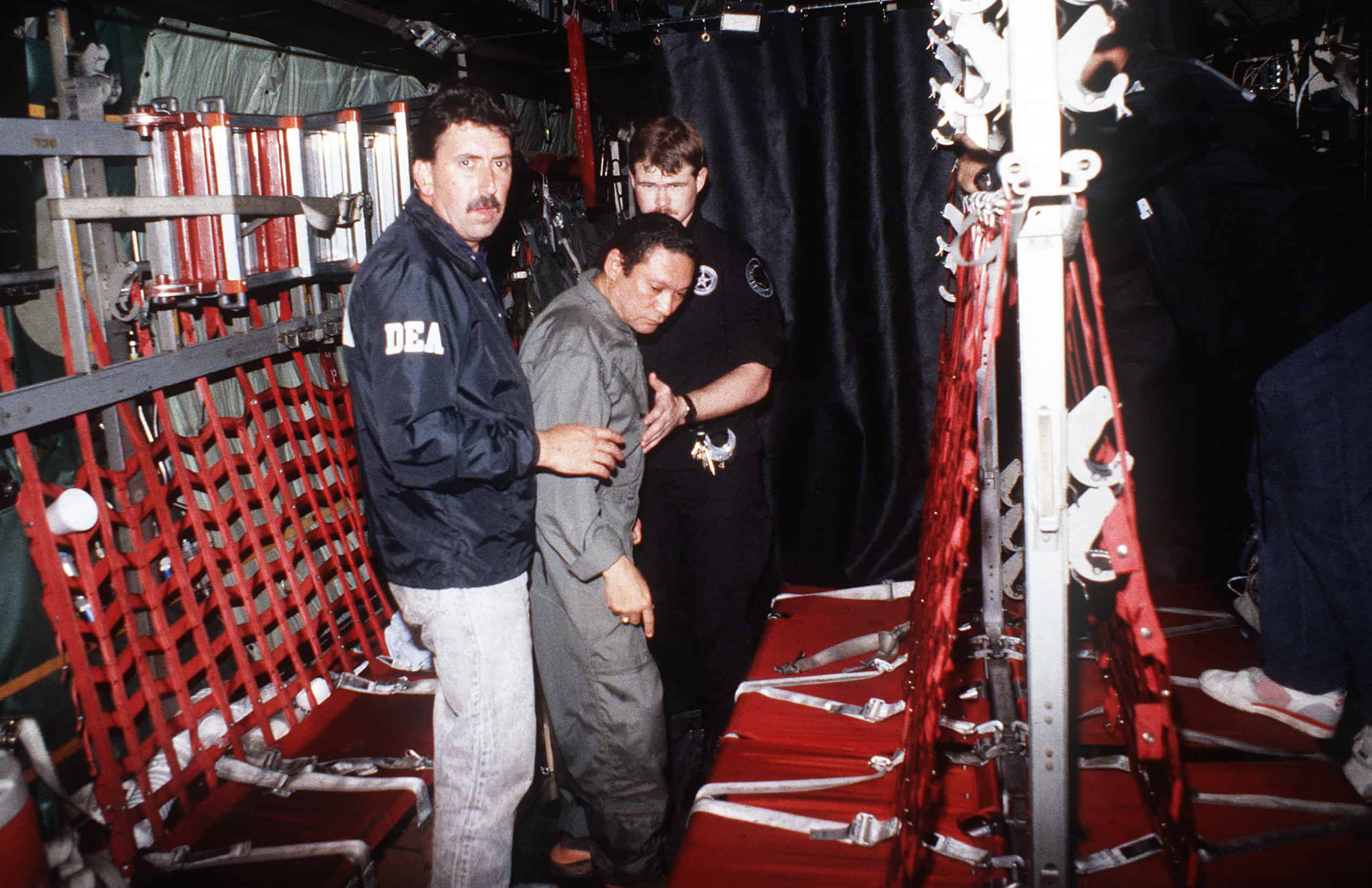
The recent U.S. military operation that led to the capture of Venezuelan President Nicolás Maduro echoes a chapter from Latin American history: the 1989 invasion of Panama and the arrest of General Manuel Noriega. Both events unfolded on January 3, separated by 36 years, and highlight Washington’s approach to removing leaders it deems threats.
In 1989, U.S. President George H.W. Bush, who had served as CIA director, authorized the invasion of Panama to apprehend Noriega, the nation’s de facto ruler. Noriega, once a U.S. intelligence collaborator, faced charges in American courts for drug trafficking. The action marked the final major U.S. military intervention in Latin America until the operation against Maduro.
Operation Just Cause involved 27,000 American troops, including 13,000 already based in Panama. Official reports listed 500 deaths, though nongovernmental organizations put the toll at several thousand. On December 20, U.S. forces seized control of Panama City’s streets. Noriega sought asylum in the Vatican embassy for two weeks before surrendering on January 3, 1990.
Two years prior to his capture, Noriega alleged that the U.S. placed a bounty on him after he rejected plans to invade Nicaragua. A Florida court sentenced him to 40 years for drug trafficking and money laundering, a term reduced by half for good conduct. He spent time in prisons across the United States, France, and Panama, facing convictions for those crimes plus forced disappearances of opponents during his rule from 1983 to 1989. Noriega died in 2017.
This sequence now parallels the events in Venezuela. On January 3, 2026, President Donald Trump declared that U.S. forces had captured Maduro and his wife, Cilia Flores, during a large-scale assault on the country. The operation included airstrikes from multiple bases and a targeted extraction in Caracas. Trump stated that Maduro was flown to New York City, and the U.S. would oversee Venezuela until a stable transition occurs.
Analysts note similarities in the justifications. The U.S. cited protecting citizens, restoring democracy after disputed elections, and fighting drug trafficking in both cases. Noriega’s trial in the U.S. set a legal framework that could apply to Maduro, who faces indictments for narcoterrorism and corruption. Like Noriega, Maduro once maintained ties with U.S. interests but fell out of favor.
The Panama invasion drew international criticism for violating sovereignty, a concern raised again with Venezuela. Regional leaders, including those in Central America, express alarm over potential instability. Costa Rica, with its tradition of neutrality and democracy, monitors the situation closely, as shifts in Venezuela could affect migration and trade flows in the area.
Experts point out differences too. Panama hosted U.S. bases, easing the 1989 logistics, while Venezuela’s operation required broader aerial support. Noriega’s regime lacked the alliances Maduro built with nations like Russia and China, which have condemned the U.S. actions.
The Noriega case offers clues to Maduro’s future. After capture, Noriega faced extraditions and multiple trials. Maduro could encounter a similar path, starting with U.S. proceedings. Panama eventually reclaimed Noriega for local justice, a step Venezuela might pursue.
These interventions raise questions about U.S. policy in the region. Latin American countries call for dialogue over force, emphasizing the UN Charter’s principles. As events develop, the international community watches how the U.S. handles Venezuela’s governance.