

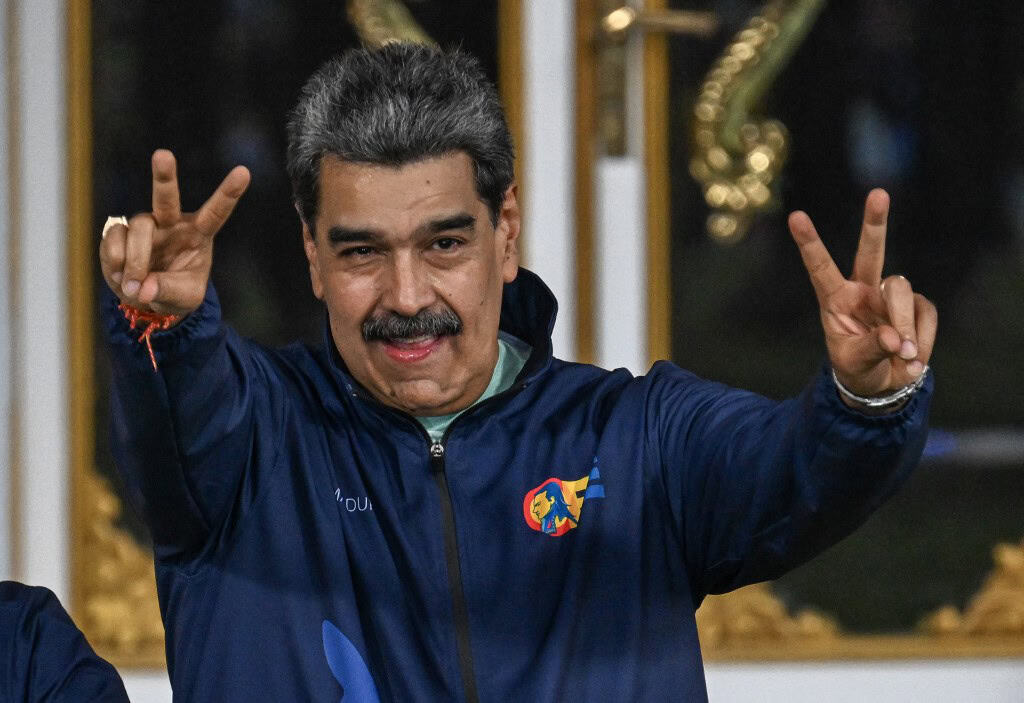
Venezuelan President Nicolás Maduro took to the stage at the Miraflores presidential palace during a Student Day march, where he danced to a remix of his own words promoting peace. Surrounded by cheering students, Maduro declared his resolve amid growing U.S. military actions in the Caribbean, echoing a similar display from years past.
“It’s Student Day, and we’re here to stand strong,” Maduro said, as he moved to the beat of an electronic track featuring his voice repeating phrases in English: “No war, no crazy war, no, no, no. Peace, peace, yes peace.” He jumped and swayed, urging the crowd to join in. “Nobody can stop me,” he added, turning the moment into a rally against what he called U.S. aggression.
The event came as the United States ramps up its presence in the region. Since late August 2025, Washington has deployed a fleet of warships, including the USS Gerald R. Ford, the world’s largest aircraft carrier, along with fighter jets and thousands of troops. U.S. officials describe the operation as a counternarcotics effort to disrupt drug trafficking routes from Venezuela and Colombia. So far, American forces have carried out around 20 strikes on suspected drug boats, resulting in at least 83 deaths. Venezuela has labeled these actions “extrajudicial executions” and claims no evidence links the targeted vessels to narcotics.
Maduro addressed the students directly, calling on them to reach out to their counterparts in the United States. “Unite with the student movement there and tell them: Stop the war, no to war. Venezuela wants peace,” he said. As the music played, a young woman shouted from the platform, “Maduro, I love you!” He responded, “I love you too,” before adding that such support gives him the strength to face “all the threats and dangers.”
Students at the gathering expressed firm opposition to U.S. involvement. “They just want an excuse to invade,” said Isabel Cupare, a first-year law student. Eudorangel Tayupe, a 19-year-old business student, added, “Venezuelan youth does not want war. We reject the U.S. threats.”
The U.S. has escalated its stance further. On Monday, Washington plans to designate the Cartel de los Soles – a network allegedly led by Maduro and top Venezuelan military officials – as a foreign terrorist organization. The State Department has also raised the reward for information leading to Maduro’s arrest to $50 million, citing his role in “narco-terrorism.” This follows the disputed July 2024 Venezuelan elections, where the opposition claimed victory based on tally sheets showing nearly 70% support, but Maduro declared himself the winner.
In response, Maduro has mobilized Venezuela’s armed forces for exercises involving 200,000 personnel and deployed Russian-made Igla missiles across the country. He has warned that any U.S. incursion could lead to a prolonged conflict, asking if Americans want “another Afghanistan or Libya in South America.” On state television, Maduro has showcased military readiness, stating, “We are ready here. We don’t want war, but we will defend our homeland.”
The tensions have drawn reactions across Latin America. In Costa Rica, President Rodrigo Chaves has voiced support for measures against drug cartels, including those linked to Maduro’s government. Chaves has condemned Maduro’s regime as “fraudulent and illegal,” noting its impact on regional security. Costa Rica, which has no standing army, has partnered with the U.S. on marine patrols and port scanning to curb drug flows. “The end of Maduro’s rule would help the entire hemisphere,” Chaves said in recent statements, highlighting how the Cartel de los Soles operates in Costa Rica and contributes to rising homicides tied to narcotics.
Other neighbors have taken different positions. Colombian President Gustavo Petro suspended intelligence sharing with the U.S., calling the boat strikes “extrajudicial executions.” Russia has condemned the actions as “unacceptable,” while Maduro has called for a unified Latin American response to the “imperial threat.”
Maduro’s public appearances, including the recent dance, aim to project defiance and rally domestic support. He has appealed to Russia for equipment repairs and claimed eight million civilians are training in militias. Venezuelan planning documents outline guerrilla tactics and potential chaos in Caracas to deter invasion, with officials acknowledging the military’s limitations in a conventional fight.
As the U.S. fleet patrols the Caribbean – the largest such deployment since the 1989 Panama invasion – Maduro continues to frame the standoff as a battle for sovereignty. “Peace, peace, peace!” he proclaimed at a recent rally, swaying to John Lennon’s “Imagine” with officials holding up peace signs.
The situation remains fluid, with U.S. Secretary of State Marco Rubio pushing for further pressure. Former U.S. Ambassador James Story has suggested an 80% chance of operations inside Venezuela, targeting airstrips or officials. For now, Maduro’s message to his people and the world stays clear: Venezuela stands firm.





