

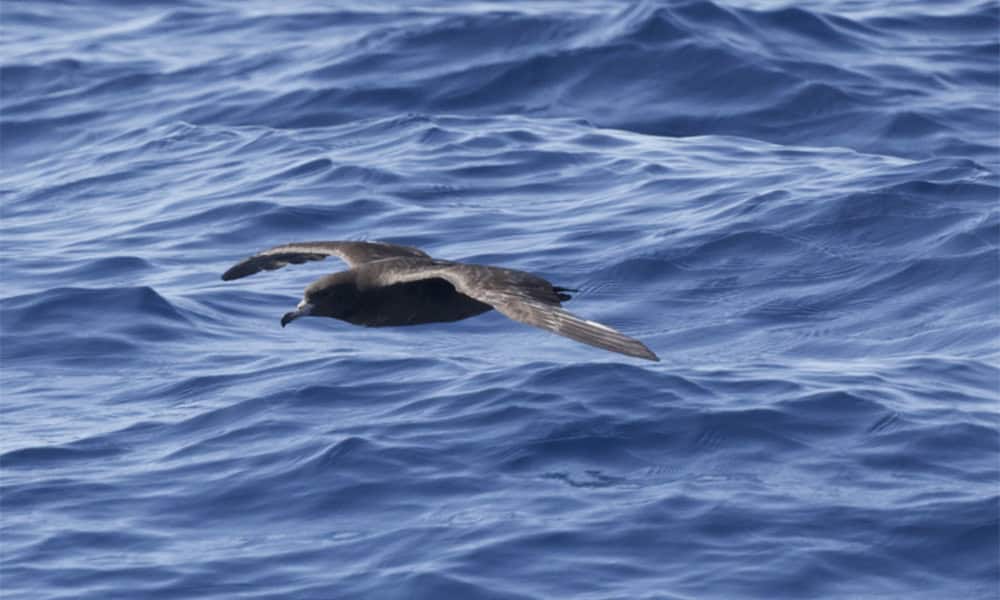
In an exciting scientific breakthrough, a team of researchers from the University of Costa Rica (UCR) recorded the presence of the Flesh-footed Shearwater (Ardenna carneipes), a species of oceanic bird considered near-threatened according to the International Union for Conservation of Nature (IUCN).
This is the first time this bird has been seen in the country. This discovery, made on January 10, 2025, during a monitoring trip from Cabuya de Cóbano, 25 miles off Cabo Blanco, marks an important milestone for science and conservation in Costa Rica. The Flesh-footed Shearwater, which has a migratory range from the Indian Ocean to the coasts of Alaska and California, was observed with a group of birds foraging alongside spotted dolphins (Stenella frontalis).
This finding is particularly relevant not only because of the rarity of the species in the region but also because it represents the first formal record of the Flesh-footed Shearwater in Central America and the first for the country. Research in these ecosystems, particularly in areas such as the Coco Seamounts, has proven fundamental to understanding how oceanic birds utilize these spaces for migration, foraging, and reproduction.
The Flesh-footed Shearwater, being a species with a vulnerable conservation status, joins the list of seabirds that inhabit Costa Rican waters, a taxonomic group that has been little studied in the region. So far, the Plumas Marinas Project has documented a total of 38 species of oceanic birds in its expeditions, and this finding highlights the wealth of biodiversity that Costa Rican marine ecosystems harbor. However, it also underscores the urgent need to protect these habitats, as many of these species face threats such as habitat loss and climate change.
According to the researchers, this finding is a clear sign that Costa Rican waters are a convergence zone for oceanic birds from different parts of the world. This implies that Costa Rica is a strategic point for the protection of these endangered species. Looking to the future, the UCR research team plans further expeditions to key areas such as Cocos Island National Park and will continue monitoring to document more findings.





