


For millennia, our ancient forebears have innovated to help people manage and care for their teeth. They intrinsically understood the importance of teeth to their health and longevity. They also cared about the appearance of their smiles. Over thousands of years of advancement, dental implants have evolved to become a remarkable substitute for natural teeth.
While dental implants as we know them are a relatively recent invention, the history of dental implants goes back thousands of years.
Ancient tooth replacements
Some of the earliest attempts at dental implants date back to ancient times. Their goal was to fill the spaces left behind by missing teeth. They practiced this art on the living and the dead.
- 4,000 Years Ago: Bamboo pegs were used in China to fill the spaces left by missing teeth.
- 3,000 Years Ago: An Egyptian Pharoah had a copper peg placed after his death into the gap left by a missing upper tooth. It was meant to prepare the Pharoah for an eternity of good eating in the next life.
- 2,300 Years Ago – An iron false tooth was found in a cadaver in a Celtic grave located in France. It’s assumed this false tooth was placed after the individual’s death.
- 2,000 Years Ago: Animal and human teeth (often from slaves or poor people) were used to replace the missing teeth of the wealthy citizens.
18th and 19th century dental innovations
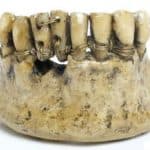 The 1700s and 1800s saw major innovations in dentistry. Dentists and doctors began to experiment with gold and other metal alloys to help support false teeth. These early attempts were ineffective since the body often rejected these early implants. It would take many years before a proper alloy for implants could be identified and developed for widespread use.
20th century dental implants
In the 1930s and 1940s, dentists and dental surgeons began to use orthopedic screws to fix false teeth in place. A special spiral post design was used to encourage bone to grow around these early implants.
Dr. Per-Ingvar Branemark, the dental innovator
 During Dr. Per-Ingvar Branemark’s 1952 study on blood flow in rabbits, he found that the bones of the rabbits had fused to titanium chambers he’d placed as part of his research.
Dr. Branemark had discovered osseointegration. This process happens when an implant fuses with the existing bone structure. At long last, science has discovered an alloy that would not be rejected by the body and could fuse with bone for proper anchoring and stability.
1965: Placement of the first titanium implant
After additional years of research, Dr. Branemark placed the first successful two-stage titanium dental implant in a live patient. This implant took six months to properly integrate with the bone tissue and lasted for an astonishing 40 years.
Thus, the modern dental implant we know today was born, thanks to the ingenuity of Dr. Branemark.
Dental implant advances
Further innovations in implants dentistry have occurred in the decades since. New oral surgery techniques have been developed. Patient recovery has improved and the stability of dental implants has increased. New implant shapes have been used to ensure proper stability of the implant when in place.
Looking toward the future
After thousands of years of advancement, dental implants are now widely used around the world. Patients are finding the only obstacle now is the price of dental implants. Dental implants can cost from $2500 to $4000 each in the US. In Costa Rica, these same dental implants cost less than $1000. Some clinics, like Goodness Dental, have a 99% success rating and offer a lifetime replacement guarantee on their titanium dental implants.
Thousands of American and Canadian patients travel to Costa Rica for safe, affordable dental care at technologically advanced clinics staffed with qualified dental implants specialists. The short trip to Costa Rica helps most patients save tens of thousands of dollars on their dental care and affords them a wonderful tropical getaway at the same time. Dental tourism is the future of dental implants and a tremendous opportunity for patients to save on world-class dental care in the tropical paradise of Costa Rica.
Look for a qualified periodontist or maxillofacial surgeon to place your dental implants. Dental tourism patients should also be careful to choose only accredited dental clinics like Goodness Dental, accredited by Global Clinic Rating and the Costa Rica Dental Association.
Patients are encouraged to call Goodness Dental at 844-297-3587 to receive a free dental estimate.
This story was sponsored by Goodness Dental.