

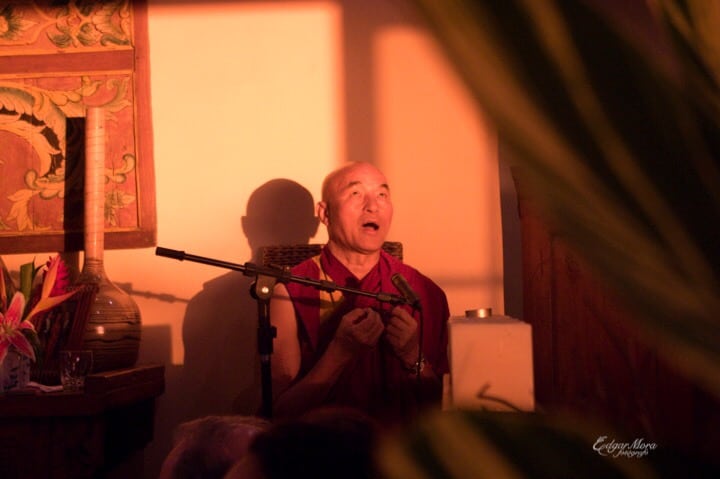
Recommended: A day with Lama Thubten Wangchen
Traveling throughout the world in search of happiness, self-consciousness, peace and union has always been a constant in Lama Thubten Wangchen’s life – a quest he has never abandoned, regardless of the hardships he has faced.
Wangchen, now a Special Representative of the Dalai Lama to Europe, was born in Tibet in 1954. In 1959, when he was five years old, he had to escape Tibet along with his father and siblings due to the Chinese invasion. His mother, however, was one of the many Tibetans killed in the invasion.
“I remember reaching Nepal and we had nothing… no house, no food, no money. The only way was to beg in the streets. We slept on the streets in Kathmandu,” Lama Wangchen, who is visiting Costa Rica this week, told The Tico Times. “Then my father heard that the Dalai Lama was in India. Everybody wanted to live near the Dalai Lama.
“Again, in India, we had nothing. Many Tibetans were begging in the streets in India. I was one of them, so the Dalai Lama asked the Indian government to please help us.”
At the age of 16, he decided to become a monk and entered the Dalai Lama’s private monastery, Namgyal. After 11 years there, Wangchen went to Spain as a Tibetan-to-English translator. Initially, he was supposed to stay there for only three years, but he has been there ever since: he founded and directs the Fundación Casa del Tibet in Barcelona, and became one of the first Tibetans ever to acquire Spanish citizenship.
Wangchen’s current visit to Costa Rica (Feb. 13 – Feb. 23) has included lectures at the University for Peace, La Salle University, National University (UNA), the Cultural Tibetan and Costa Rican Association, the Ligmincha Organization, the Legislative Assembly and two conferences at private homes: one hosted by Costa Rican artist Juan Carlos Chavarría, the other by philanthropist Renata Beffa.
On a chilly night in Villa Real, Santa Ana, The Tico Times sat down and spoke with Lama Thubten Wangchen, 62, about his life and work. Excerpts follow.
How did you cope as a child when you had to move away from your country with your father?
I was really young. I have some memories about that time, but I don’t remember it specifically. I remember that on the way that we saw many, many dead bodies. We experienced a hard life.
Now, you see the [current] problems in Syria and the poverty in Africa. That really teaches us [a lot of things] and…wow [pauses]. We do have an experience. There are other people who have never experienced this before and say: “Oh, what a pobre and qué pena,” but after a minute they forget [about it]. We really felt it… we wanted to see the real suffering of these people in a more compassionate way and generate more love.
This is what I got from this experience when I was young. I still am trying my best to be happy and to accept the things that happened before to live in the present, and I’m really enjoying it.
What did it feel like to be one of the first Tibetans to acquire Spanish citizenship?
Spanish law [grants] citizenship to foreigners who stay for ten years. Ten years go so fast! [Laughs]. I obtained the citizenship and it was very easy at the time. Now it’s very difficult. To get citizenship you have to pass an oral exam; even if you have been living for 10-12 years in Spain, if you don’t speak Spanish well and don’t know about the history and culture of Spain, you won’t obtain the citizenship.
What has your relationship with the Dalai Lama been like? What have you learned from him?
I was 16 years old when I became a monk , where I was being taught by him and learning from him. I stayed with the Dalai Lama for 11 years.
I cannot tell you one by one what we learned there. In brief, what we learned is to be a good person, to have a good heart and to have no resentment and hatred towards the Chinese. That is something unbelievable and difficult to do, but we can manage it.
What did the Dalai Lama teach you about the relationship between China and Tibet?
All of a sudden, the Chinese came with machine guns, military and cannons and we lost our country. The Tibetans couldn’t fight against the Chinese: we were a very small population of about seven million, and one million were killed. Now [the Tibetans in Tibet] are about only six million and [there are about] eight million Chinese in Tibet. We are now a minority. There’s also a lot of discrimination between the Tibetan and the Chinese in Tibet… the better houses, jobs, wages and hospitals are for the Chinese people. Tibetans go to simple hospitals and simple schools.
Above all, there are no human rights in Tibet, no freedom of religion in Tibet – or in China, either. In China there are no human rights and no freedom of religion.
Could you tell me more about that?
The Chinese say that the Tibet has religious freedom. How? The monks are not allowed to pray. They are prohibited [from doing so]. The families and monasteries in Tibet are all Buddhist and they want to have a Dalai Lama photo in the altar. It’s prohibited and considered a crime. If they have a Dalai Lama photo in their house or in the monastery, they are sent to jail just because they have the photo for their prayers. What religious freedom is that?
In general, what has your experience been like as an immigrant?
All immigrants suffer. They’re not happy, because you have to leave your country and your home. You come into a new country were you don’t speak the language or know anybody. It’s a hard life, but if you’re open-minded, wherever you go becomes your world, your country, and your home. My house is your house. My country is your country. We are citizens of the world.
Of course, now we see immigrant refugees in Syria, Greece, Italy, Spain [and many other countries]. They are traveling and they are trying to cross the sea. They give up their lives to become refugees. They sometimes get help, but other times they die or go back.
Recently I went to Greece to [the camps] where the immigrants are. There were 5,000 people, and they were really cold. It was raining and they were sleeping in tents. I went there to see [what was happening]. On a government level, we must help the poor people. This is our job. Even the Dalai Lama is asking the politicians of the whole world to take care of the refugees and to help them. Similarly, I’m repeating it.
Since Costa Rica is known on a global level for peace, how do you think the country’s doing right now on this topic?
I met several times with Oscar Arias. Last year he was in Barcelona and I met him there. He is known for a Nobel Peace Prize, but there are many people against him. The situation in Costa Rica with no military is good. When you strive for peace that’s good, but I think there are still corrupt people and, politically, I’ve been told that there are many people that are not happy with the government. This is what Costa Rica needs to improve on a little bit. Be conscious about watching out and taking care of your people… [but] Costa Rica is pura vida and people are easygoing.





