

CARACAS, Venezuela — On aisle seven, among the diapers and fabric softener, the socialist dreams of the late Venezuelan president Hugo Chávez looked as ragged as the toilet paper display.
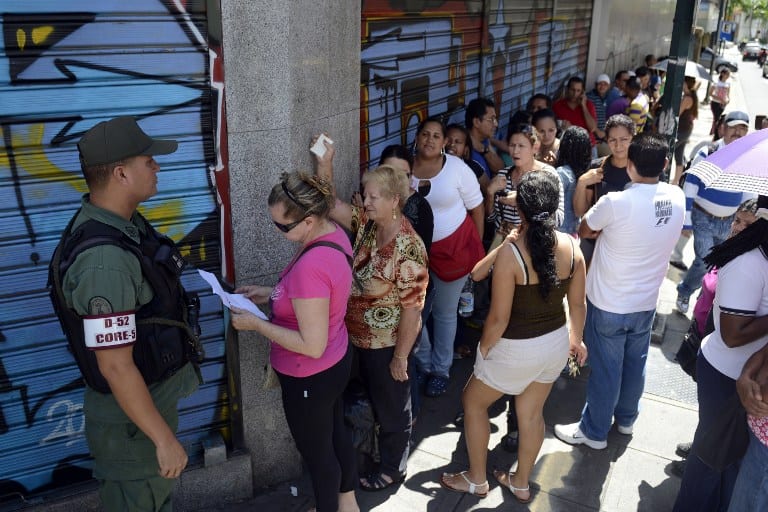
Employees at the Excelsior Gama supermarket had set out a load of extra-soft six-roll packs so large that it nearly blocked the aisle. To stock the shelves with it would have been pointless. Soon word spread that the long-awaited rolls had arrived, and despite a government-imposed limit of one package per person, the checkout lines stretched all the way to the decimated dairy case in the back of the store.
“This is so depressing,” said María Plaza, 30, a lawyer, an hour and a half into her wait. “Pathetic.”
Depressing, in an otherwise bright, modern supermarket that sells $100 bottles of Spanish wine, Jack Daniel’s whiskey and organic rice puffs.
Pathetic, in a country with the world’s largest petroleum reserves and oil prices at nearly $95 a barrel, yet unable to supply basic goods because of its crumbling local currency and a shortage of U.S. dollars.
“Soon we’ll be using newspaper, just like they do in Cuba!” said an elderly man nearby, inching forward in line. “Yeah! Like Cuba!” others shouted.
The fate of Venezuela’s revolution, it seems, will be decided at the supermarket.
Nearly a year after Chávez’s death of complications from cancer at age 58, his handpicked successor, Nicolás Maduro, is struggling to contain food shortages, spiraling inflation and rampant crime.
The arrival of basic staples such as cooking oil, chicken, flour or milk brings Venezuelans running to supermarkets and touches off surreal mob scenes, even as the government imposes price caps and rationing to prevent hoarding.
Maduro squeaked past opposition candidate Henrique Capriles in April’s presidential election, and Maduro’s United Socialist Party won enough races in Dec. 8 local elections to push back against perceptions that Chávez loyalists were deserting him. Just before the vote, with television cameras rolling, he sent soldiers into an appliance store accused of price gouging and ordered huge markdowns on televisions and microwaves. Apparently it gave his party a final boost at the polls.
Only the shortages and overall sense of unraveling seemed to have worsened since then.
Each day, the arrival of a new item at Excelsior Gama brought Venezuelans flooding into the store: for flour, beef, sugar. Employees and security guards helped themselves to the goods first, clogging the checkout lines, and then had to barricade the doors to hold back the surge at the entrance.
“The store owners are doing this on purpose, to increase sales,” said Marjorie Urdaneta, a government supporter who said she believes Maduro when he accuses businesses of colluding with foreign powers to wage “economic war” against him.
“He should tell the stores: Make these items available – or else,” she said.
But store managers said they are putting scarce, price-capped supplies out on the floor as soon as they arrive from government-run distribution centers.
Venezuela’s real problem, economists say, is that a shortage of U.S. dollars is squeezing the ability of the government and the private sector to import. Even in upscale Caracas shopping malls, international chain stores such as Zara and Gucci are gutted, their employees standing around with nothing to sell and the mannequins left naked.
While the government has fixed the exchange rate of the country’s currency, the “strong bolivar,” at 6.3 to the dollar, the widely used street rate is more than 10 times higher. Inflation was 56 percent last year, officially, and in an oil-warped economy that depends heavily on imports, businesses can’t obtain the dollars they need to restock their shelves. Even Venezuelan-made items go scarce as factories struggle to get replacement parts and raw materials.
Venezuela’s parliament has granted Maduro temporary decree powers, and analysts say he has the political breathing room this year to make unpopular economic adjustments, such as raising state-regulated gas prices, the lowest in the world. “The distortions have become too large,” said economist Luis Zambrano. “And this year is the first in a long time that there are no elections.”
Maduro’s government also plans to grease the wheels by selling at least $5 billion in U.S. money – at nearly twice the official rate – to companies trying to shed bolivars and secure hard currency. Economists liken this to a de-facto devaluation – a recognition that the strong bolivar is, in fact, quite wimpy.
After his annual address to parliament last month, Maduro declared 2014 “the year of the ultimate triumph in the economic war,” announced a new team of economic managers and decreed a law capping business profits at 30 percent.
“You can be sure we will be inspecting everyone, sooner or later,” Maduro warned, part of the “New Economic Order” he vows to create.
But if the president’s fiscal policies are anything like his response to rising crime, the country looks to be in trouble.
The Jan. 6 roadside killing of former Miss Venezuela Monica Spear in a botched robbery attempt jolted a country long-numbed by one of the world’s highest homicide rates and near-total criminal impunity. Fear is so widespread that shopping mall kiosks offer “Express Armoring” for motorists who want their vehicles bulletproofed, fast.
Despite calls for an overhaul of Venezuela’s woeful police forces, Maduro said violent soap operas were to blame and warned broadcasters to clean up their content.
Most Venezuelans are too busy just trying to secure the basics. Residents from the country’s interior say the shortages are even worse outside the capital.
“There’s nothing to buy where we live,” said María Valencia, a preschool teacher from the oil-producing hub of Maracaibo, near Venezuela’s western border, while shopping at a government-run Bicentenario supermarket where products sold by recently nationalized companies carried little heart symbols and the phrase “Made in Socialism.”
Valencia and three family members had filled their cart with corn oil, four bottles each, the maximum. “This stuff is gold,” she said.
Shoppers here were more inclined to blame the scarcities on badly behaved countrymen whom they said were trying to profit from the situation.
“All Venezuelans are to blame for this,” said Jeanpierre Sifontes with a shrug, his cart loaded with cooking oil, discount beef imported from Brazil and two Sony-brand karaoke machines.
“We need something to do at night because it’s too dangerous to go out,” Sifontes said.
Maduro, like Chávez, still counts on the broad support of the poor Venezuelans who have benefited from a reallocation of the country’s oil wealth, such as the new government apartment towers all over Caracas, the city’s expanding subway system and even cable-car gondolas to ferry poor favela dwellers high up into the hillside slums.
But with the country’s economy wobbling and inflation falling heaviest on the poor, Maduro isn’t taking any chances, and many of his recent moves have put military officers in key government posts.
As a former paratrooper, Chávez didn’t need to prove his mettle to the country’s armed forces, said Margarita López, a political analyst in Caracas. But Maduro is less secure and seems to be trying to win loyalty by steering more power and resources to the military.
“The military was never this visible under Chávez,” López said. “It’s going to be a very difficult year.”
Washington Post correspondent Emilia Díaz-Struck contributed to this report.
© 2013, The Washington Post





