

Wandering among neat rows of bushy green coffee shrubs, Fabián Echeverría surveys the plots through his tinted glasses. As genetic improvement coordinator for the Costa Rican Coffee Institute, ICAFE, Echeverría is studying the health of the coffee on the experimental farm CICAFE in San Pedro de Barva in Heredia.
Coffee plants in one plot stand at attention, demonstrating a uniformity of height and size seldom seen outside a Radio City Rockettes Christmas Spectacular. These are well-established varieties of Arabica coffee, the heart of Costa Rica’s high quality coffee production for decades. Despite their pedigree, though, these plants might not have what it takes to flourish in the future as climate change mounts an attack on growing regions.
By 2050, Costa Rica, El Salvador and Nicaragua all could lose more than 40 percent of their land suitable for planting Arabica, considered a superior bean to the hardier but less refined Robusta species, according to a policy memo from the International Center for Tropical Agriculture, CIAT by its Spanish acronym.
CIAT noted that a one-two punch of decreased precipitation and hotter climates could reduce Nicaragua’s potential Arabica-growing land by 85 percent, leading to an expected income loss of more than $74 million in 2050 alone. As the threat of a changing climate looms on the horizon, Central America has a dearth of researchers working on the development of new, hardier coffee varieties. Today, there is only one fulltime researcher in the region dedicated to developing new plants that can thrive in this changing environment: Echeverría.
His work has taken on a sense of urgency in recent years as climate change and other factors combined to unleash a devastating outbreak of fungus hemileia vastatrix also known as leaf rust, or “roya” in Spanish, across the isthmus. Roya has decimated harvests across Central America, dropping production in many plantations to its lowest point in 30 years. Leaf rust has damaged more than 60 percent of Costa Rica’s coffee crops. ICAFE Executive Director Ronald Peters last month estimated an 18 percent decrease in production for the 2013-2014 harvest season.
The geneticist attributed Costa Rica’s success fending off pests and disease to good management by farmers, but changing conditions are taking their toll. “Things that have served us well for 40 years are losing their potency,” Echeverría told The Tico Times.
One of the lesser-publicized aspects of the roya outbreak is how the lack of genetic diversity in much of the coffee planted in Central America contributed to the fungus’ rapid spread. In Costa Rica, for example, two varieties, Caturra and Catuaí, make up 90 percent of the country’s prized coffee production.
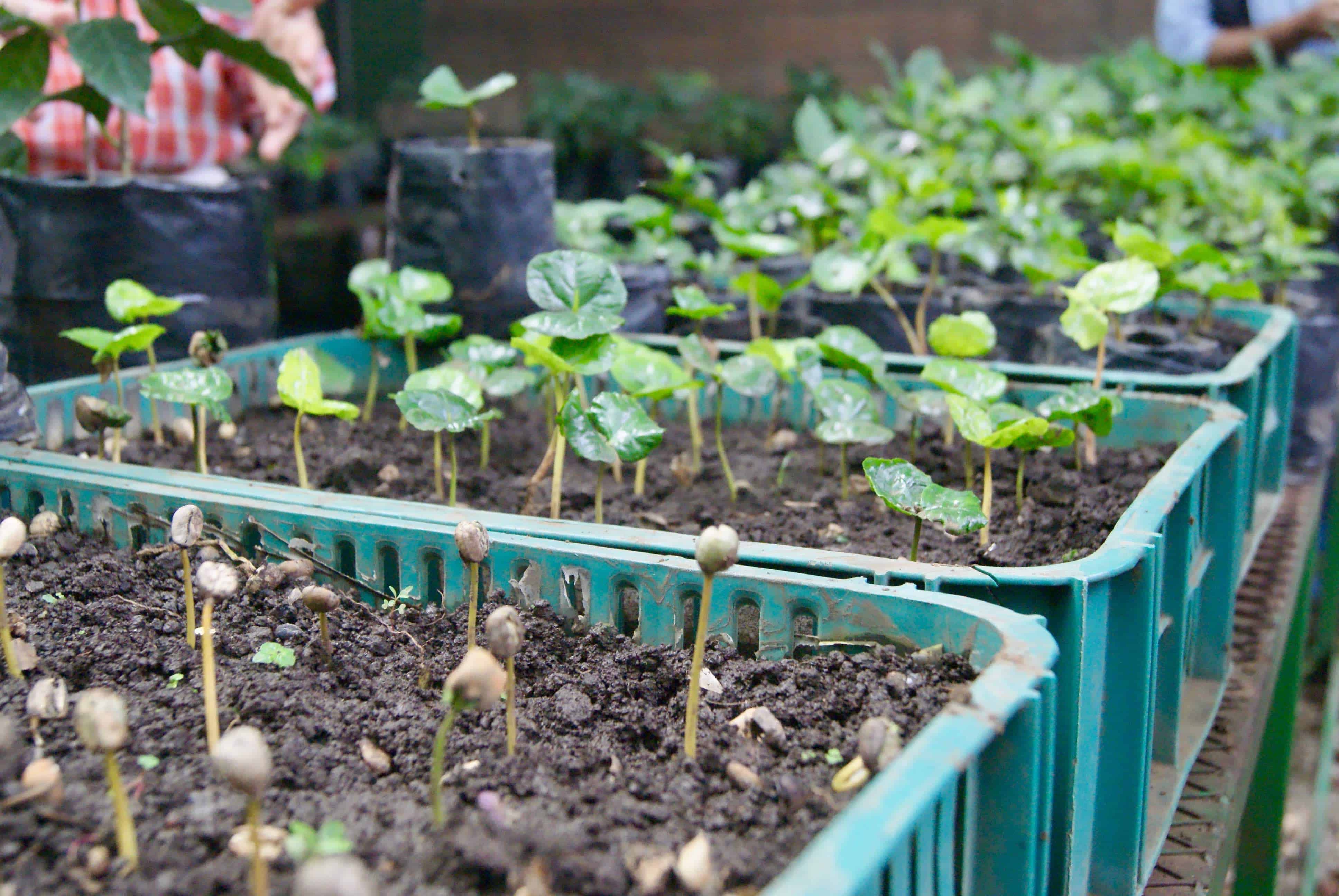
New types of plants referred to as hybrids could help Costa Rica overcome looming challenges for the coming decades. Using coffee plants from Costa Rica and around the world stored at the Tropical Agricultural Research and Higher Education Center, in Cartago, Echeverría assess the challenges to Costa Rica’s coffee crop and looks for traits in other Arabica varieties that might offer a solution.
The term “hybrid” might spark concerns about genetically modified java, but Echeverría said that CICAFE uses selective breeding, the “natural” way to steer the plant’s development. The team uses cross pollination and grafts, among other techniques, to develop hybrids from two separate varieties of Arabica.
Resistance to drought, heat and leaf rust are among his top priorities. Echeverría offered one variety, Catimor, as a successes story and cautionary tale. Created by joining Caturra, a variety widely planted in Costa Rica, with another variety grown on the Pacific island of Timor, this hybrid showed impressive resistance to leaf rust, and farmers planted it with zeal.
Catimor successfully fended off roya but farmers at higher altitudes reported seeing more cases of another fungus, mycena citricolor, known as “ojo de gallo” in Spanish, rooster’s eye.
“It’s difficult to come up with one solution for the entire country, so we need to come up with alternatives that work for different regions,” said Echeverría. “We’re running the risk that we don’t know how [the plants] will react in the field and we won’t know if by making them resistant to one disease, we’re making them more vulnerable to another,” he added.
Identifying a successful trait, like roya resistance, is the first step. But the creation of a stable variety like Catimor, well, that’s another story. This is where the patience comes in. There’s no way to gauge the hybrid’s success until the plant has come to full maturity, roughly five years. And that’s if they get it right at all. Echeverría said it’s not uncommon to put years into a project and just walk away from it.
Long term projects like genetic research, however, run up against short budgets, especially when exports are down. “Unfortunately, because of a lack of funding, many investigators have had to leave. This weakens the research and, as a result, slows our progress,” Echeverría said.
ICAFE’s funding depends on a 1.5 percent tax on Costa Rica’s coffee exports. This means when the harvests are good, there’s more money for ICAFE and ostensibly for research. But there’s another edge to that sword: When exports are down, research budgets get a close shave.
Costa Rica has so far managed to dedicate resources to genetic diversity research, but Echeverría was concerned about the lack of coinciding research in the isthmus, adding that a lack of research and maintenance in other Central American countries could create conditions or nourish diseases that could jump the borders and threaten Tico coffee.
“If we don’t do research, if we don’t realize that things can be better, we stall, we don’t grow,” he said. Back in the fields of CICAFE’s experimental farm, Echeverría stops to chat with some of the coffee pickers combing the branches of mismatched plants for the plump red fruits.
Compared to the uniform shrubs in the first plot, this one seems more like a ragtag group of underdogs: short chubby plants sit low to the ground, their branches bow under the weight of bright red coffee cherries, while others tower high above, some with full green waxy leaves, and others with brittle, dry fruit.
Echeverría said that this was an example of what happens when they plant the seeds from one of their hybrids. Like apples and other fruits, the seeds of a coffee plant do not necessarily recreate the parent plant. Despite their looks, the next big thing in coffee could be coming out of these misfits.
Postscript:
After the publication of this article, Fabián Echeverría wanted to stress that his work on coffee plant genetics is one part of a larger effort both here in Costa Rica with ICAFE and at a regional level within the PROMECAFE group of countries. While Echeverría is the only person dedicated fulltime to genetic research on coffee in Central America, other countries in the region do conduct research and work to improve their coffee industry through the development of new hybrids and better farming practices.





