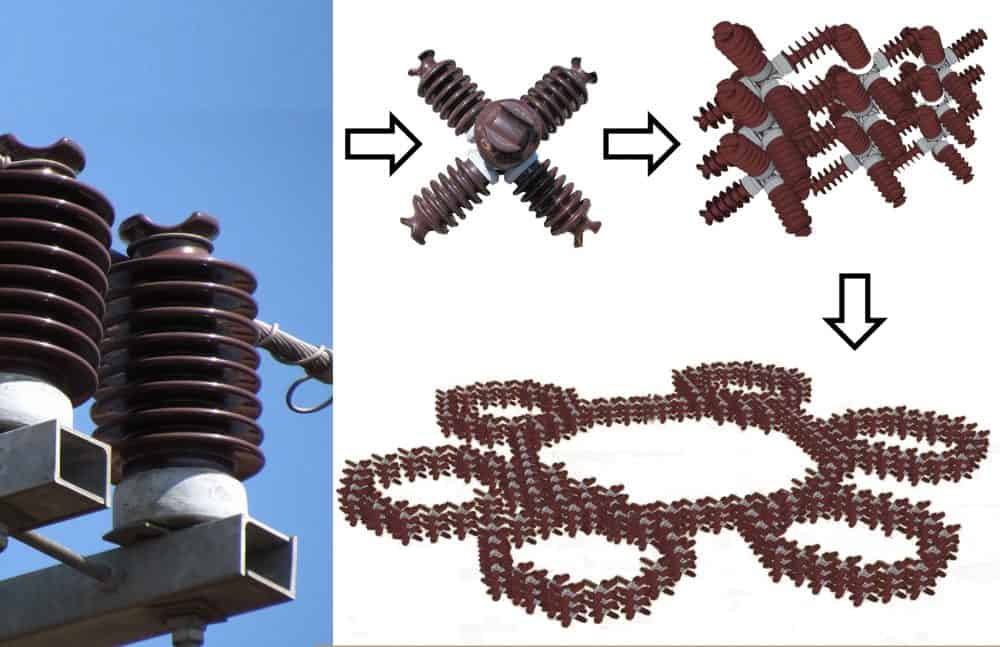
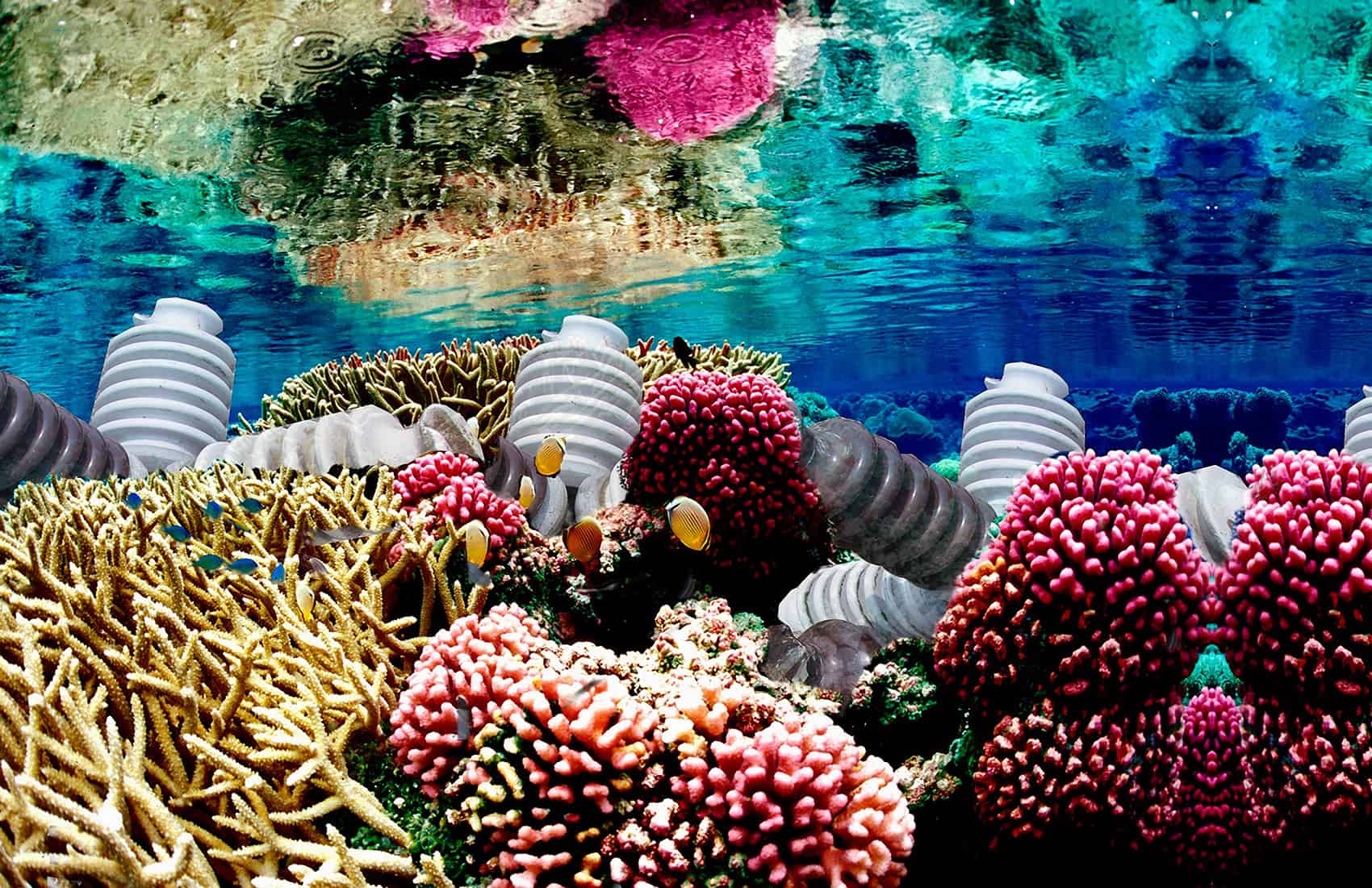
The government-run Costa Rican Electricity Institute (ICE) is working on a project to create artificial reefs using waste material from the national electrical grid. The plan is to sink a structure made of discarded porcelain insulators, the cylindrical, accordion-shaped objects used to isolate electrical currents on utility poles and at power stations, into the ocean to induce the reproduction of coral, polyps, fish and other marine species currently being affected by climate change and changes in ocean temperature and water quality.
Walter Arias Alvarado, ICE’s socio-environmental coordinator for the central region, said the project aims to benefit coral reef ecosystems and provide a reuse for ICE waste materials that would otherwise be stored or discarded. Porcelain insulators will be stitched together in a circular module that can be further attached to similar modules into a bigger structure.
ICE will initially build a single module to study its evolution in the ocean before considering an expansion of the project, Arias said. The first module is a circular structure 6 meters (19 feet) in diameter and 1.3 m (4 ft.) tall that will be sunk in the Playa Hermosa bay in Guanacaste at a depth of 28 m (92 ft.).
A team of ICE divers who work at hydroelectric dams will be responsible for sinking and anchoring the structure to the bottom of the sea. Marine biologists from ICE, the Environment Ministry (MINAE) and the local group Playa Hermosa Artificial Reef Project, which began building artificial “fish condos” in the bay in 2010, will monitor the structure during six months to evaluate how well coral reproduces there and whether and how other marine species adopt the reef, Arias said.
He noted that some people have questioned whether ceramic pieces can facilitate the reproduction of living organisms. Arias said ICE’s experience with porcelain insulators in high humidity areas of the country shows otherwise. ICE staff often have to clean insulators on utility poles that get covered with moss and other organisms, he said.
Nidia Novoa, a marine biologist with the National University, said similar projects in the country have successfully created artificial reefs using materials as diverse as cement blocks, PVC pipes and old vessels.
“Most of them have been quite successful and have effectively helped the regeneration of reefs along the Pacific and the Caribbean coasts,” she said. Novoa noted, however, that the process is slow. Corals grow approximately 1-1.5 centimeters (0.4-0.6 inches) per year, she said.
Juan José Alvarado, a biologist with the University of Costa Rica’s Center for Research in Marine Sciences and Limnology (CIMAR), said the first projects to create artificial reefs started in the 1980s using old tires. Most of the first efforts failed because the tires got loose and the structures did not hold together.
Alvarado said reefs along the country’s coastlines are severely deteriorated. He said CIMAR maps show that up to 90 percent of reefs in Guanacaste were covered by live corals in the 1980s. Today that coverage has shrunk to about 3-5 percent, he said.
The reef destruction severely affected fish populations and the fisheries industry in the province.
From waste to habitat
ICE’s reef initiative was born two years ago out of research on how to reuse porcelain insulators when they need to be replaced. More than half a million insulators are used along the national electrical grid, and those that get replaced are currently stored in warehouses.
“These objects have internal metal components that limit the options for reuse or recycling,” Arias said.
ICE considered selling them to cement factories, but the process to detach the porcelain from the metal components is complicated and expensive, he said. Arias said he proposed the reef option after seeing a Discovery Channel documentary about artificial reefs.
ICE specialists began with laboratory tests in which they kept the insulators inside salt water chambers for periods as long as 350 hours to see how the material would behave under the sea and to rule out leaks of any polluting material.
The insulators were then evaluated under MINAE protocols to certify that they’re free of any hazardous material. “Results from both tests were negative in pollutants that might affect the environment,” Arias said.
ICE discovered the Playa Hermosa Artificial Reef Project, known as CondoFish, which has made reefs out of cement blocks, and reached an agreement with the group to develop the project at the popular Guanacaste beach. ICE hopes to have all the required permits for the project from MINAE within two months.
Arias said data collected about the reef during the first six months will be published in a scientific paper and also used to decide whether to expand the project.
ICE has been in contact with tourism businesses in Playa Hermosa and Arias said they’ve mostly been receptive to the plan. The bay’s artificial reefs could attract tourists interested in diving and some have suggested creating “reef trails” for diving tours, Arias said.
Still, he noted, ICE’s main goal is to find an environmentally-friendly solution to waste disposal from the electricity sector.