

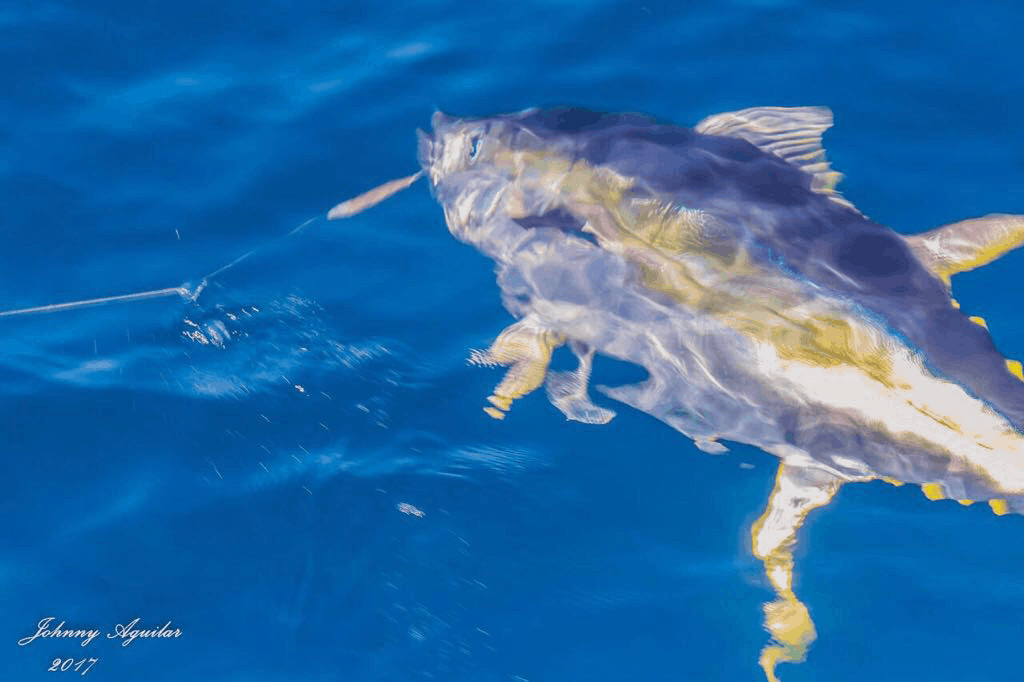
At a breakfast for the press this week at the Crowne Plaza Hotel Corobici, representatives from the Costa Rican Fisheries Federation (FECOP) and other organizations told a room of journalists that Costa Rica’s tuna fishery is in peril. The problem, says FECOP, is that international fishing fleets are disproportionally benefitting from Costa Rica’s depleting tuna resource.
“While 15,000 Costa Rican fishermen and their families are suffering from a severe economic crisis, international tuna fishing boats have taken more than 90 percent of the tuna from Costa Rican fisheries using high-impact fishing methods,” according to a FECOP press release.
Between 2002 and 2011, international tuna fishing fleets have captured and sold more than 253 metric tons of tuna, according to a recent study by FECOP and the Costa Rican National Fishing Sector.
Priscilla Cubero Pardo, the scientific director for FECOP, explained that the study analyzed ten years of information based on information from fishing reports submitted by tuna ships and, in the last four years, from fishing observers now mandated by the Costa Rican government on international ships.
According to the study, a total of 146 tuna boats have fished in Costa Rican waters in the last ten years. The majority of these boats were from Panama and Venezuela, and of the 1,489 fishing trips recorded in ten years, 51 percent disembarked from Ecuador. Only 15 percent of tuna boats disembarked from Costa Rica.
Costa Rican fishermen (artisanal fishermen, longliners and sport fishermen) do have exclusive access to the resources within the first 12 miles of coastal territory. But the rest of the Costa Rica’s Pacific coast is open and apparently overrun by international seine net fishing fleets. The National Fishing Sector Commission and FECOP hope the figures will prompt debates in Costa Rica about its tuna.
“Our goal is to create a favorable climate to promote fishing regulations in Costa Rica,” said Enrique Ramírez, the executive director of FECOP. “Non-selective fishing methods, like seine nets, have reduced fishing production by 40 percent in the last decade and threaten hundreds of species of fish.”
Along the country’s coasts, the livelihood of about 100,000 people depends either directly or indirectly on the fishing industry, and they are in crisis due to the reduction of fish, according to Ramírez. The capture of tuna by international fishing fleets, he says, is what’s causing the depletion of the resource.
“In the Costa Rican Pacific we have identified competition for resources between different fishing industries, from artisanal, sport, and semi-industrial fishermen to the international seine fleets. We want to encourage the country to define policies that encourage responsible fishing practices to ensure the existence of resources for the Costa Rican fishermen,” Ramírez said.
Part of the problem is the uneven distribution of tools with which to catch the fish. Small Costa Rican fishing boats are unable to compete with international fishing fleets equipped with better motors and technology.
“Until now, no one has been able to make a strategic decision about tuna resource management and the national fishing sector wants to help the country define policies directed at the responsible harvesting of this resource,” said Mauricio González, a fishermen and member of the Costa Rican Fishing Sector Commission.
Tuna fishing with seine nets has a high impact on marine resources. Seine nets are a non-selective form of fishing that often ensnares ensnares unwanted species, including dolphins, marlin, sailfish, mahi mahi, sharks and 27 other small species. The likelihood of this “bycatch” increases with the use of Fish Aggregating Devices (FADs), according to Ramírez.
Data indicates that more than 1,000 metric tons of unwanted fish are captured accidentally and then left for dead due to laws prohibiting their capture. The species most affected are billfish, manta rays, mahi mahi and sharks. This level of bycatch has a negative impact on the national fishing sector, limiting its economic contributions to the country.
Tuna fisherman are also said to throw nets over pods of dolphins in order to capture nearby tuna, killing the dolphins in the process. The boats use floating objects to entice fish to congregate. When they cast their nets over these areas, every species of fish near the object is captured. Sometimes these floating objects are artificial FADs, which are prohibited by Costa Rican law.
“The majority of tuna caught are pulled from nets cast over large pods of dolphins,” Ramírez said. “This happens 84 percent of the time. The other 11 percent of tuna capture occurs when nets are cast over other species of fish.”





