

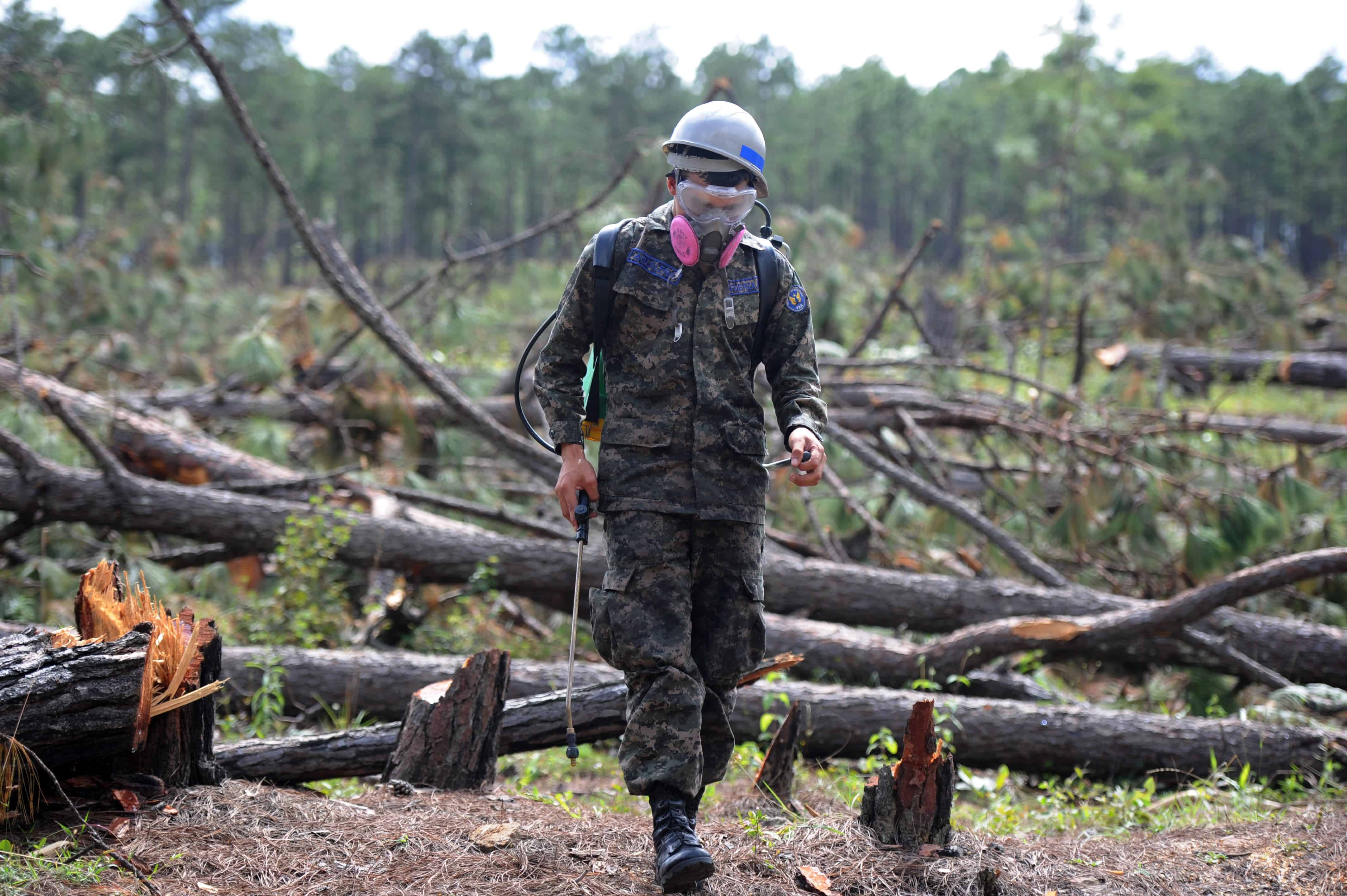
Their tenacious adversary? A tree-munching bug called Dentroctomus frontalis, more commonly known in North and Central America as the southern pine beetle.
It has always been present in Honduras, in smaller numbers. But this year has seen a sudden explosion that some experts blame on global warming.
As world leaders prepare to gather in Paris at the end of this month for a United Nations summit aimed at forging a pact to curb climate change, the Honduran soldiers from the First Artillery Battalion in Zambrano province just north of the capital are locked in a battle they know they are losing.
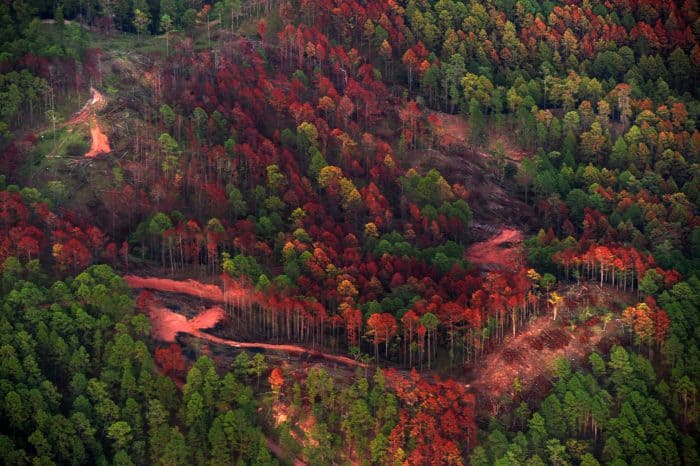
The southern pine beetle has already destroyed 400,000 hectares (one million acres) of pine forest — nearly a quarter of the country’s primary forest cover. And its appetite shows no sign of abating.
The devastation in such a biodiverse country, a third of which is covered with trees, is being called an unprecedented “ecological catastrophe” by experts.
Insect ‘plague’
“This plague will leave us with just half the pine trees in Honduras — if we’re lucky,” said a military adviser, Lucky Medina, supervising the soldiers as they cut down trees.
Commanders of the battalion of 350 men admit they feel impotent against the beetle, and have called in reinforcements from the country’s Forest Conservation Institute (ICF) and the military’s Forest Commando unit.
The commandos are paired up into a tree-cutter and assistant, and are taking down pines in different parts of Honduras, even some healthy ones, in a bid to clear buffer containment lines around infected zones.
“It’s a shame to see this,” one commando officer, Colonel Bernardo Avila, told AFP.
Angela Sevilla, an ICF expert watching the operation, adds sadly that it took “40 to 50 years to have a forest like this.”
“But we need to cut the tree to save the forest,” responded Medina.
He noted that, last year, the beetles destroyed a relatively limited 15,000 hectares.
But a prolonged drought caused by the El Niño weather phenomenon in the Pacific Ocean this year boosted insect numbers six-fold. From September to November, it is estimated that the area they had spread to tripled.
Climate change blamed
“The increased insect population is the product of climate change, due to the elevation in temperatures,” Medina asserted.
El Niño wreaks havoc on world weather patterns every two to seven years, causing floods and droughts. Although there is no global scientific consensus that El Niño is itself a sign of climate change, researchers have noted it is occurring with greater frequency.
The U.S. Department of Agriculture calls the bug “one of the most destructive pests of pines.” It says sudden outbreaks have been recorded in the U.S. every few years for “unknown” reasons.
The southern pine beetle is active across parts of Central America, Mexico and the United States.
In the group watching the soldiers is Sergio Quiñonez, an expert sent by the Mexican government to help Honduras tackle its bug infestation.
He used a knife to cut into one of the trees, then tweezers to lift out some of the beetles, no bigger than a grain of rice, and put them in a plastic container for later study.
Quiñonez said the long drought had “stressed” the trees, making their bark more vulnerable to the encroaching insects.
Thousands of the beetle eggs are under the bark of a stricken tree, with each female able to lay 50 eggs at a time, prompting Quiñonez to urge the soldiers to burn the bark and harvest the wood to help finance the fight against the bugs.
Medina pointed out a tall tree about 50 years old that was streaming with resin.
“When a tree is infected by the larvae it secretes the resin as a defense mechanism, to protect itself. But the discharge it receives from the insects is so great that it ends up succumbing,” he said.
“It’s like cancer in humans.”





