

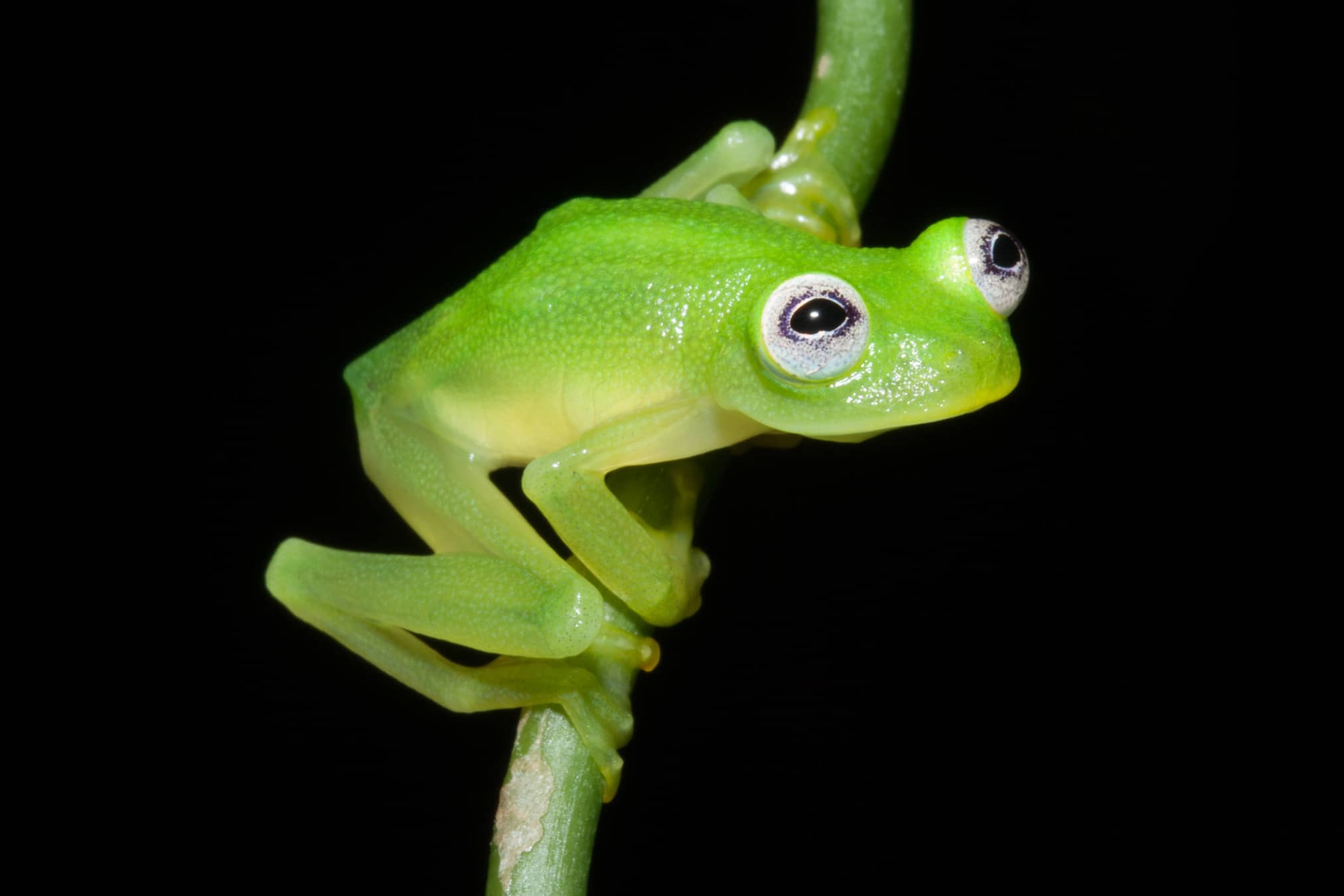
Tucked away in the Talamanca mountains, a tiny, semi-translucent frog lurked out of scientists’ sight during more than a century of field work in the area. But the newly discovered frog, Hyalinobatrachium dianae, made its world debut in February in the taxonomy journal Zootaxa.
Characterized by a lack of pigmentation in their skin, glass frogs can only be found in parts of Central and South America. Some glass frogs, including H. dianae, are so translucent that their organs are visible from their underside, hence the name.
Herpetologists are unsure of the practical reason for the frogs’ see-through appearance, but it is possible that their translucence aids in camouflage. Of the 149 species of glass frogs, 14 can be found in Costa Rica.
H. dianae is the first glass frog discovered in Costa Rica since 1973. The frog is named for Janet Diana Kubicki, the mother of the frog’s discoverer Brian Kubicki, as well as the Roman hunting goddess, Diana.
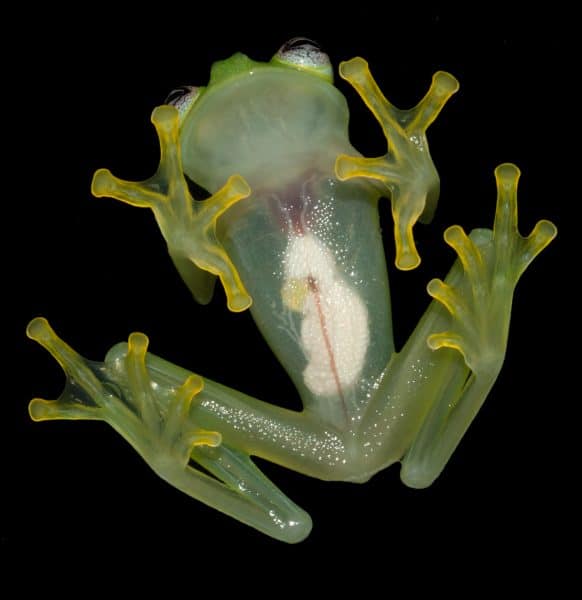
Herpetologists found six specimens of the new frog in higher elevations in the western provinces of Limón and Heredia. The frog is about 2.5 centimeters in length. It has unusually long and thin feet and bright white and black eyes.
While H. dianae shares many characteristics of other glass frogs, the nocturnal frog’s strange call is what most distinguishes it as a separate species.
“It’s advertisement call is quite unique,” Brian Kubicki, the paper’s lead author, said. “It’s different than any other species that has been discovered.”
Advertisement calls are used by male frogs to attract females for mating. Rather than using calls similar to other glass frogs, H. dianae’s advertisement is a long metallic whistle with rapid pulses.
According to Kubicki, the call is similar to an insect’s call, which may have helped mask the frog from field herpetologists for so long. Investigators also identified morphological and genetic differences in H. dianae compared to other glass frogs.
The frog’s distribution throughout the Talamanca mountain range is another likely reason it went undiscovered for so long.
“Costa Rica is a very well-studied area by herpetologists so this discovery was surprising,” Kubicki said. “We just needed some fieldwork in these areas that were poorly explored.”
The discovery is the second this year in Costa Rica for Kubicki. He and fellow herpetologist Stanley Salazar published a paper in March detailing the discovery of the first three Costa Rican specimens of the fringe-limbed treefrog, Ecnomiohyla bailarina.
E. bailarina was discovered in Panama in 2014. The specimens found by Kubicki and Salazar were the first E. bailarina frogs seen outside of Panama.





