

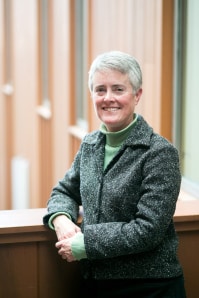
WASHINGTON, D.C. – Economist Lee Badgett says equal treatment for gays and lesbians can benefit economies from Virginia to India. For the past two decades, she’s mined data in her quest to prove it.
“My long-run goal has always been the same: It’s using research to help create a more just world,” said Badgett, 54, director of the University of Massachusetts at Amherst’s Center for Public Policy and Administration. “When policy makers can pick out their favorite myth about gay people to hang their policy on, it’s pretty hard to argue against.”
The World Bank is collaborating with Badgett to analyze homophobia as a hurdle to development in emerging markets. She’s been called as an expert witness before U.S. Congressional subcommittees and in a court case that found California’s same- sex marriage ban unconstitutional. Colleagues credit her with publishing the first research tackling gay and lesbian issues as economic rather than sociological.
“Lee was absolutely a pioneer,” said Gary Gates, a distinguished scholar with the Williams Institute at the University of California at Los Angeles, which focuses on sexual orientation and gender identity law and public policy, and where Badgett is also a distinguished scholar. “There was no one in economics who was really thinking about these issues.”
Badgett’s work for the institute was widely cited recently by national and international news outlets after the White House said President Barack Obama plans to issue an executive order that would bar federal contractors from discriminating against gay and transgendered employees. The change would cover 14 million more workers than state laws do, she found.
The World Bank also has a new initiative focusing on social inclusion to help end extreme poverty and promote shared prosperity. As part of this, Badgett created an economic model that she applied to India in a case study presented at the bank in March.
Preliminary findings showed that discrimination related to homophobia leads to less education, lower earnings, poorer health and shorter lives. The lost workplace productivity and health problems connected with homophobia cost the United States between $2 billion and $31 billion in 2012. The range is wide because data on sexual minorities is scarce, she said.
Though a lack of statistics on gays remains a challenge, Badgett said academics and society have become more attentive to sexual-minority issues and recognize the need for further research. The World Bank is working to gather better data in India, according to bank consultant Phil Crehan.
Badgett’s expertise also was recognized when she was called as a witness in the case of Perry v. Schwarzenegger, which found that California’s Proposition 8 banning same sex weddings was unconstitutional.
She broke into her field with a 1995 paper debunking the idea that gay men are richer than their heterosexual counterparts. In the early 1990s, she was studying gender and racial discrimination as an assistant professor at the University of Maryland at College Park when she read a newspaper article that labeled gays a marketer’s dream, citing their above-average affluence.
“I thought: ‘This is really interesting. I know a lot of LGBT people — I am one — and this doesn’t characterize the people that I know,'” she said. “I needed better data, so that was really the quest. Marketing data wasn’t going to cut it for economists.”
Badgett used the National Opinion Research Center’s General Social Survey to show that gay and bisexual male workers made between 11 percent and 27 percent less than heterosexual men with similar experience, education and region of residence.
“Lee’s seminal research on the economics of sexual orientation was critical,” said Marieka Klawitter, a University of Washington economist in Seattle who published studies on gays after Badgett. “The myths that gays were all rich, carefree, without families, led to the perception that they didn’t face discrimination.”
Badgett’s interest in social equity started in the 1960s in Winston Salem, North Carolina, where “even as a kid, I could notice the vestiges” of racism, she said. Her Girl Scout troop was desegregating, yet “the world of black and white people intersected in very few places.” She was expected to behave differently from boys and experienced “a kind of discrimination” because she enjoyed sports and “didn’t like to wear dresses to school, but had to.”
Her family moved when she was 11 to a Chicago suburb, where she fit in more easily. She was interested in politics, and in high school began working on campaigns. She quickly realized “there was another angle that covered everything, and that was money. Power went with money.”
She followed that observation to the University of Chicago, where she studied economics before graduating in 1982 into a recession. Jobs were hard to get, and she took a clerical position at a warehouse. She learned that male employees working in the stock room earned more.
“Just that assumption — that women will be in the office, men will be in the warehouses and pay will reflect that difference — was really interesting to me,” she said. Studying wage inequality “kind of became a quest.”
Badgett headed to the University of California at Berkeley in 1984 to explore labor economics, focusing on discrimination. She completed a Ph.D. in 1990. After graduating, she moved to Maryland to be an assistant professor. She had been there about a year when she came across the newspaper piece that spurred her to study economics related to sexual minorities, she said.
“She took an enormous risk by doing this work,” because homosexuality was stigmatized in academia, so her research could have damaged her career, Klawitter said.
Badgett said it was difficult initially to spread her findings: One journal rejected the study without sending it for peer review. When a different journal published the research, some gays challenged it.
One camp didn’t believe the results. Others thought it was “really important” to have numbers showing gay people had a lot of spending power, she said. Even among economists, she encountered a few who made hints that homosexual people might deserve lower pay because they were morally wrong.
“She was a little bit early, but she eventually caught the wave of increasing sympathy for gay rights,” said William Dickens, one of Badgett’s advisers at Berkeley and now a labor economist at Northeastern University in Boston.
From the outset, Badgett wanted her studies to shape policy. She and her colleagues founded a research group on gay and lesbian issues in 1994, as she was working on her first related study.
“We started creating publication outlets, we networked with media and policy makers to get the work out,” she said.
In 2006, the organization merged with the Williams Institute. Her work there has shown that gay couples without the option to marry miss out on tax and insurance benefits, and states that don’t allow same-sex marriages lose incremental revenue. Virginia could realize as much as $60 million in the first three years from spending on weddings and tourism, April research showed. While the impact is relatively small — Virginia’s gross domestic product totaled $426 billion in 2013 — it does contribute to the economy.
Badgett has “argued persuasively that legalizing gay marriage offers important economic and social — as well as personal and symbolic — benefits to nontraditional couples,” Nancy Folbre, a professor emerita at the University of Massachusetts at Amherst and a mentor of Badgett’s, wrote in an email.
Same-sex marriage also has personal relevance for Badgett, who wed Elizabeth Silver, an attorney, in 2005, the year after it became legal in Massachusetts.
Badgett says her goal is to continue “providing facts and analysis that policy makers need and that the public needs.”
Heidi Hartmann, president of the Washington-based Institute for Women’s Policy Research and a former co-author, said she sees this in Badgett’s work.
“She’s a person who is really dedicated to the data, on how to make sure you tell the truth with data.”
© 2014, Bloomberg News





