

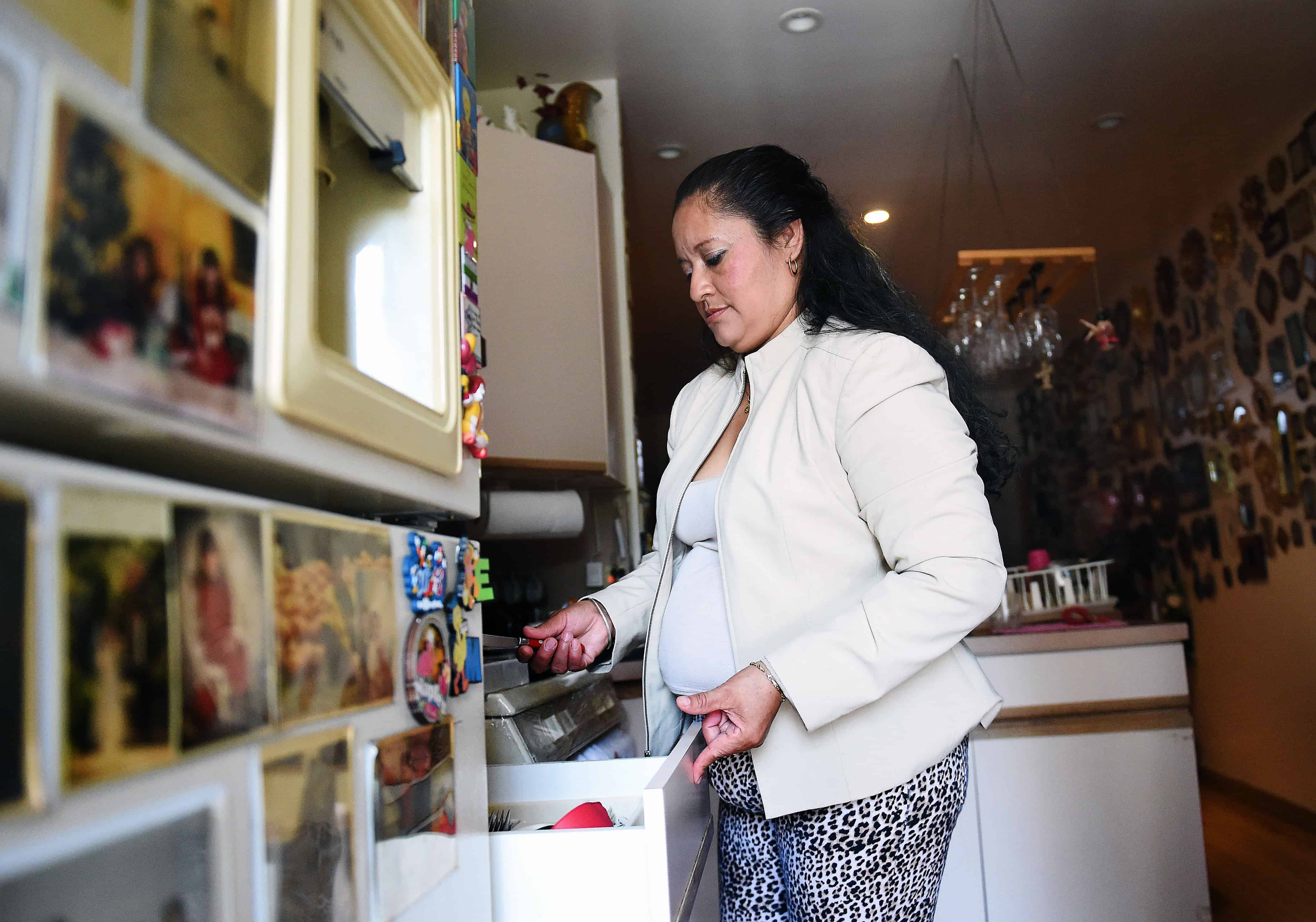
CHALATENANGO, El Salvador – With no job or education, Mirna Meléndez paid a smuggler to help get her out of El Salvador. As she left, she told her four children: “You will have to go without my love here, but not without support.”
That was more than 17 years ago. Today, Meléndez is keeping her promise to her kids, working as a maid in New York.
“I told them I would be gone five years, but I knew that was not the case,” said the short, 43-year-old Meléndez.
Left behind in El Salvador with their grandparents were her daughters Liliana, Sindy and Roxana — who were then aged 11, 9 and 6 — and her 4-year-old son Javier.
Meléndez is just one of many from Central America who risk their lives to get to the United States — a perilous journey north, often with the help of people smugglers.
Chasing the “American dream” brings the promise of better wages and a better life for family at home, but can also mean a life split in two, forever.
From the U.S. to El Salvador
Seated in the living room of the house where she works in Brooklyn, the brown-haired, round-faced Meléndez recalls her childhood in San Francisco, a mountain village in northern El Salvador.
She says she could not go to school because her family was too poor. So she worked selling things in the street.
She got pregnant at age 14, and by the time she was 20, she had four kids and a failing marriage — her husband José was the first to leave for the U.S., where he works, illegally, as a gardener in Maryland.
Convinced she was going nowhere, she borrowed money to pay the $7,000 charged by a human smuggler to take her to the United States.
Speaking no English, she got by doing a variety of jobs, working as a maid, in a factory, in the kitchen of a Salvadoran restaurant and taking care of elderly people.
With her spirit of self-sacrifice, Meléndez managed to support her kids. These days, she now has proper residency papers and is paying for Javier and Roxana’s studies in El Salvador.
But she is more than 3,000 kilometers (1,860 miles) from home and she missed seeing her children grow up. She also has only been home three times in 17 years.
Nevertheless, she says she feels close to her children.
“I am a very protective mother,” she said. “I have been able to guide them over the telephone, even though I was not there. I want the best for them,” she said.
Meléndez also is helping to raise a second family — shortly after arriving in New York, she met a man named Fernando, with whom she had three more daughters.
‘She does it all’
El Salvador has a population of 6.2 million, but another three million Salvadorans live abroad, 85 percent of them in the United States.
In 2013, they sent home $4 billion in remittances, or 15.9 percent of the country’s gross national product.
Back home in Chalatenango department, Meléndez’s first family is bursting with pride, but realizes the cost of her sacrifice.
“She does it all,” 21-year-old Javier says. “She tells us that she is tired at the end of the day because she works late and must get home to fix dinner.”
When they were small, the kids lived with Juana, Meléndez’s mother. But when she got sick, they moved to nearby El Rosario to live with their paternal grandmother Gudelia.
Unlike their sisters Liliana and Sindy, who themselves emigrated to the United States, Javier and his sister Roxana have no intention of leaving El Salvador.
They live in a modest house in San Salvador that was purchased by their mother and still visit their two grandmothers on weekends.
Emigrating “would mean the loss of our family life,” Javier says. “First my grandmother Juana and then grandmother Gudelia have served as mother and father all these years.”
El Rosario, with its paths of stone and packed dirt, is home to some 200 families and is already showing the signs of the influx of remittance money. A road into town is paved. People drive all-terrain vehicles and some houses are now made of concrete, which is a step up there.
Gudelia, in her concrete house painted white and baby blue and surrounded by flowers and fruit trees, remembers times when she had little money for food and medicine for the children.
“The remittances help meet our needs, but there is a lot of loneliness,” she said.
Javier and Roxana still hold out hope for a more permanent reunion.
“Maybe one day, our mother will come home to stay,” the young man said.
But in New York, Meléndez says she has no plans to backtrack.
“I would love it if my children came here to work one day. I would be the happiest woman in the world,” she said.





