

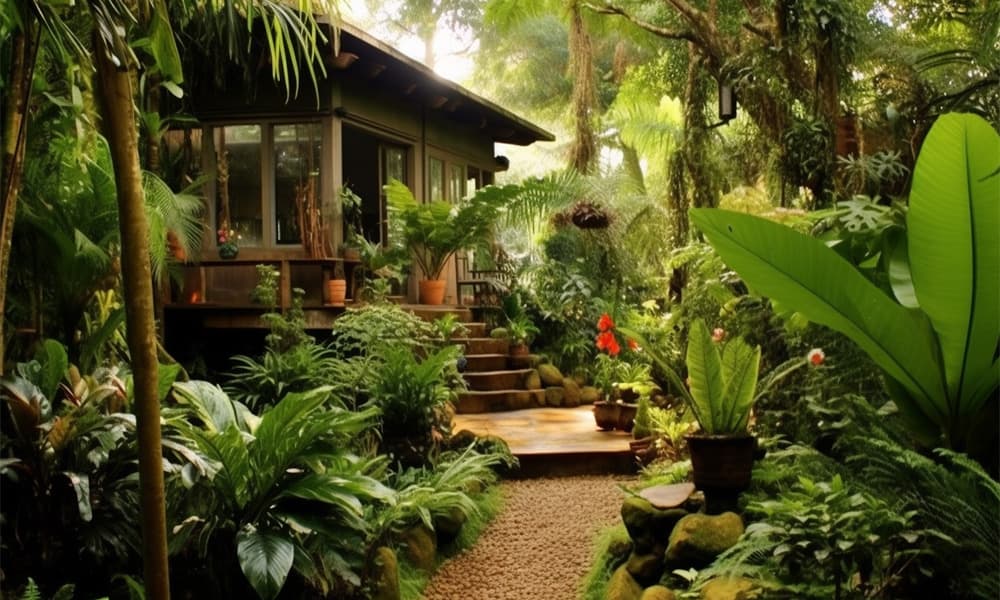
If you are beginning a new chapter here with a new home or property in Costa Rica, landscaping may be an important issue right now. If you’re ready to put on the gloves and grab the tools, here are some tips that will help you create an eco-garden around your apartment, home or farm.
Plants and trees bring warmth and life around our dwellings, as well as creating a peaceful ambience in our home. Decorating with plants also brings out our creative talents and nourishes our caring instincts to help us regain some of that link with our vital connection with nature. Eco-gardens can also produce a good portion of fresh fruits and vegetables for home use. It’s easy to create a tropical “edible” landscape that provides fresh fruits and vegetables throughout the year.
A gardener can be likened to an artist with a shovel. The gardener’s palette consists of a wide array of seeds, flowers, cuttings, plants and trees. The landscape is the canvas, with five basic ingredients: sunlight, air, water, soil and vegetation.
1. Sunlight
Some plants, such as most annual flowers and vegetables, grains and grasses, need lots of sun. Try to keep your east- and south-east facing sides of the home open for lots of sunlight in the mornings, and arrange your annual flowers and other sun-loving plants in this area.
On the shadier northern side of the home, use shade-loving plants such as foliage plants, ferns and trees. The western side is also ideal for trees, to cool your home in the hot afternoons. Palms are ideal for providing your home with broken shade and provide that real tropical look.
2. Air
Costa Rica has a wide variety of climatic zones, and understanding your particular climatic conditions can help you plan your selection of plants and trees.
The coastal regions are truly tropical regions, whereas the highland regions are similar to northern temperate zones. The middle region of the country has an overlap of these two extremes.
Over the years, it’s been good to see the nursery business in Costa Rica flourish, and you’ll usually find that your local nurseries can help you make the right choices of plants and trees for your area.
3. Water
The availability of water is a central issue for most properties. Each year, Costa Rica’s watersheds are producing less water as demand rises. If we design our landscapes with eco-gardens, we can lower our water consumption and help conserve this valuable resource.
Using hardy plants and trees that require little or no irrigation is one way to do it.
Refitting our household gray water from sinks and showers for watering plants is another great way to reuse our water. Or we can use rainwater, which can be collected from the roof and stored in a cistern.
To reduce consumption to the minimum, plan a xeriscaping design, which consists of three important zones.
The “oasis zone” is located nearest to the house and should contain showy plants and the vegetable garden, which requires frequent irrigation. During the dry season, cut back on the size of your garden to save water.
Mulch as much as possible, particularly with grass clippings and dry leaves collected around the home. This will keep the soil moist and cool, cutting down considerably on watering.
The second zone is called the “drought tolerant zone,” where plants need an occasional watering during dry times. This area may consist of fruit trees and other ornamental plants that are drought resistant. Next is the “natural zone,” which ideally needs no watering during the dry season.
This area should consist of entirely native plants that weather the dry season without water. For example, the hardy local grass for the lawn called jenjibrillo may turn brown during the dry season but never needs watering and greens up as the rains return.
4. Soil
Without fertile soil, plants grow poorly and are more prone to insect attacks and disease. Eco-gardens include a composting unit that can convert organic waste from the kitchen and garden, as well as dry leaves and grass clippings, into rich, fertile soil for plants and trees. By composting at home, we reduce disposable waste up to 40%.
Compost is the best solution for regenerating soil. If you have hard, red clay soil, compost will turn it into brown humus. If you have sandy soil, compost will turn it into rich sandy loam that retains water and nutrients.
Terracing is another important aspect of good planning that prevents costly and ugly erosion.
5. Vegetation
When designing any landscape, keep in mind the following friendly triad of plants.
Flowers provide color and variation over a limited time period, while foliage plants and trees lend a constant background to your decorating theme with flowers. An orchid bloom may last only days or weeks, but it can be displayed against a backdrop of tranquil green ferns and colorful foliage plants. The art of plant decoration with these three types of plants involves mixing the cooler greens of the bushes and trees with the brighter colors of flowers and foliage plants to create a contrast that is pleasing to the eye.
Eco-friendly plants for your pallet
Hibiscus (Hibiscus rosa-sinensis), known as amapola in Spanish, is at the top of the list for eco-garden plants. Readily available in nurseries, this queen of flowers blooms year round on hardy bushes that can serve as large potted plants for apartments and living fences for homes. The leaves and flowers of the bush are edible, too. Hibiscus needs no irrigation in the dry season.
Marantas (Maranta spp.) are shade-loving foliage plants with exquisite colorful designs on their leaves. These hardy plants require no watering in the dry season and bloom at the beginning of the rainy season. They can serve as potted plants for apartments and homes or foliage displays in landscape designs. No insects or diseases affect this plant, which means no need to spray costly and toxic pesticides. They come in many variations and are common in nurseries.
The rose trumpet tree, or roble de sabana (Tabebuia rosea), is a well-known, worldclass landscaping tree. This native species grows well in the coastal and middle regions of the country. Few know, however, that the tree was a favorite medicine of the Mayas and Incas. The inner bark from the branches serves as potent botanical tonic.
Ideal for larger properties for their spectacular blooms of pastel-rose flowers, these trees require no watering in the dry season and can provide firewood and a hardwood lumber. Roble de sabana is stocked in many nurseries, also in yellow-flowering species.
You’ll find an abundance of plants and trees at nurseries around the country, and many offer landscaping designs and installations.
If you use their services, ask them to help you build an eco-garden, keeping in mind the points mentioned here.





