

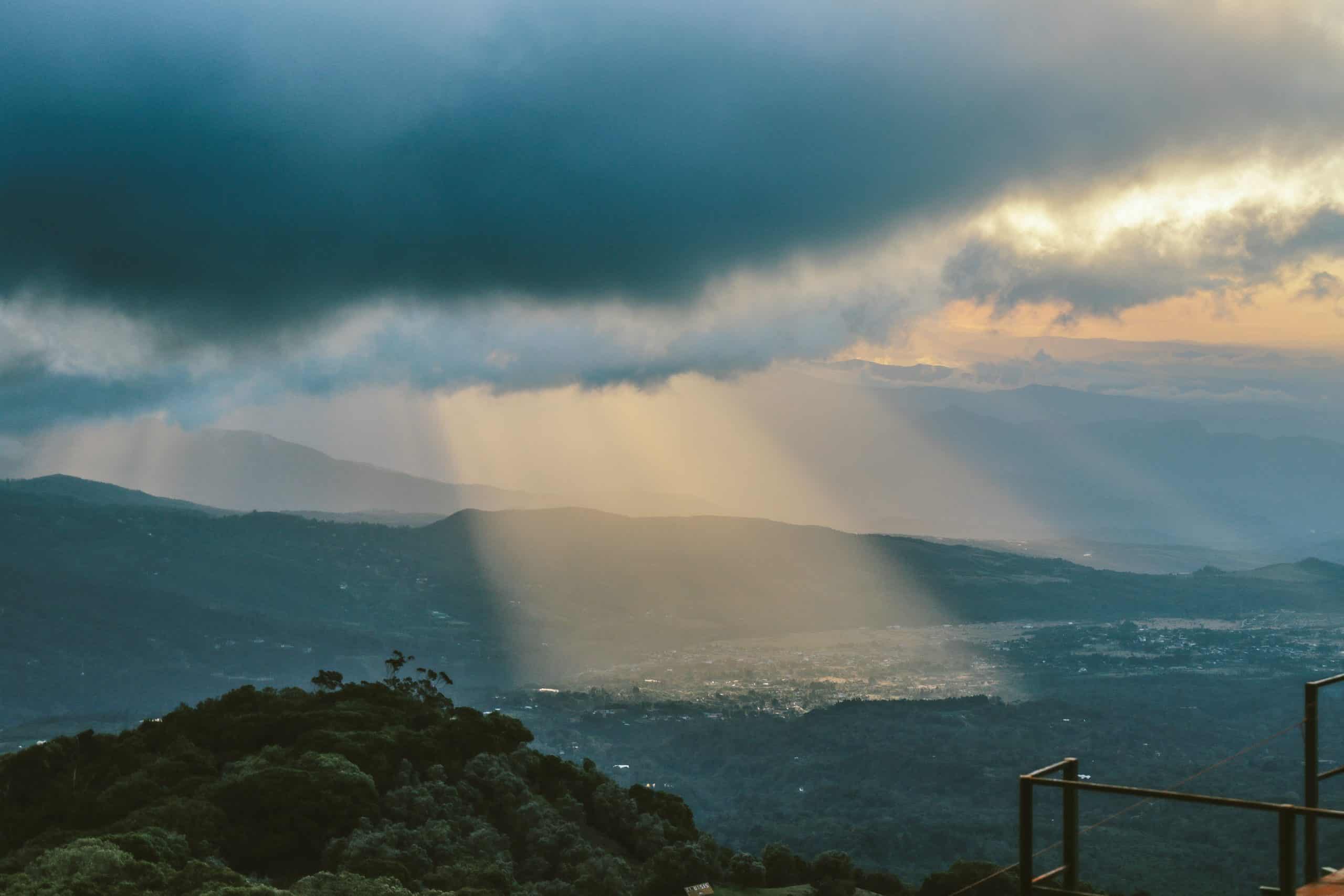
Between dry and wet seasons in Costa Rica, a transition period occurs when rainy and dry days alternate. A typical transition forecast for the end of April in the Central Valley might read: “Mornings clear, with few clouds. Afternoons partly cloudy, with isolated rainfall. Temperatures warm, with a lot of haze.”
Meteorology is the science dealing with the atmosphere, weather and climate. Costa Rica’s weather conditions are the domain of the National Meteorological Institute, a department of the Ministry of the Environment and Energy (MINAE).WERNER Stolz is the head of analysis and prediction management at the institute. “Meteorology is a living science,” he says. “It’s not just theory, and it has an important application in society.”
Stolz, 41, a naturalized citizen of Costa Rica, was born in Honduras. He studied physics and meteorology at the Autonomous University of Honduras and the University of Costa Rica, and has lived and worked here for 10 years. He and his team of five meteorologists and three technicians evaluate data from numerous sources in Costa Rica and abroad.
Approximately 400 weather stations across the country and 14 satellite stations deliver information on prevailing weather conditions, such as solar radiation, temperatures, air pressure, humidity, winds and rainfall. Additionally, every morning, a radios on derises from the institute’s weather bureau in Alajuela, northwest of San José. Data are completed with information from international weather services, including the U.S. National Hurricane Center in Miami, Florida.
Computer-based numeric programs facilitate analysis and evaluation of current and upcoming weather events. The weather reports are released to the public via fax, e-mail and the institute’s Web site(www.imn.ac.cr).The institute runs weather bureaus in Puntarenas, the principal Pacific port city, and all four of the country’s international airports, issuing aviation weather forecasts. Other users include the National Emergency Commission, the media, databanks, tourism, agriculture, shipping and water and electricity providers.
Not only does the institute analyze the country’s weather, it also researches its climatic peculiarities.“ There are basically two seasons in the Pacific basin,” Stolz explains. “The rainy season, May to November, and the dry season, December to April.
On the Caribbean side of the country, March and September are the driest months.” Year-round, the weather in Costa Rica is determined by the country’s geographic position in the Neotropics – 10 degrees north of the equator – and by the orientation of the Central Mountain Range, running northwest to southeast. This mountainous barrier splits the country into two major climatic bodies.
Temperatures fluctuate relatively little in the tropics; no more than a 5-degree-Celsius difference exists between the mean temperatures of the warmest and coldest months. In general, temperatures vary with elevation rather than time of the year. Stolz says precipitation is the most important weather element. The southern Pacific, the northern Caribbean coast and parts of the Central Mountain Range are among the wettest areas, receiving more than 4,500 millimeters (180 inches) of rainfall per year, while the northwestern lowlands are the driest areas in the country.
The principal disturbances that cause most of the weather changes in Central America, as well as average conditions in the tropics, are the trade winds, the polar fronts, hurricanes and the so-called Intertropical Convergence Zone (ITZC).At the equator, two major air masses, one from the north and one from the south, together with ocean currents, form the ITCZ, the major climatic heat engine on the planet, extending five latitudes to the north and south of the equator. Intense solar heating in this region forces air to rise through convection, resulting in a plethora of precipitation. Ancient mariners called the ITCZ “the doldrums,” due to the lack of horizontal air movement.
The zone follows the path where the sun is directly overhead, with a lag of approximately two months, and its annual migration has an enormous influence on weather patterns in Central America.“ The ITCZ is where the northeasterly trade winds converge with Pacific winds,” Stolz explains. “It accounts for 60% of the precipitation in Costa Rica, and its advent heralds the start of the rainy season.” In late April, when winds blow from the southwest, the rains hit the Osa Peninsula, on the southern Pacific coast, first, arriving in Guanacaste by the end of May.
During the rainy season, the precipitation lets up for a window in the middle of the year. This period is called veranillo, which means “little summer.” Verano, or “summer,” in Costa Rica refers to the dry season, December to April. In September and October, while the ITCZ is stationary above Central America, Pacific showers and thunderstorms bring the peak in annual rainfall to the country’s western side.
The interaction between the ITCZ and hurricanes can generate rainfall of differing durations and strengths .Suction from hurricanes in the Atlantic basin intensify precipitation by lifting moisture-laden air over the Central Mountains, dumping even more rain on the Pacific side.
These disturbances are called temporales (rainstorms), referring to any spate of nearly continuous rain occurring during the morning and sometimes lasting into the afternoon. In December and January, when the cold air of the polar region penetrate slower latitudes, it brings several days or weeks of rain, cooler weather and strong winds, known as nortes (northers), causing the lowest temperatures of the year. While the Pacific slope enjoys its sunniest, driest period, the Caribbean side of Costa Rica can be bathed in rain.“ Very strong winds were among the disturbances responsible for the devastating Atlantic rainstorm that occurred in January – the strongest in history,” Stolz adds.
“The Limón province experienced 344 millimeters (13.5 inches) of rain in only 19 hours; the average amount of precipitation for the entire month is 303 millimeters(12 inches).”STOLZ’S prediction for the coming rainy season includes another phenomenon that might impair weather patterns in Central and South America.“ In Costa Rica,” the weathercaster says, “the first months of the 2005 rainy season will be influenced by El Niño. Should this climatic event extend into the second half of the year, we expect higher temperatures and deficiency of rainfall.”





