

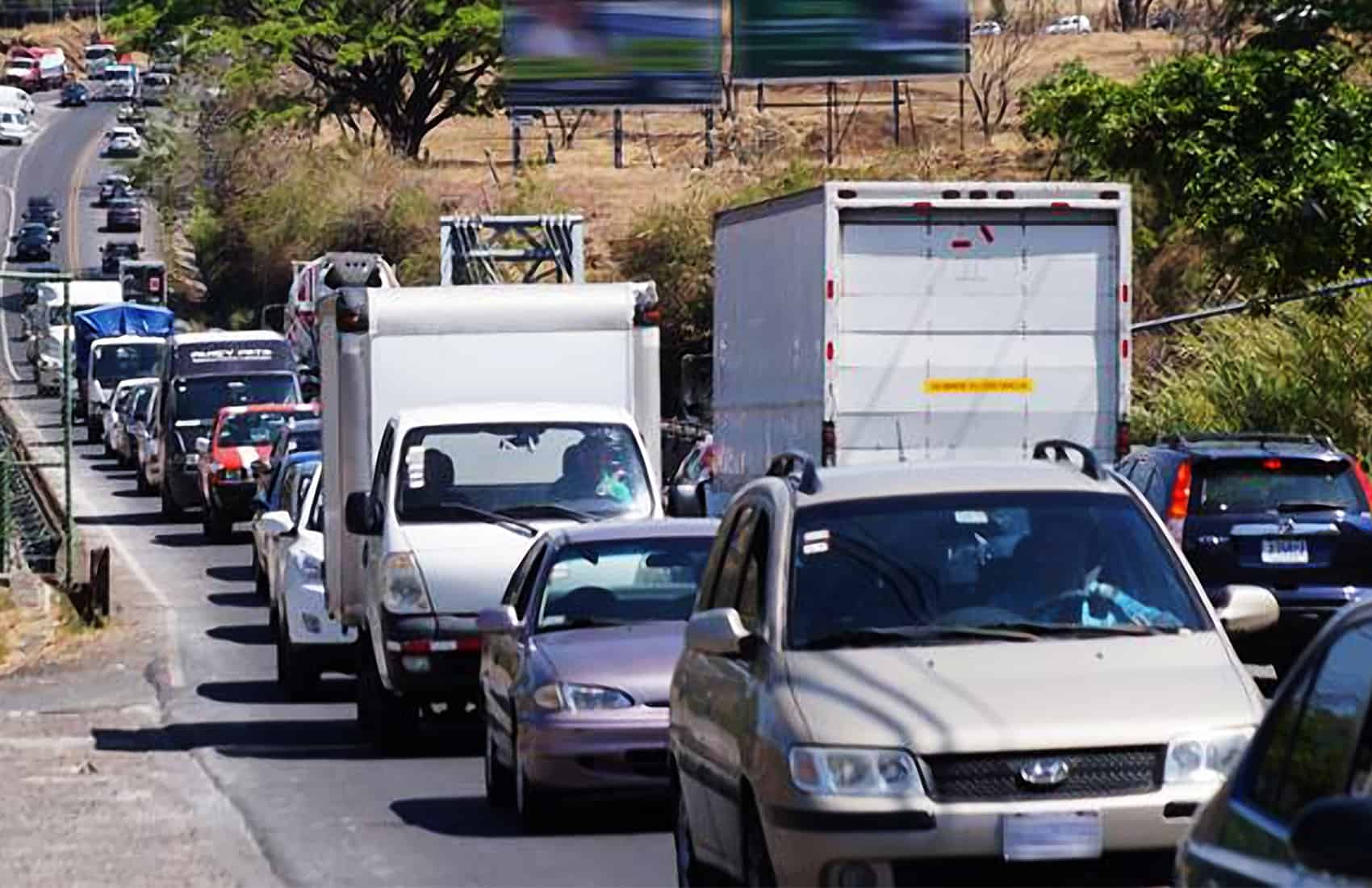
Costa Rica has spent decades underinvesting in its road network, and the gap has pushed Costa Rica’s traffic problems well beyond long commutes, Public Works and Transport Minister Efraím Zeledón said this week. Zeledón acknowledged that Costa Rica has not put enough money into roads to keep pace with the growth in vehicles, leaving a deficit that has built up over several decades. He argued, however, that wider highways alone will not solve the problem.
No country has managed to end its congestion by adding lanes, the minister said, because more road capacity draws more drivers. Transport planners call this induced demand, and Zeledón cited it as the reason the Ministry of Public Works and Transport (MOPT) is betting on trains, buses and digital mobility platforms rather than road expansion alone.
He also pointed to a newer pressure on the network. The exchange rate has pushed vehicle prices down sharply, Zeledón said, making it easy for more people to buy a car or motorcycle and adding traffic to roads that were already over capacity. The cost of congestion is showing up in the workplace. A recent study by the Federation of Chambers of Commerce of the Central American Isthmus (FECAMCO), based on consultations in five cities across the region, found that 60% of workers said a company’s location influences whether they accept or keep a job. About one in four, or 24%, had considered changing jobs because of commuting problems.
Employers described similar strain. Half of the business owners consulted said mobility conditions or their company’s location had made it harder to attract or retain staff, and eight in ten identified added costs tied to those problems. Seven in ten participants overall reported a moderate or high impact on their family, personal or rest time. In the Greater Metropolitan Area, where daily commutes link San José, Heredia, Alajuela and Cartago, those hours on the road come directly out of time for work, study and family.
The government’s main bet is the electric passenger train known as Tibi, which Zeledón has described as the backbone of a future public transport network and which authorities aim to have 80% complete by 2030. The project still faces hurdles, including more than 400 buildings that sit in its right of way.
MOPT is also exploring a cable car that would connect southern San José areas such as Desamparados and Aserrí with the future train. Zeledón has said the ministry is seeking financing for the prefeasibility and pre-investment studies needed to determine whether the project is viable. The minister framed the task ahead as recovering years of lost investment while building a public transport system reliable enough that commuters choose it over their own vehicles.





