

WHILE most divers come to Costa Rica to see big animals, the corals living at dive sites on both coasts always add to the attraction. The southern Caribbean coast from Cahuita to Punta Mona contains the country’s biggest area of reefs, both fossilized and living. There are many patch and fringing reefs, small barrier reefs, and uncountable coral heads.
On the other side of the country, the Pacific sports a great deal of coral growing on rocky outcroppings, and even a few small patch reef areas in the northwestern province of Guanacaste, Manuel Antonio on the central Pacific coast, and the offshore Caño and Cocos islands.
Corals are tiny animals that resemble upside-down jellyfish in a cup. They make the cup themselves as they grow, and it becomes hard as rock. The little tentacles grab tiny plants and animals called plankton that drift with the currents; the arms pull down the prey for feasting in the homemade cave. Some corals are solitary while others grow together in colonies called reefs.
REEF-building corals continually build upon their dead ancestors, forming bigger and bigger structures. Given the right conditions and enough time, patch and fringing reefs begin to form. After even more time, barrier reefs grow. These take hundreds or even thousands of years to develop. They are the biggest animal-made structures on earth, dwarfing anything made by man.
As is usual in nature, the little coral animals don’t do it alone. To build reefs, corals need the help of plants, specifically algae. Little bits of algae grow in some coral animals, receiving protection and providing nutrients. Only with these nutrients can corals produce reefs. The tiny plants also give corals their color.
Well-developed reefs have been called rain forests of the sea because of their comparable biodiversity. As in the rain forest, a seemingly uncountable number of species live in coral reefs. The two ecosystems are masterpieces of evolution, holding great value not only for tourists who pay to experience them but also for all humanity in the form of unique chemical compounds with a vast array of uses.
THE reefs of the southern Caribbean are the most species-diverse in the country. Here is where divers wanting to experience coral reefs usually come to drop. But the big-animal diving of the Pacific owes more to corals than most divers realize. Without the coral growing on the rocks, there might not be any big stuff to see.
Many kinds of small fish live among the corals growing on the rock parts of the Pacific floor, including the barberfish, a kind of butterfly fish about the size of your hand. These little fish operate like underwater cleaning stations – sort of a carwash for fish.
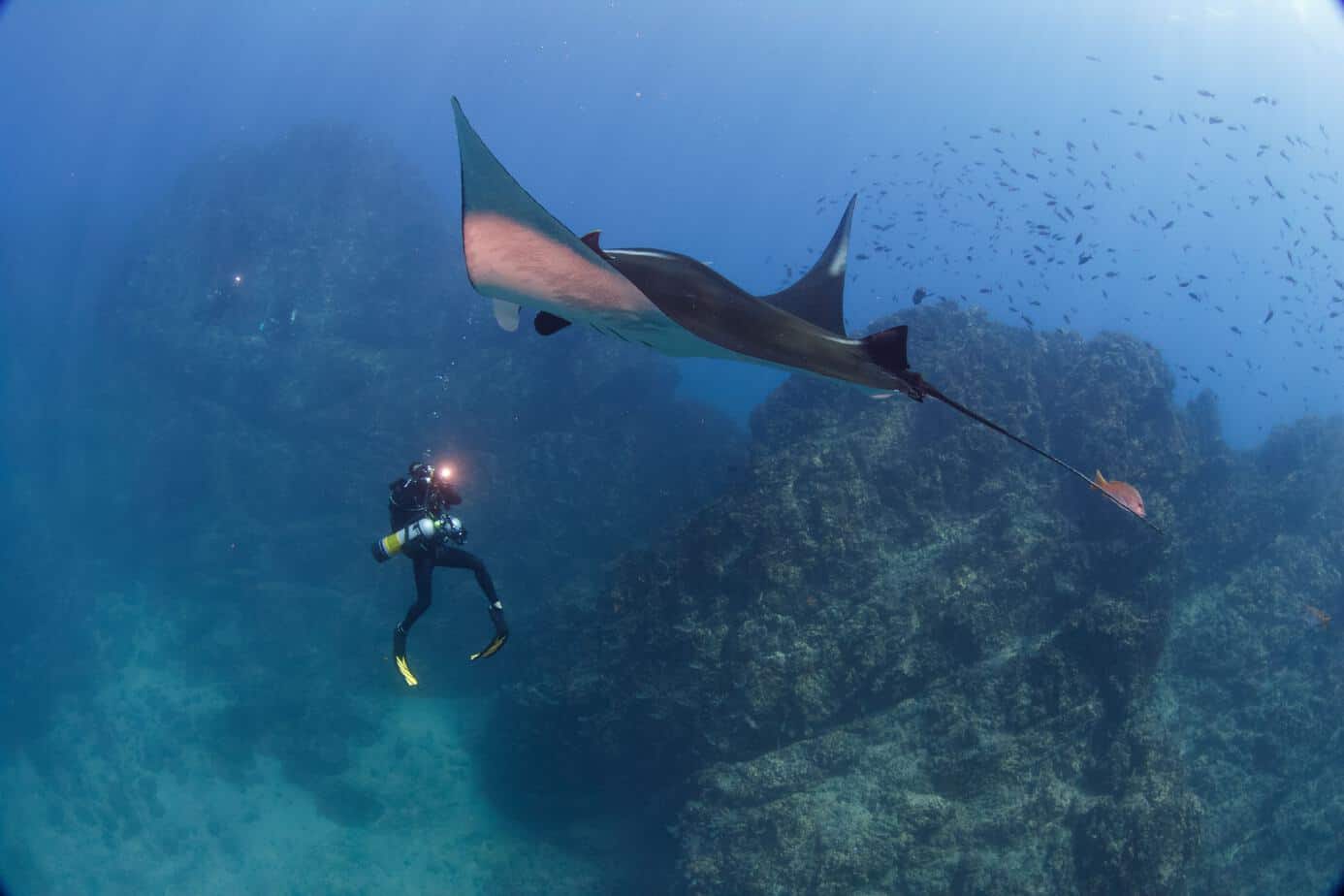
Large or even huge fish such as jack, snapper, whale sharks, and manta rays swim in and hover. The barberfish moves over and begins to eat the small, shrimp-like parasites on the skin and gills of the much bigger fish. Many of the big animals that thrill Pacific divers in the country hang out at the dive sites to get cleaned by the little fish, which only live in areas where there is coral to live around.
Divers must be careful to not kick, break, or even touch corals. Just a touch can break their skin and lead to infection. Dives on which anyone in the group touches coral should be unacceptable to divers who care about the coral reefs of the Caribbean and the big animals of the Pacific. Take a course in buoyancy control if you have any doubts.
EPIC rain and waves on the Pacific have stoked surfers but left divers high and dry. However, the southern Caribbean coast is in the middle of a hot, sunny summer. The seas are mirror-flat, and visibility is reaching 25 meters on some days. As usual for this time of year, the southern Caribbean is the place for divers in Costa Rica. Summer conditions may hold until some time in November, when rain and wind blow in from the northern winter.





