

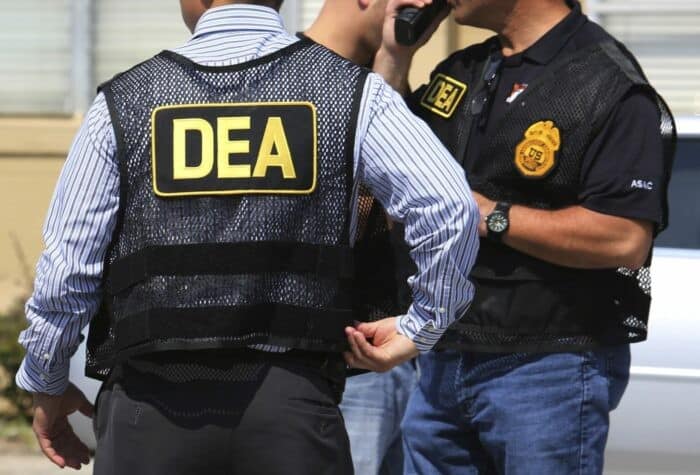
Costa Rica is expanding its cooperation with the United States Drug Enforcement Administration (DEA) to investigate suspected drug traffickers operating behind legitimate businesses and professional careers, including people with political connections. Attorney General Carlo Díaz said the next phase of joint investigations will focus on individuals who have managed to avoid the attention traditionally directed at organized crime groups despite allegedly maintaining direct connections to the drug trade.
Díaz outlined the strategy in an interview published yesterday just days after Costa Rica’s Supreme Court unanimously reelected him to another four-year term as the top prosecutor. The new approach targets what investigators call invisible drug traffickers, people who may appear to be successful business owners, respected professionals or influential political figures but are suspected of helping criminal organizations operate behind the scenes.
Unlike the armed groups responsible for much of Costa Rica’s drug-related violence, these individuals may have no obvious connection to criminal activity. Investigators believe some use legitimate businesses, professional relationships and positions of influence to help criminal organizations move money, establish connections or avoid detection.
The attorney general said the first phase of cooperation with the DEA concentrated on identifying and arresting leaders of criminal organizations, including individuals wanted by authorities in the United States. That work has already produced several high-profile arrests and extraditions.
Costa Rica has extradited six of its citizens to the United States under constitutional changes allowing nationals to be sent abroad to face certain criminal charges. Another 25 extradition proceedings are currently underway, according to Díaz. The change in extradition rules marked a major shift for Costa Rica, which previously prohibited the extradition of its own citizens.
Among those extradited were former magistrate and security minister Celso Gamboa and Edwin López Vega, known as Pecho de Rata, who was identified by investigators as a major figure in an international drug-trafficking network. The next phase of the investigation is expected to reach people who allegedly helped organizations such as these operate while maintaining the appearance of legitimate business or political activity.
One case attracting attention involves businessman Guobin Tam Zhang, also known as Juan Carlos Tam, who was arrested earlier this month following an investigation involving Costa Rican authorities and the DEA. Authorities have described Tam as a high-profile suspect with alleged links to international criminal organizations. Investigators have also examined his connections with influential people in Costa Rica.
Díaz has emphasized that knowing or appearing publicly with a person under investigation does not, by itself, establish criminal wrongdoing. The prosecutor says investigators will follow the evidence regardless of whether suspects hold prominent positions in business, government or other institutions.
The expanded cooperation comes as Costa Rica faces growing pressure to control organized crime and violence connected to international drug trafficking. Costa Rica has become an important transit point for cocaine moving from South America toward the United States and Europe. Criminal organizations use maritime routes, ports and other transportation networks to move illegal shipments through Central America.
As trafficking operations have expanded, competition between criminal groups has contributed to violence in several parts of Costa Rica. It recorded 906 homicides in 2023, the highest annual total in its history at that time, with a rate of 17.2 killings per 100,000 residents.
The violence has put additional pressure on police, prosecutors and government officials to strengthen investigations and prevent criminal organizations from gaining influence in local communities and public institutions. Díaz believes Costa Rica must look beyond the people directly transporting or selling drugs and focus more attention on those who provide financial assistance, connections and other support.
The strategy also comes during a period of tension between Costa Rica’s judicial system and the administration of President Laura Fernández. Díaz has repeatedly criticized efforts he believes could weaken judicial independence or reduce the resources available to investigate serious crimes.
He said DEA representatives have expressed concern about political and institutional divisions in Costa Rica, warning that disagreements between government institutions can make the fight against organized crime more difficult. Despite those disagreements, both the government and the Public Prosecutor’s Office support continued cooperation with U.S. law enforcement agencies.
Fernández has strengthened Costa Rica’s security relationship with Washington and supported regional initiatives intended to combat drug trafficking and organized crime. However, Díaz has rejected the president’s suggestion that Costa Rica could benefit from having U.S. military forces operate inside Costa Rica.
He argues that Costa Rica’s own police and investigative agencies can confront criminal organizations if they receive sufficient funding, equipment and institutional support. The attorney general has also questioned whether the government’s new high-security prison, modeled partly on El Salvador’s approach to organized crime, will produce lasting improvements in public safety.
While Díaz acknowledges that additional prison space could help relieve overcrowding, he argues that building larger prisons will not address the financial and institutional networks that allow criminal organizations to continue operating. Costa Rica’s recently completed high-security facility has space for approximately 5,100 inmates and forms part of the government’s broader response to rising crime.
For Díaz, the next challenge is identifying the people who remain outside prison walls but allegedly help criminal organizations maintain their influence. The expanded investigations could bring additional arrests and extradition requests, although authorities have not publicly identified the full list of individuals being investigated or announced when further operations might take place.
Díaz’s message is that Costa Rica’s fight against drug trafficking will no longer concentrate solely on the people transporting cocaine or directing criminal groups. Investigators are increasingly turning their attention to the money, businesses and influential connections that allow those organizations to operate.





