

More than 50 small earthquakes struck the area around Irazú Volcano this morning, but seismologists say the activity points to movement along a shallow fault rather than a volcano waking up. The Volcanological and Seismological Observatory of Costa Rica (OVSICORI) at the National University recorded the swarm between about 6:30 a.m. and 11 a.m. Seismologist Marino Protti said the observatory had pinpointed the location of 33 of the quakes by 9:30 a.m., and all of them were shallower than 3 kilometers (1.9 miles).
Protti said the earthquakes were lined up along a northwest-to-southeast direction. Most were concentrated around Llano Grande, Tierra Blanca and San Juan de Chicuá, farming communities on the Cartago side of the volcano along the main road to the summit. The strongest event was registered automatically by OVSICORI at 6:56 a.m. with a preliminary magnitude of 3.1. Its epicenter was about 0.7 kilometers (0.4 miles) southeast of San Juan de Chicuá in Oreamuno.
The National Seismological Network (RSN) separately reported five early quakes between 6:36 a.m. and 7:58 a.m., with magnitudes between 2.4 and 2.7. At least three of the earthquakes were felt by residents of nearby communities. The rest were too small for most people to notice.
A seismic swarm is a cluster of many small earthquakes in the same area over a short period of time. Unlike a typical earthquake sequence, where one large quake is followed by a series of smaller, fading aftershocks, a swarm has no single dominant event. The quakes tend to be similar in size and can continue for hours or days before stopping.
Swarms can have different causes. In volcanic areas, they can sometimes signal magma moving underground. They can also be caused by ordinary stress releasing along faults, which is what OVSICORI believes happened on Sunday. Protti said the activity is not related to the behavior of Irazú itself but to a shallow tectonic fault that runs through the volcanic massif. He noted that similar swarms have occurred in the same area before, including a significant one after the magnitude 7.7 Valle de La Estrella earthquake of April 1991, known here in Costa Rica as the Limón earthquake.
The alignment of the quakes also fits that explanation. Earthquakes that line up along a clear direction, at very shallow depths, are consistent with movement on a fault plane. When volcanologists assess whether a volcano is heading toward an eruption, they generally look at more than earthquake counts. Changes in gas emissions, swelling of the ground, rising temperatures in crater lakes and specific types of volcanic tremor all factor into the picture. Nothing OVSICORI reported on Sunday pointed to that kind of activity at Irazú.
At 3,432 meters (11,260 feet), Irazú is Costa Rica’s highest volcano and one of its most visited national parks. Its last major eruptive period ran from 1963 to 1965, when ash fell across the Central Valley, and a smaller steam-driven explosion occurred in December 1994. Scientists have recorded occasional earthquake swarms under the massif for decades.
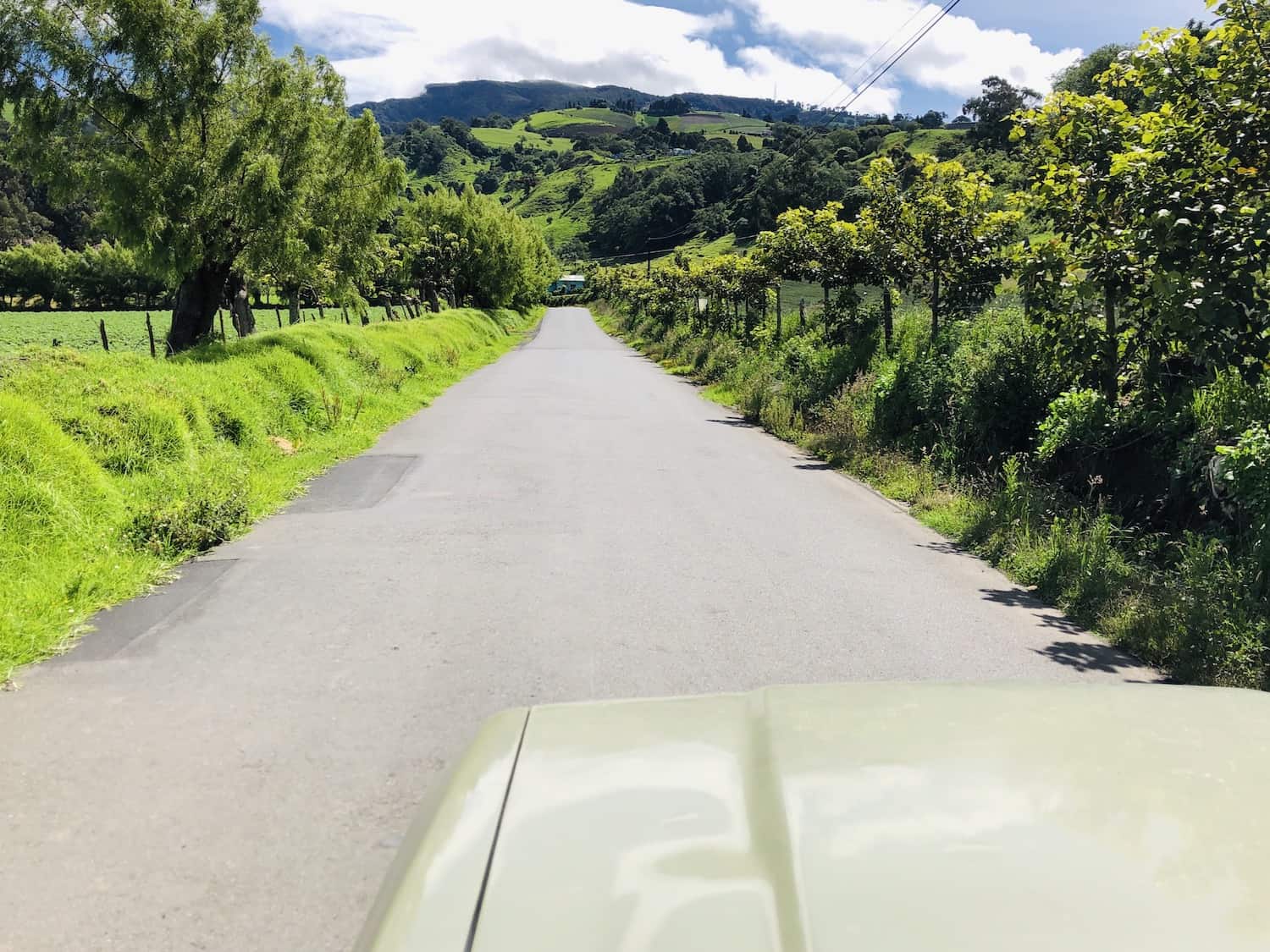
If you were planning to visit Irazú in the coming days, the earthquakes are not the main issue. The road is. A landslide hit Route 219, the main road from Cartago to the volcano, around 5:30 p.m. Saturday after heavy afternoon rain, temporarily cutting off about 30 people. The Costa Rican Red Cross said Sunday that 24 people, including three children, were in a safe area and none needed hospital treatment. Crews from the Public Works and Transport Ministry (MOPT) were expected to bring in heavy machinery on Sunday to clear the road.
Route 417, which connects through La Pastora, has been recommended as an alternative while work continues. Check road conditions and the park’s operating status before you leave, because saturated soil on steep mountain slopes can trigger new slides even after the rain stops.
OVSICORI said it continues to monitor the area. Swarms like Sunday’s often end on their own, though additional small quakes are possible in the coming hours as the fault settles. Costa Rica sits where several tectonic plates meet, and records thousands of earthquakes each year, most of them too small to feel. Irazú, like the other active volcanoes, remains under constant monitoring by OVSICORI and the RSN.





