

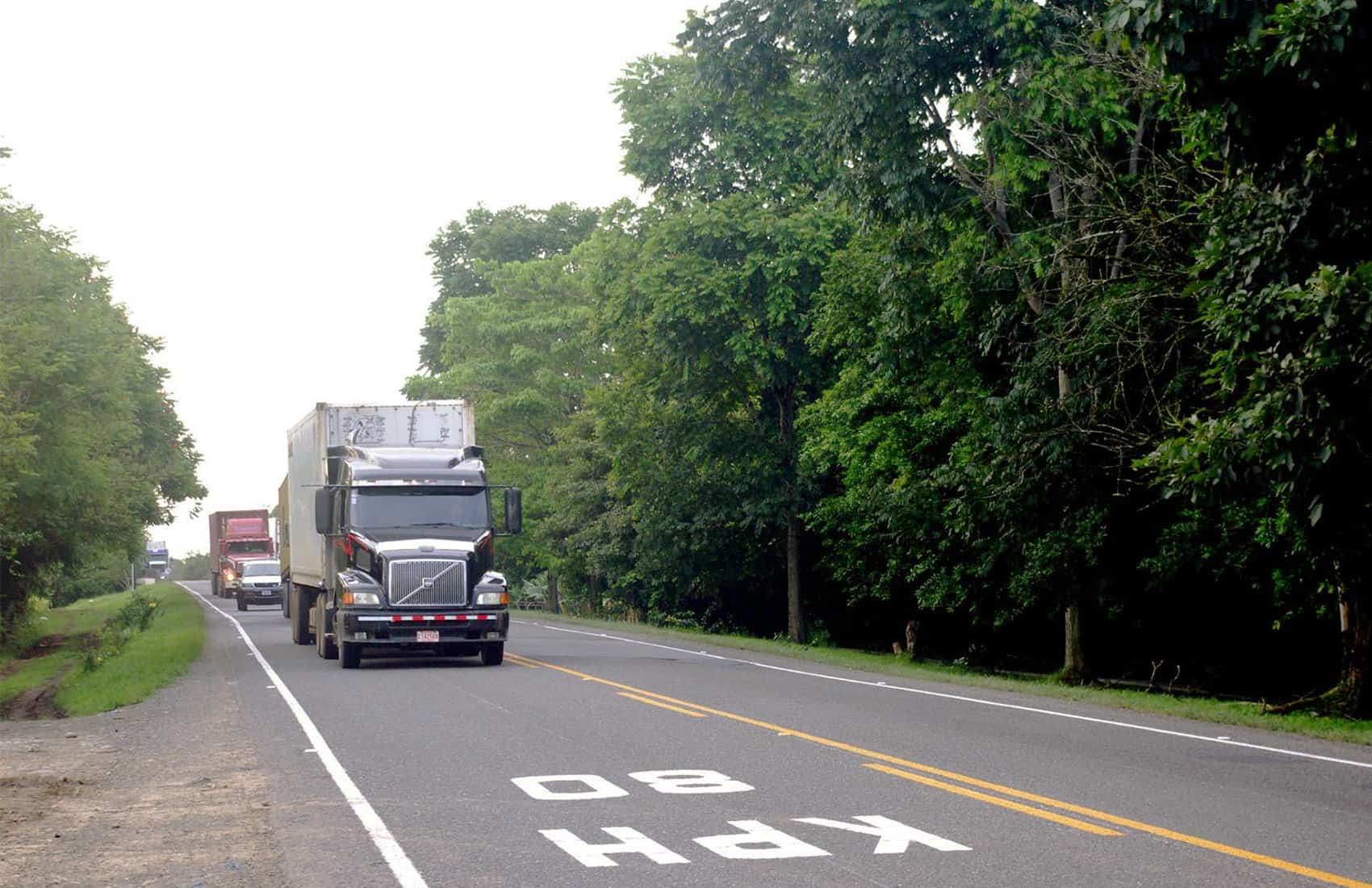
Costa Rica’s Comptroller General has ordered highway authorities to address safety problems on Route 32 after finding that seven roundabouts on the key Caribbean highway were originally designed for trucks substantially shorter than many of the vehicles that use the road. The Comptroller General of the Republic ordered the National Road Council (CONAVI), to take immediate action on the section of Route 32 between the Route 4 intersection near Sarapiquí and Limón.
The investigation found that the seven roundabouts were designed using a 16.8-meter, or 55-foot, tractor-trailer as the standard vehicle for determining how much turning space was needed. Transportation officials said the designs should instead have allowed for trucks as long as 22.4 meters, or about 73 feet, given the heavy commercial traffic moving between Costa Rica’s Central Valley and the Caribbean ports.
Correcting the original designs has already generated more than $1.4 million in additional costs, according to the Comptroller. That comes on top of approximately $5.4 million spent to construct six of the roundabouts. The difference in truck size was not simply a technical issue.
The Comptroller said the original designs created potential risks that included trucks entering neighboring or opposing lanes, collisions caused by differences in speed, heavy vehicles overturning and trucks encroaching on areas intended for pedestrians and cyclists. Government data cited during the investigation showed how common oversized trucks are on the highway. In 2025, 9,816 heavy vehicles passing the Búfalo weigh station measured more than 20 meters long.
Of those, 3,463 were between 22 and 25.68 meters. Route 32 is one of Costa Rica’s most important highways and it connects the Central Valley with Limón and the Caribbean ports at Moín, making it a major corridor for container trucks as well as residents and tourists traveling to destinations along the Caribbean coast.
The roundabouts became part of the highway expansion after permanent structures planned for several intersections were replaced with less expensive temporary solutions. In June 2024, modifications to the construction contract replaced nine permanent structures, including three interchanges and six overpasses, with seven roundabouts and two ground-level right-turn accesses.
The Comptroller said CONAVI failed to establish a clear timetable for replacing those temporary works with permanent structures. Safety concerns had already been raised before the latest order. The University of Costa Rica’s National Laboratory of Materials and Structural Models (LanammeUCR), warned beginning in 2024 that some of the roundabouts had turning areas too tight for the larger trucks commonly traveling Route 32.
Inspections and drone flights showed heavy vehicles using shoulders, entering neighboring lanes and driving across green areas at roundabouts including La Unión and La Herediana. The Constitutional Chamber also intervened in 2025, ordering transportation authorities to implement technical recommendations addressing safety concerns on the highway.
The Comptroller’s investigation went beyond the roundabouts. It also questioned decisions involving land expropriations, project documentation and the lack of technical support for some changes made during construction. Authorities were ordered to determine which properties are still required for the project and to improve recordkeeping so future decisions can be properly documented.
CONAVI must also prepare a road map showing how temporary intersections will eventually be replaced by permanent solutions. The latest order comes as the government has already begun moving toward eliminating the roundabouts. President Laura Fernández announced in late August that her administration intends to replace the roundabouts with 10 grade-separated interchanges on Route 32, arguing that the traffic circles are not appropriate for a highway carrying large volumes of heavy freight.
The government has said the replacements will be developed gradually over the coming years. For motorists using Route 32, however, the Comptroller’s order means authorities must address existing safety risks rather than simply wait for future interchanges to be built. The wider Route 32 expansion has faced years of delays, design changes and unfinished work since construction began in 2017.
A separate LanammeUCR audit released in August identified 157 pending works along the corridor, along with problems involving drainage, road signs, slopes, construction materials and supervision. The new Comptroller order adds further pressure on transportation authorities to resolve problems on a highway that remains vital to both Costa Rica’s economy and travel to the Caribbean.





