

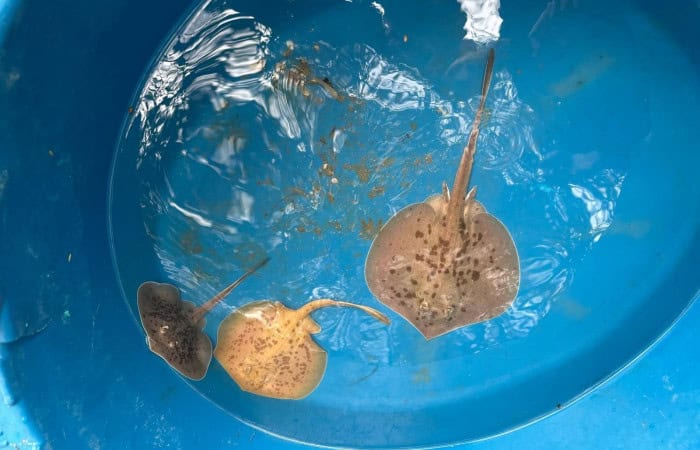
A small ray the color of a gold coin turned up in shallow water off Guanacaste, and researchers say nothing like it has ever been recorded in its family. The animal was a juvenile female blotched round ray, a common bottom-dwelling species along Costa Rica’s Pacific coast. Rays of this kind are normally sandy brown with dark spots scattered across the disc. This one was a deep, saturated yellow.
The condition is called xanthism, and it works in a way that is easier to picture than the name suggests. Ray skin carries different types of pigment cells stacked together. When the cells that produce dark pigment fail to develop, the yellow ones underneath are no longer masked, and the animal comes out gold. The dark spots on this individual survived, which is why researchers describe the case as partial. That detail turned out to matter later.
The ray was caught and photographed twice at Playa Manzanillo, near the community of El Jobo in La Cruz, during a monitoring program run since 2018 by the Costa Rican conservation group Equipo Tora Carey. The first finding was in February and the second came in April.
At the first capture the ray measured 22 centimeters (8.7 inches) long, 13 centimeters (5.1 inches) across the disc, and weighed 25 grams, roughly the weight of a AA battery. Two months later it had grown to 23.9 centimeters (9.4 inches) long and 13.9 centimeters (5.5 inches) across.
No tag was ever attached to the animal. Instead, the team matched the pattern of dark spots on its back between the two sets of photographs, the same way researchers identify individual whales by tail markings. The spots functioned as a fingerprint. That second sighting is the scientifically useful part. Bright coloring is normally a liability for a small fish, since it makes it easier for predators to spot against the seafloor and can hurt its chances of finding a mate.
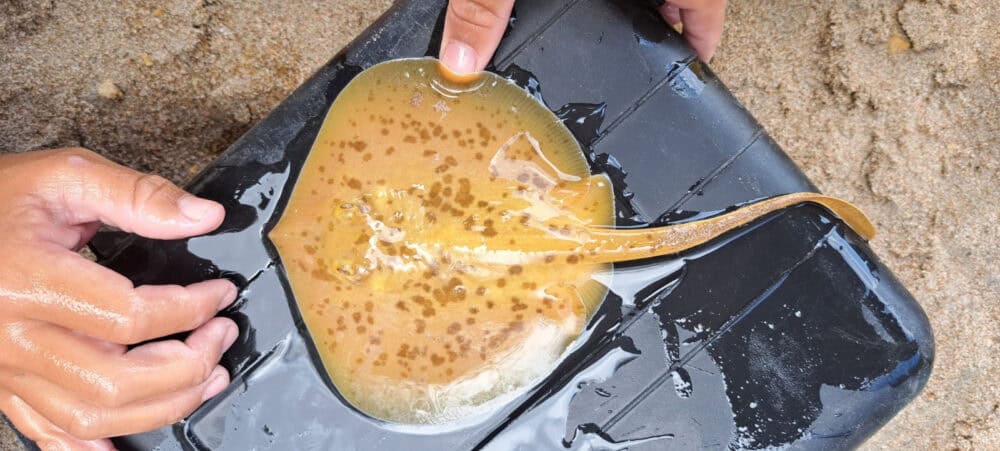
Finding the same animal alive, feeding and measurably larger two months on suggests the color was not costing it much, at least in the short term. Round rays also bury themselves in sand, which may hide the problem entirely. How rare this is takes some context. There are roughly 1,250 known species of sharks and rays worldwide. Xanthism has been documented in only seven of them. Within the order that includes stingrays, there was exactly one previous case, a common stingray in the Atlantic.
None had ever been reported from the Eastern Tropical Pacific, the stretch of ocean running from Mexico down past Costa Rica to South America. Costa Rica had a single prior record of a yellow shark or ray of any kind, a nurse shark on the Caribbean side. The researchers, from the Costa Rican organization Oceanic Alliance, Equipo Tora Carey and the University of Costa Rica, are careful about what caused it. Genetic mutation is one possibility.
So are diet, hormonal imbalance, and problems during gestation, since these rays carry their young internally and a nutrient shortfall can leave lasting marks on a pup. Pollution is the fourth possibility, and it is the one the authors spend the most time on. Heavy metals and pesticides in seafloor sediment have been linked to mutations and developmental disorders in fish elsewhere. Bottom-dwelling species are especially exposed, because they rest in that sediment and eat the animals living in it.
Playa Manzanillo is not a pristine site and the team notes that trash and discarded fish waste from fishing activity are regularly seen along the beach. They also report that this stretch of coast has produced an unusually high number of deformed rays in recent years, mostly eye abnormalities, in this species and in others.
The paper stops short of connecting those two facts. It calls instead for environmental testing to find out whether they are related, which is a fair reading of what the evidence currently supports. The findings appear in the Revista de Biología Tropical, published by the University of Costa Rica, in a special issue devoted to the marine biodiversity of the Guanacaste Conservation Area.
The work forms part of BioMar-ACG, a long-running effort to inventory marine life in the region. A tissue sample taken during the second capture has gone for genetic sequencing. Where the ray is now, nobody knows. It has not been seen since April 2025, and the authors note that juvenile fish sometimes change color as they mature, so it may not even be gold anymore.
What the case does show is the value of showing up in the same place year after year. A monitoring program that has been running on one beach since 2018 caught something that exists nowhere else in the scientific record, twice, and had the photographs to prove it was the same animal both times.





