
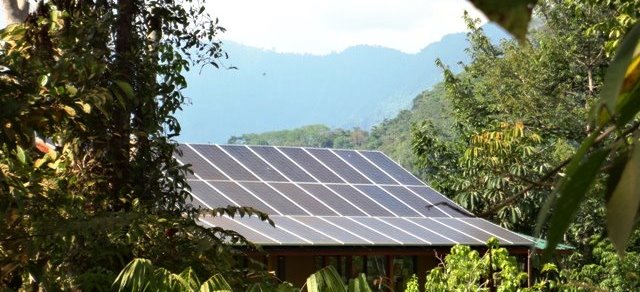
Costa Rica has some of the best solar radiation conditions anywhere in the world and already runs on nearly 100 percent renewable electricity. Yet solar power contributes less than one percent of the national grid, a gap that has little to do with sunshine and everything to do with law.
The Costa Rican Electricity Institute, known as ICE, has held a legal monopoly over the commercialization of electricity since 1949, and it remains in force today. Private generators face a hard ceiling, limited to 30 percent of total generation capacity, with foreign investment inside that private share separately capped at 65 percent.
Any generation project larger than five megawatts must connect through ICE’s own transmission network and receive ICE’s authorization, since ICE owns every transmission line in the country and is the only entity permitted to trade electricity in the regional market. Private companies are, in effect, limited to generation only, and are mandated to sell their output exclusively to ICE, competing for contracts through ICE’s own tendering process, which sets both the quantity and terms of what it will buy.
Homeowners fare somewhat better, though the constraints remain real. Costa Ricans who install rooftop solar can sell excess power back to the grid under net metering rules, but those rules include a limit that has puzzled energy analysts for years: generate more than 49 percent of what gets fed back into the grid and the utility will not credit the surplus.
One legal analysis of the regulation found no technical grid justification for that specific number, describing it instead as an arbitrary ceiling meant to prevent generation from growing too large. A separate rule caps all private distributed generation on any given circuit at just 15 percent of that circuit’s peak demand, meaning even a popular neighborhood full of enthusiastic solar adopters eventually hits a wall regardless of how much rooftop capacity homeowners want to add.
This is not a new complaint. Costa Rica has cycled through more than a decade of solar policy whiplash: a promising pilot program in 2010 that ran through roughly 300 participants, new fee disputes in 2015 that required renewable energy advocates to fight for workable regulations, a stronger legal framework passed in 2021 that pushed installed distributed capacity past 3,500 active systems and nearly 100 megawatts, and then a fresh round of controversial tariffs in 2023 that slowed the market again just as it was gaining real momentum.
Each round of reform runs into the same structural fact: ICE is simultaneously the dominant generator, the transmission monopoly, and the government body responsible for planning the country’s entire energy expansion, which means the same institution that stands to lose market share from private solar growth is also the one deciding how much room to leave for it.
That structural conflict is precisely why international investors are watching a bill currently before Costa Rica’s Legislative Assembly that would restructure the electricity market itself. The proposal would create a new National Electricity Market and hand coordination to a newly created body operating under the environment ministry and the national utility regulator, a shift toward the kind of separation between generation, transmission, and retail supply that international economic reviewers have recommended for years, arguing it would spur the innovation, customer responsiveness, and lower prices seen in countries that have taken similar steps.
If enacted in anything resembling its current form, the bill would open the door to direct power purchase agreements between private generators and large consumers, the exact mechanism that has driven utility scale solar booms elsewhere in Latin America, from Chile to Colombia to increasingly Mexico.
But the reform is now in serious jeopardy. The National Liberation Party, whose own lawmakers helped shape the current bill text during the prior legislative session, reversed course this year and pulled its support, arguing the proposal would weaken ICE, break the long standing solidarity principle underpinning Costa Rica’s electricity model, and benefit large consumers at the expense of households and small businesses.
The party says it will introduce its own competing energy security bill instead, aimed at preventing rationing and speeding up renewable generation without the deeper market restructuring the original bill proposed. The dispute has taken on added urgency after Panama recently suspended electricity sales to Costa Rica amid a trade disagreement, even though ICE maintains the country currently has enough supply to meet demand without those contracts.
The reversal lands against a broader backdrop of renewed investor optimism about Costa Rica generally. A new legislature took office this year with early momentum behind a pro-growth agenda, and some emerging markets analysts see a real possibility of Costa Rica reaching investment grade credit status if political fragmentation eases and reform momentum holds, a shift that would mark a meaningful re-rating of the country’s borrowing costs on international markets.
Electricity market liberalization sits near the top of that reform agenda specifically because foreign capital is watching to see whether Costa Rica will finally dismantle the barriers, the generation caps, the foreign ownership limits, the mandatory sale through ICE, that have kept its considerable renewable energy potential, especially solar, so far below what the country’s natural resources would otherwise allow.
None of this is entirely new territory for Costa Rica. The last serious attempt to open ICE’s monopoly, a 2000 package known as the Combo ICE, triggered some of the largest social protests in the country’s modern history and was ultimately withdrawn amid fears of privatization and foreign intrusion into a deeply popular public institution.
That history helps explain why the current reversal carries so much political weight, and why investors continue to treat electricity market reform in Costa Rica as a genuine open question rather than a foregone conclusion, even as the economic case for opening the market, and finally letting Costa Rica’s solar potential compete on equal footing, grows harder to ignore.