

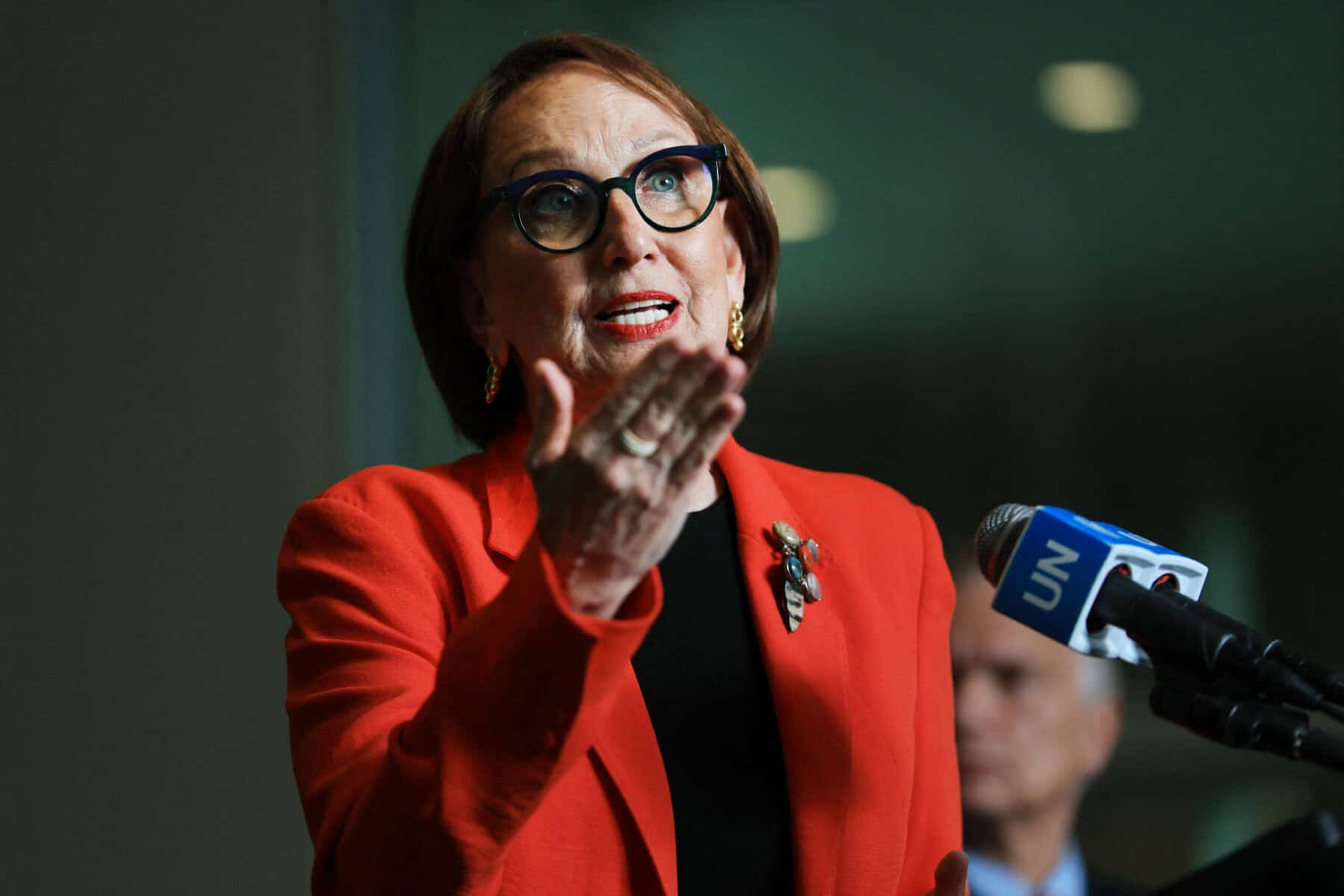
Costa Rican economist and former vice president Rebeca Grynspan has fallen to second place in the race to become the next secretary-general of the United Nations, but the contest remains far from decided. Grynspan received seven votes encouraging her candidacy during the second informal ballot held by the 15-member U.N. Security Council on Friday. She also received four votes discouraging her candidacy, while four council members expressed no opinion.
The results have not been formally released by the United Nations because the vote was secret. The figures were circulated among diplomats and widely reported after the closed-door meeting. Grynspan had led the first informal vote on July 30 with 10 encouraging votes, one discouraging vote and four members expressing no opinion. Her support therefore dropped by three votes during the latest round, while the number opposing her candidacy rose by three.
Carolyn Rodrigues-Birkett of Guyana moved into first place with eight “yes” votes, three “no” votes and four no-opinion. She had received nine “yes” votes in the first round, meaning her support also declined, but not as sharply as Grynspan’s. Argentina’s Rafael Grossi, who leads the U.N. nuclear watchdog, matched Grynspan with seven “yes” votes. However, Grossi received six “no” votes, compared with four for the Costa Rican.
The results do not mean Rodrigues-Birkett has won the position or that Grynspan has been eliminated. These early ballots are meant to show candidates how much support and opposition they have before the Security Council holds a formal vote. Council members mark each candidate as “encourage,” “discourage” or “no opinion.” Several rounds are normally needed before the council reaches an agreement.
To advance, a candidate eventually needs at least nine of the council’s 15 votes. The candidate must also avoid a veto from China, France, Russia, the United Kingdom or the United States, the council’s five permanent members. The ballots used so far do not reveal whether any negative votes came from those five powerful countries. Later votes may use different-colored ballots to show whether a permanent member is blocking a candidate.
That means Grynspan’s four “discouraging “no” votes could become more important as the process continues, but it is currently impossible to determine whether any amount to a potential veto. Eight candidates are competing to replace António Guterres of Portugal, whose second five-year term ends on December 31, 2026. His successor is expected to take office on January 1, 2027.
Grynspan served as Costa Rica’s second vice president from 1994 to 1998 and has led the U.N. Conference on Trade and Development since 2021. She took temporary leave from that position while campaigning for the U.N.’s top job. Costa Rica formally nominated her on March 3. Her campaign focuses on strengthening the U.N.’s role in peace and security, making the organization work more effectively and preparing it for future global challenges.
The eventual candidate must first be recommended by the Security Council and then formally appointed by the 193-member U.N. General Assembly. The process could continue through September or October if council members remain divided.





