

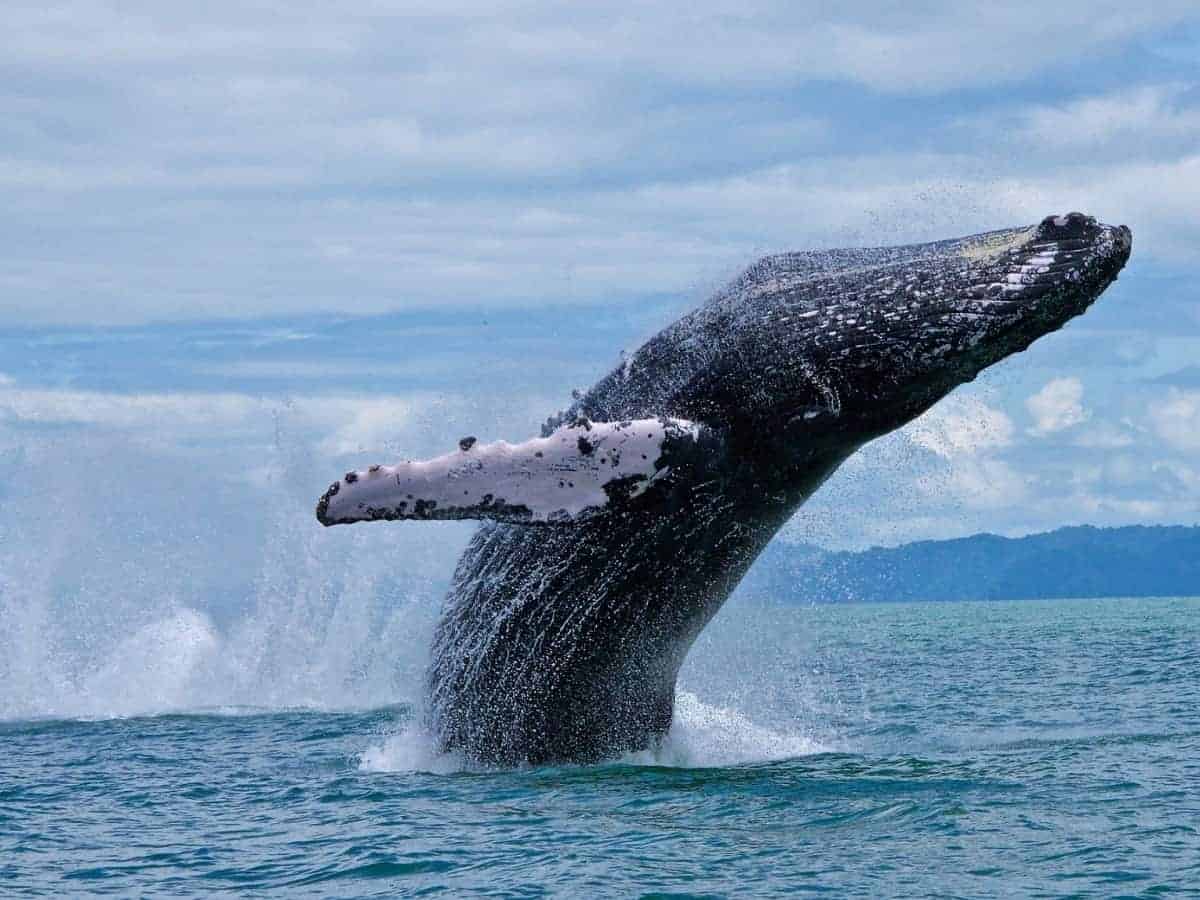
There is one stretch of water on the planet where humpback whales from the far north and the far south both come to give birth, and it sits at the southern tip of Costa Rica. Golfo Dulce, the deep inlet that separates the Osa Peninsula from the mainland, receives mothers that have swum up from the freezing waters off Antarctica and mothers that have come down the Pacific coast of North America. Nowhere else do the two populations overlap. Researchers who worked on a new Costa Rican documentary about the gulf call it the womb of the Pacific.
That documentary, Costa Rica, Cradle of Whales, premiered Wednesday night on Canal 7 as the first episode of a revived nature strand called El Planeta Azul, or The Blue Planet. The full film went online free after broadcast. The production took three years. Camera teams worked in Golfo Dulce and in Bahía Ballena, the bay farther north where the whale watching industry is concentrated, filming in high definition and 4K with drones, underwater cameras and hydrophones to record the animals’ songs. Broadcaster Teletica describes it as the first wildlife documentary produced entirely in house.
Director María Jesús Prada leads the project alongside marine biologist Frank Garita, producer Eddy Vargas and editor Rigoberto Quirós. Biologists were embedded in the production team rather than consulted afterward, and the broadcaster says every factual claim in the film was checked against academic standards before it reached the screen.
“In Costa Rica we are privileged,” Garita said. He described two separate humpback populations that visit the country’s waters across nearly the entire year. The episode follows a mother and her calf through the stages that make the journey so costly. Humpbacks carry one of the longest gestations in the ocean, and a mother arriving in Costa Rican waters has typically not eaten for months. She nurses anyway, at a volume the film quantifies, while teaching her calf to breathe, dive and travel before the two of them turn around and swim back.
The film also takes on questions science has not settled. Humpbacks sing without vocal cords, and the documentary explains the mechanism. Male song changes from season to season across an entire population, and here the film is careful to separate what researchers have measured from what they still cannot explain.
Accounts of the migration itself vary. Material released on premiere day put the journey at more than 8,000 kilometers (about 4,970 miles), while an earlier description gave roughly 9,000 kilometers (about 5,590 miles), and organizers of the annual whale festival in Osa have used a figure of up to 8,400 kilometers (about 5,220 miles). The northern population’s starting point is also described inconsistently, as Alaska in one account and as the coasts of Oregon and California in others.
The timing of the premiere is not accidental. Costa Rica is in the middle of the southern hemisphere season now, which runs roughly from mid-July into November and peaks in August and September. A second season built around northern hemisphere whales opens in December and runs into April, giving the country one of the longest whale watching windows anywhere.
If you want to see them yourself, book a morning departure. Seas are calmest early and the animals are more active, and most tours out of Bahía Uvita run three to four hours, often with a stop at the sandbar that emerges at low tide in the shape of a whale’s tail.
Choose an operator with an environmental permit. The permit exists because boats that crowd or chase a nursing pair can push a calf away from its mother, and a calf that loses contact in open water is in serious trouble. National rules also bar swimmers from entering the water while a cetacean is nearby, for the same reason.
The Whale and Dolphin Festival in Osa, which builds a weekend of boat tours, talks and community events around the peak of the season, is scheduled for early September, with organizers listing the fourth through the sixth. Discounted tours for residents are typically part of the program.
Golfo Dulce itself carries protections that predate the film. It is one of a small number of tropical fjords in the world, and in 2018 the government declared roughly 4,000 hectares (about 9,880 acres) of the northern gulf a no take sanctuary for scalloped hammerhead sharks, the first shark sanctuary in the country. The gulf was named a Mission Blue Hope Spot the following year, and Piedras Blancas National Park protects some 14,000 hectares (about 35,000 acres) of rainforest along its northeastern shore.
The episode is dedicated to Marco Picado Cozza, who pioneered nature programming at the broadcaster and died in 1996. Prada is his niece. El Planeta Azul is scheduled to return every three months with new films on Costa Rican wildlife and ecosystems.
For a place like ours that markets its biodiversity abroad more successfully than almost anywhere, homegrown wildlife filmmaking on this scale has been surprisingly rare. Whether the quarterly schedule holds will say something about how much appetite there is for it.





