

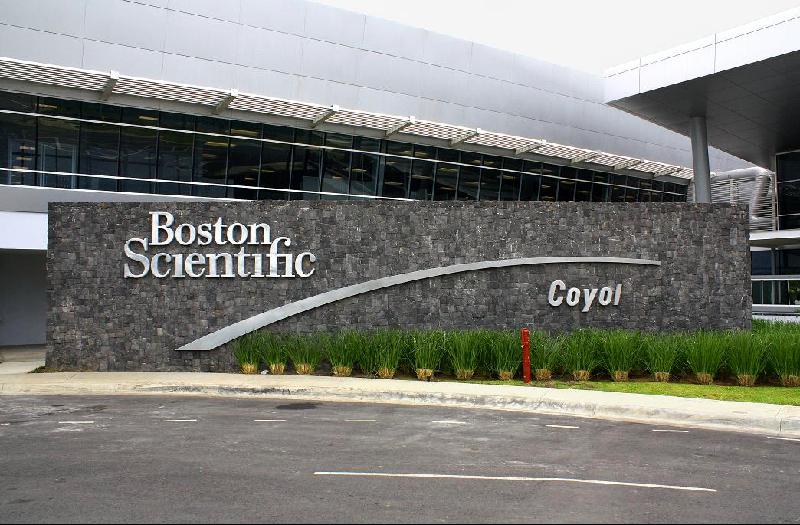
Boston Scientific has confirmed that its Costa Rican operation forms part of a global restructuring program that sets aside as much as $300 million for employee termination benefits, though the company has not disclosed how many workers it will cut in Costa Rica, in which of its local sites, or on what timeline.
The medical device manufacturer’s board of directors approved the plan, which the company calls its 2026 Restructuring Plan, on July 21. It was disclosed publicly six days later in a Form 8-K filing with the United States Securities and Exchange Commission. The filing estimates total pre-tax charges of between $700 million and $800 million, broken down into $300 million to $350 million to move production lines between facilities, $275 million to $300 million in employee termination benefits, and $125 million to $150 million in other costs including consulting fees, contract cancellations, program management and asset write-offs.
Between $600 million and $700 million of the total is expected to result in cash outlays. The company projects the program will reduce gross annual pre-tax expenses by roughly $500 million once its benefits are realized, and says those savings will be reinvested into growth initiatives. The plan began this year and is expected to be substantially complete by the end of 2029.
In the filing, Boston Scientific stated that it anticipates some headcount reductions while continuing to create positions in areas of growth. It provided no figures for total job losses and no country-level breakdown. Asked afterward about the Costa Rican operation, the company confirmed that the country is included in the reorganization but declined to specify numbers or the areas affected. In a written position, Boston Scientific said Costa Rica has been an important part of its global organization for more than 25 years and that it maintains a commitment to its long-term future in the country.
The scale of that operation is substantial by any measure, though the company’s own public figures for its Costa Rican workforce have not been consistent. Boston Scientific has previously stated through its vice president of operations that it employs 10,000 people in Costa Rica, a figure it has also characterized as 16.9 percent of a global workforce of 59,000. In a separate response to questions this week, the company put its local payroll at approximately 12,000 across San José, Alajuela, Cartago and Heredia. The two figures have not been reconciled by the company, and no explanation has been offered for the difference.
Against those numbers stand the commitments Boston Scientific filed with the state. The record of free trade zone benefits granted to the company, published in La Gaceta, shows a projected investment of more than $850 million together with 9,531 direct jobs beginning in January of this year and a further 200 positions by September 2029. Boston Scientific has not confirmed whether it will maintain those projections following the restructuring announcement. Those figures are the terms on which the company received its tax and tariff exemptions, and they represent the clearest public benchmark against which the plan’s local effect can eventually be measured.
Evidence that the cuts have already begun in Costa Rica comes from workers themselves. A research and development engineer who was let go and spoke on condition of anonymity described being notified without warning after three years supporting product review work for one of the company’s local divisions. The engineer said reductions of one to two people had occurred across several different teams and that layoffs of this kind had not previously been seen at the Costa Rican operation, in contrast to the United States. That account has not been independently confirmed by the company or by labor authorities.
The government has acknowledged it does not yet know the domestic impact. Foreign Trade Minister Indiana Trejos said information on Boston Scientific remains in development and that the global plan has not specified its effects in Costa Rica. The administration of President Laura Fernández has announced preliminary measures in response.
The announcement lands on a free trade zone regime already under strain. More than 600 companies operate under the regime, and together they generated 67 percent of the $11.722 billion in goods Costa Rica exported in the first half of 2026. Medical device manufacturers accounted for $5.382 billion of that total, with the United States as the principal destination. Costa Rican exports to the United States now face a 12.5 percent tariff imposed on July 24 following a Section 301 investigation into the enforcement of prohibitions on goods produced with forced labor, a rate higher than the 10 percent applied to Guatemala, Honduras and El Salvador.
Boston Scientific has operated in Costa Rica since 2004, manufactures more than 1,800 types of medical devices in the country and opened an additional plant in Cartago earlier this year. It ranked as the country’s leading medical device exporter in 2024 and the first half of 2025. What remains unknown is the only question that matters locally: how many of those jobs, and which of those plants, fall inside the $300 million the company has now set aside to pay people to leave.





