

Costa Rican investigators say they have identified members of the police forces who allegedly helped the criminal organization led by Alejandro Arias Monge, known as alias “Diablo,” and expect to make additional arrests. Michael Soto, interim director of the Judicial Investigation Agency (OIJ), said the suspected officials provided assistance that made it easier for the criminal network to operate. He did not identify the officers, specify which police agencies they belong to or say how many people are under investigation.
Soto said investigators deliberately postponed action against the suspected police collaborators while they concentrated on locating and capturing Arias, who had become Costa Rica’s most wanted fugitive. “The objective was to arrest them,” Soto said following Operation Némesis, the large-scale raid that ended with Arias’ capture.
He added that investigators expect to provide more information about the suspected police connections soon.The announcement indicates that Friday’s capture may become the starting point for a wider investigation into the support network that allowed Arias and his associates to avoid arrest and operate across several parts of Costa Rica.
Investigators recovered a significant number of cellphones from the house in San Bernardino de Sarapiquí where Arias was hiding. Some were damaged during the prolonged exchange of gunfire, but Soto said authorities still obtained important electronic evidence that will be examined for information about the organization and those who assisted it.
Attorney General Carlo Díaz separately said Arias told officers after his surrender that he had control over some members of the Fuerza Pública, Costa Rica’s national police force. The claim made by Arias does not by itself prove that any officer committed a crime, but it came as the OIJ confirmed that police personnel were already part of its broader investigation.
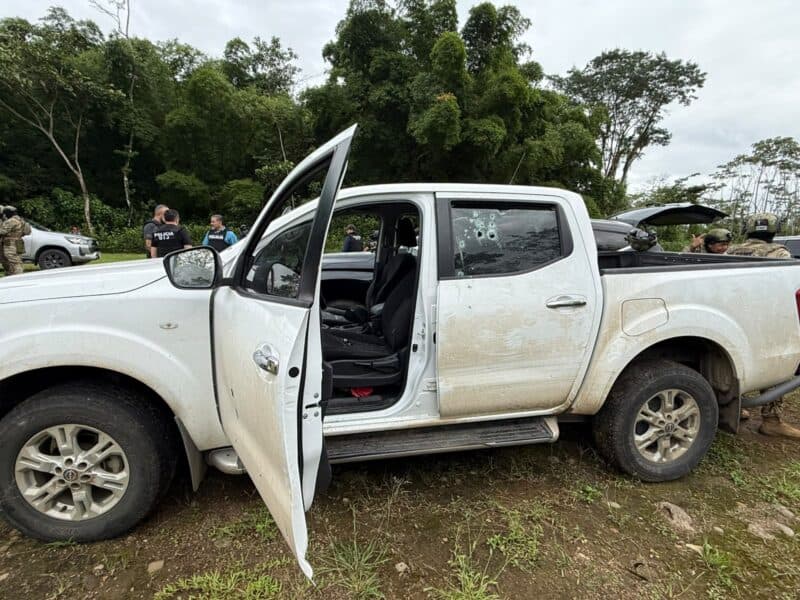
Operation Némesis began at approximately 5 a.m. Friday when heavily armed tactical officers entered the Sarapiquí property. The confrontation lasted between 45 and 50 minutes and left roughly 2,500 bullet impacts inside and around the house.
Eight OIJ agents were reported injured. Arias and Jonathan Pérez Méndez, known as alias “Tan,” eventually surrendered. Ronnie José Ríos Oconitrillo, alias “Coco Guácimo,” was killed after authorities said he continued firing at officers. Investigators also recovered high-powered rifles, pistols, drones and approximately 2,750 unused rounds of ammunition.
The OIJ says the criminal organizations associated with Arias, Pérez and Ríos are connected to approximately 360 homicides across Costa Rica. Soto stressed that the figure refers to crimes linked to the wider organizations, not accusations that the three men personally committed every killing.
Authorities say the groups maintained influence over drug trafficking, weapons, contraband and violent crime in communities including Pococí, Sarapiquí, Guácimo, Batán, Valle La Estrella, Liberia, Nicoya, Cañas, Quepos, Parrita, Garabito and parts of the Southern Zone. Some of the homicide investigations have resulted in arrests, while others remain open.
Arias and Pérez were transferred Friday night to the maximum-security section of La Reforma prison. The Justice Ministry placed them in separate cells under permanent surveillance and prohibited family visits, personal telephone calls and physical contact during meetings with attorneys. Authorities also plan to request virtual court hearings to reduce the risks associated with transporting the two suspects outside the prison.
The expected arrests of police personnel would mark a new phase in the case. For investigators, the next task is no longer limited to prosecuting the alleged leaders of the organization. It also involves determining who helped them remain hidden, move throughout the country and continue operating while under an intensive nationwide search.





