
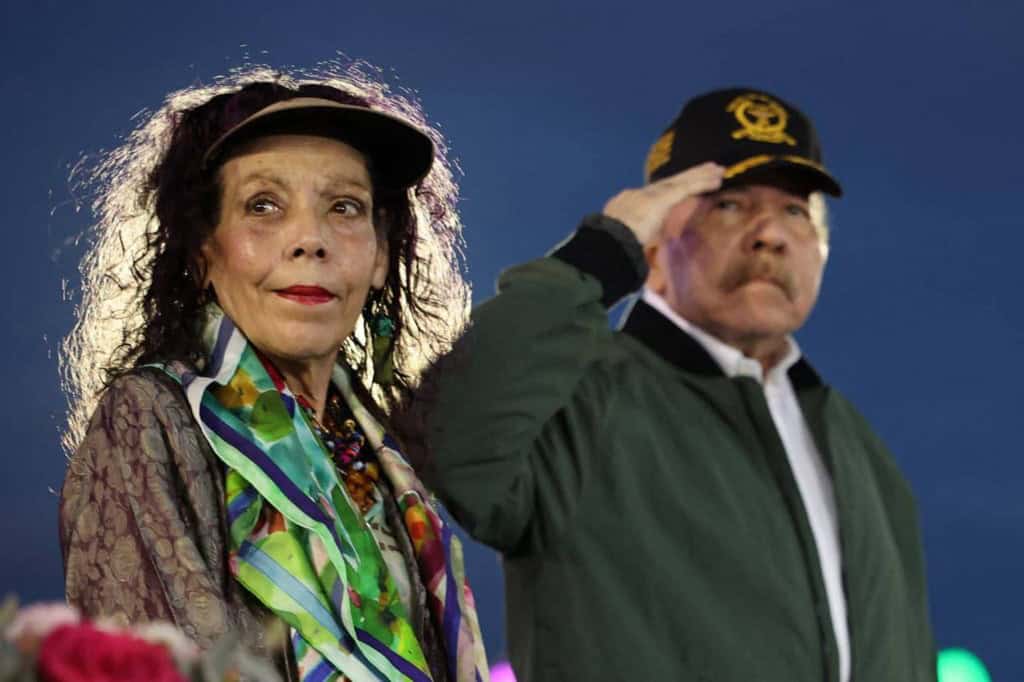
The United States warned Tuesday that it would not stand “idly by” after President Daniel Ortega announced that Nicaragua would no longer hold elections, raising fears that the country is moving toward a one-party system. Ortega, a former leftist guerrilla who has been in power for nearly two decades, made the announcement Sunday as opposition groups in exile expressed hope that pressure from the United States and other countries could lead to a political transition or free elections.
Nicaragua’s National Assembly said Tuesday that it had begun “analyzing” reforms to comply with the president’s “directives.” President Donald Trump and the international community “will not stand idly by while the dictatorship deepens repression and creates instability that threatens the national security” of the United States, Secretary of State Marco Rubio warned.
“Abolishing” elections “shows their cowardice and fear of the will of the Nicaraguan people,” he added. Ortega and his wife, Rosario Murillo, rule with absolute power and crushed the domestic opposition following mass protests in 2018 that left about 300 people dead. The couple described the demonstrations as a U.S.-backed coup attempt.
Washington has imposed sanctions on the Nicaraguan government, including visa restrictions on more than 2,350 officials and their relatives, but it has stopped short of applying the same level of pressure used against Cuba, whose economy is nearing collapse. Following a constitutional reform approved in late 2024 that extended the presidential term from five to six years and elevated Murillo to the position of co-president, Nicaragua was expected to hold general elections in 2027.
But Ortega, 80, warned Sunday during the 47th anniversary of the Sandinista revolution that “there will never again be elections in Nicaragua” in which “parties installed by the Yankees,” referring to the United States, could take power. His announcement was also rejected by Organization of American States Secretary General Albert Ramdin, who said, “the regime has abandoned democracy,” and by the Costa Rican government, which recalled its ambassador in Managua for consultations.
One-Party Rule
In the most recent elections, held in November 2021 after opposition figures capable of challenging for the presidency were jailed, Ortega won by a wide margin with the Sandinista National Liberation Front, or FSLN, the former guerrilla movement that overthrew dictator Anastasio Somoza in July 1979.
The constitutional reform defined Nicaragua as a “revolutionary” and “socialist” state and elevated the FSLN’s red-and-black flag to the status of a national symbol.
Opposition leaders interviewed agreed that Ortega’s announcement reflects his fear of losing a competitive election and signals a move toward a system similar to Cuba’s, where the Communist Party is the only legally recognized political party and candidates are nominated by neighborhood assemblies or government-aligned civil organizations.
“Ortega is admitting what worries him most: he has failed to neutralize the opposition. He knows the desire for change remains alive and that the opposition is still challenging him for control of the country,” said Félix Maradiaga, a former presidential hopeful and political prisoner who was stripped of his nationality and now lives in exile in the United States.
“His fear has increased,” said former guerrilla commander and political prisoner Dora María Téllez. She argued that Murillo had “failed in her attempt to draw” some political groups inside the country into an “electoral farce” intended to give the vote a veneer of legitimacy. Juan Sebastián Chamorro, coordinator of a political movement in exile, said Ortega had finally admitted his desire to “turn Nicaragua into a one-party country like China, North Korea and Cuba.”
“Faced with the most closed dictatorship in the hemisphere, every government in the region should push for a transition and open the way for international justice,” said Juanita Goebertus, director of Human Rights Watch’s Americas division. Ortega has been accused by a group of United Nations experts of crimes against humanity.
Opposition activists, intellectuals, journalists and religious leaders have gone into exile, many after serving time in prison. About 450 people have been stripped of their nationality and property. Two weeks ago, the government revoked the work permits of about 2,000 lawyers, according to Nicaraguan media outlets operating in exile.
Opposition figures say Murillo is carrying out an internal purge and is holding about 200 government supporters in prison as she prepares for the possibility of Ortega’s death. Ortega reportedly suffers from lupus and kidney failure.