I probably shouldn’t have done this. That’s what I was thinking as I lay, flat on my back, in the middle of a trail drenched in sweat getting crawled on by ants and bitten by mosquitoes trying to catch my breath.
The idea was a good one. I had a free Saturday and because I love what I do, I wanted to use that time to ‘work’. Though it was related to my job, it wasn’t really work, the plan was to review some camera traps deep in a forest that I hadn’t had time or reason to review for about a month. I happened to have some sort of respiratory infection, but I wasn’t going to let that stop me; besides, these cameras were accessible from a dirt road that I could drive my truck down. I wouldn’t’ do that much walking.
The first tree that had fallen across the road was thin. I got out, chopped it with the machete, drug it out of the way, and continued to the first camera trap. I reviewed the camera and though it had stopped working at some point, seemingly for no reason, it had recorded a few Baird’s tapirs, so it was a decent start.
The next two trees that had fallen across the road were also in the ‘choppable’ category, but before I could even get in the neighborhood of the next camera trap, a tree that most definitely required a chainsaw stopped me in my tracks, forcing me to do some tricky reversing until I found a space wide enough to turn around. This was my first opportunity to go home and, of course, I didn’t take it.
The road was actually a giant loop through the forest, so I could try the other direction of the loop to reach the remaining cameras. Surely this section of road would be clear, and I could spend the rest of my Saturday easily reaching cameras and being delighted by their contents.
After hacking through a vine-covered branch of a massive tree that had fallen on the road, I drove maybe 100 more meters to a tree that wasn’t so big, but I just couldn’t bring myself to continue to chop. This was my second chance to quit and go home, but Mama didn’t raise a quitter, and I still had only reviewed one of my seven cameras, so I ignored my sinuses, threw some extra water in my backpack, left the truck in the road, and started walking.
Fast forward several hours and here I am laying in the middle of path having pushed my sick body a little too far, waiting for my heartrate to go down, telling myself it was worth the effort, this counts as a good day. As I rest, I hear the sound of a large bird’s wings whooshing, and then I hear it again and again. I recognize the sound as coming from vultures. There must be something dead nearby.
I take a big gulp of water, get up, and continue towards the truck. A few meters down the trail, the smell of death smacks me in the face. There’s definitely something dead somewhere. I consider ignoring it and continuing forward, but my curiosity wins out. Even though I work in forests full of predators, I almost never come across the remains of one of their meals, so I leave the road and start hacking through branches and vines, following the stink. It doesn’t take long to find the source of the smell; laying in the underbrush are the remains of a white-tailed deer.
The head was covered in leaves. The abdomen was completely open with almost all of the ribs chewed off and organs missing. The only organ that remained looked to be a big, puffy stomach. I immediately suspected it was the work of a puma. Though it looked a little too decomposed for the owner to come back to eat more, I put a camera trap on a nearby tree and hoped to return to find videos of the big cat returning to the kill.
My first opportunity to return to the site came exactly 14 days later. After leaving the truck at the tree that still blocked the road, I hiked in and found the camera surveilling an empty spot on the forest floor where a dead deer used to be. I started searching the area and eventually found a shoulder blade, then a pile of legs and vertebrae, and a few meters away some more backbone and an antlered skull. Bones were all that remained, and there was no longer a hint of stink in the area.
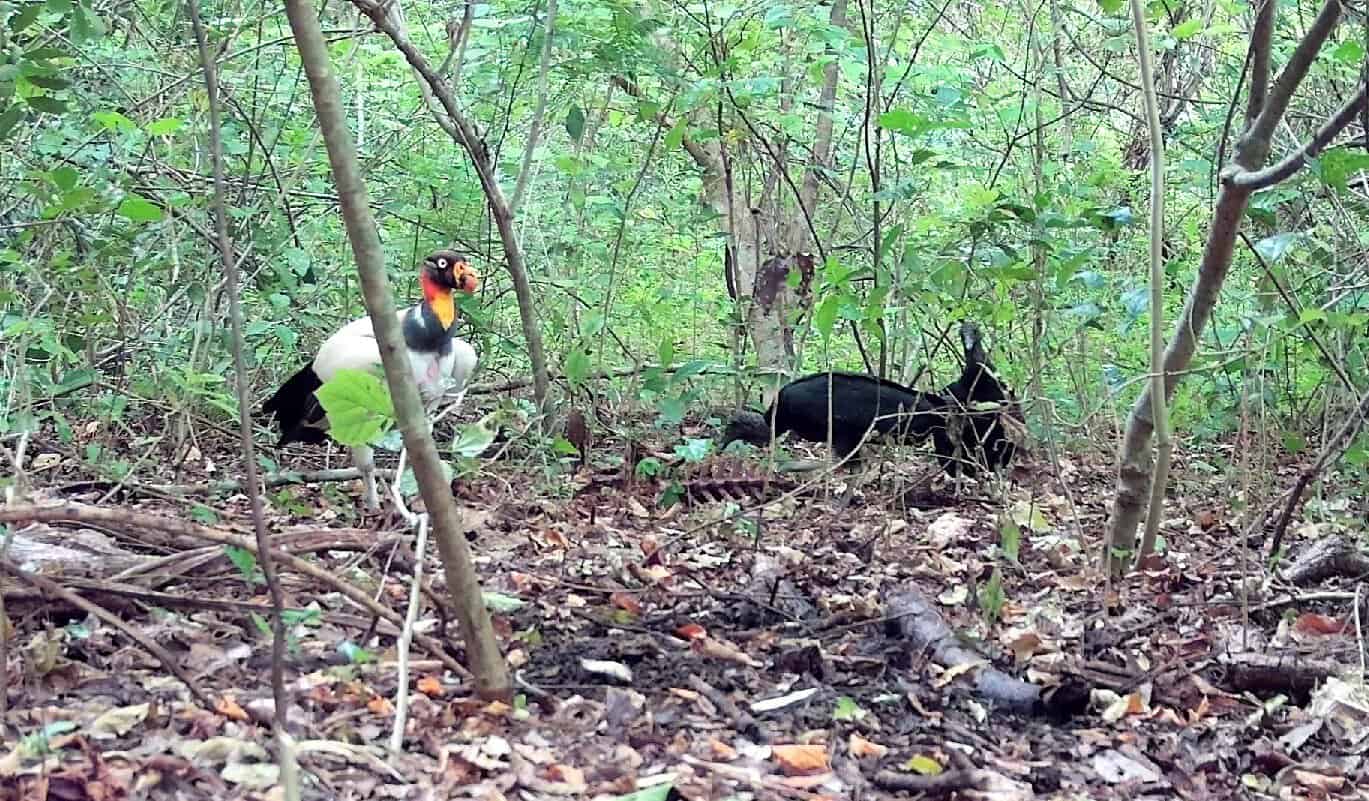
I reviewed the camera and no large predators had returned to the kill site. As I had suspected, I found the deer after the owner had its fill. What I did find was proof of why I so infrequently come across remains in the forest. A team of scavengers that included a huge number of flies and beetles, a coyote, a common opossum, and three species of vultures, including turkey vultures, black vultures, and a beautiful king vulture made quick work consuming everything but some of the bones.
Though I had no video evidence, some research confirmed that it was a puma that had killed the deer. Pumas are known to cover part of their meals in leaves to hide it from other predators, open the abdomen to consume the nutrient rich organs, and ignore the stomach, as spilling its contents would introduce unwanted bacteria into the meat. All of that exactly describes the situation that I had found.
I have no video evidence of the puma, but I do have cellphone footage of the state of the deer when I found it and what it looked like two weeks later, and camera trap videos of all of the scavengers doing their job. If you have a weak stomach or prefer not to see dead things, this video isn’t for you. If you’re interested in seeing how quickly nature recycles an animal after it is taken by a predator, take a look at the video below.
About the Author
Vincent Losasso, founder of Guanacaste Wildlife Monitoring, is a biologist who works with camera traps throughout Costa Rica.