

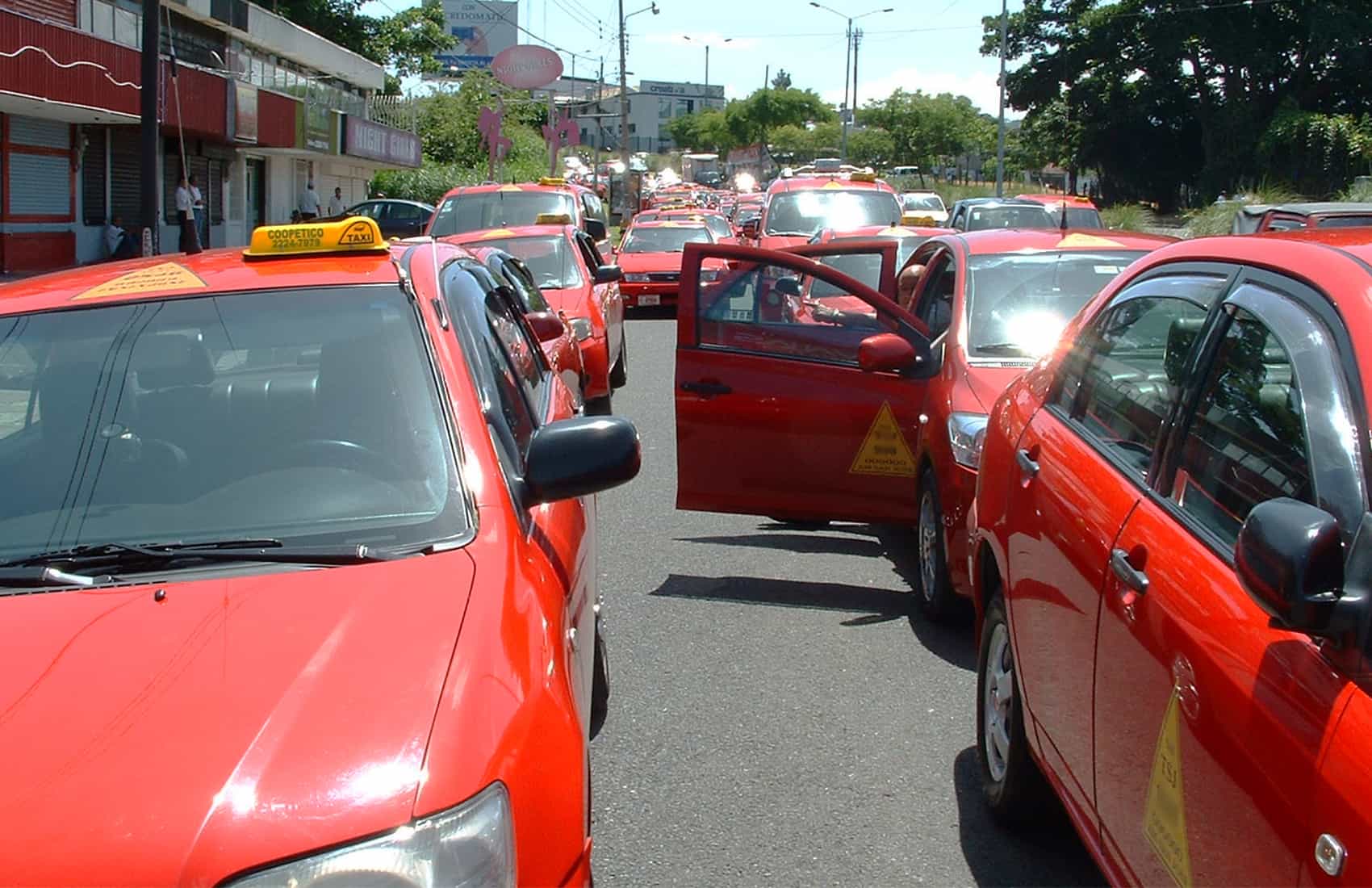
If you have spent any time in Costa Rica, you know the two systems that move people around this country have never spoken to each other. There are the red taxis, licensed, metered and everywhere. And there is Uber, unregulated after more than a decade here, and used by almost everyone anyway. On Monday those two systems started to merge.
Uber opened registration for red taxi drivers who want to take fares through its app, under a new option it is calling Uber Taxi. Nothing changes for you yet. The option is not in the passenger app, and Uber says it will appear in the coming weeks, once it finishes signing drivers up. When it does, you will see red taxis as a choice alongside the ones you already have.
Here is what that will mean in going forward. You will be able to order a licensed red taxi from your phone, see the driver and the car before it arrives, track the trip, and pay through the app. You will not have to flag one down on the street, agree a price through the window, or find out at the end of the ride that the meter was never switched on. If you have avoided red taxis for those reasons, this removes them.
Uber is paying drivers to come across. A driver who registers and activates an account gets ₡20,000, about $44. Completing 20 or more trips in the first two months is worth up to ₡50,000 more, about $110. Referring another taxista who joins and completes at least 50 trips in their first month pays ₡30,000, roughly $66.
The bonuses stack, so a driver who signs up, drives and brings a colleague in can clear about ₡100,000, around $220. To register, a driver needs a C1 license, a current Dekra inspection, vehicle insurance, and the driver code issued by the Consejo de Transporte Público. That last requirement matters to you, because it means the cars appearing under Uber Taxi are the legally licensed ones, not private drivers in a red car.
Laura Santillán, Uber’s general manager for Central America and the Caribbean, said the pitch to drivers is about the hours they currently spend circling the city empty, and about connecting them to the app’s existing base of passengers. Drivers keep control of their day. They decide when to switch the app on and which requests to take, and they can keep working the street the way they do now.
Naturally, not everyone is happy about this. Gilbert Ureña, who represents the Foro Nacional de Taxistas, rejected the announcement. The objection is not really about the app. It is about the fact that Uber has operated here for years without a specific law governing it, while red taxi drivers work under a licensing regime that limits how many of them there are, what they can charge and what condition their cars must be in. A bill to regulate transport platforms is still moving through the Asamblea Legislativa. Until it passes, the two sides are playing by different rules, and this announcement lands in the middle of that argument.
There is a precedent worth knowing about. Uber already lets you request the orange airport taxis at Juan Santamaría, under a pilot that began earlier this year. Those cars operate on special concessions, and there are only about a hundred of them. Red taxis number in the thousands. If the same integration works at that scale, the practical effect for anyone arriving in this country is that the choice between a licensed taxi and a ride-hailing car stops being a choice at all. It becomes a line in the same menu.
For now, nothing on your phone has changed. Order the way you always have. When Uber Taxi does appear, the thing to check is the price. A red taxi under this arrangement is still a red taxi, and the question nobody has answered yet is whether you will be quoted an Uber fare, a metered fare, or something in between.





