
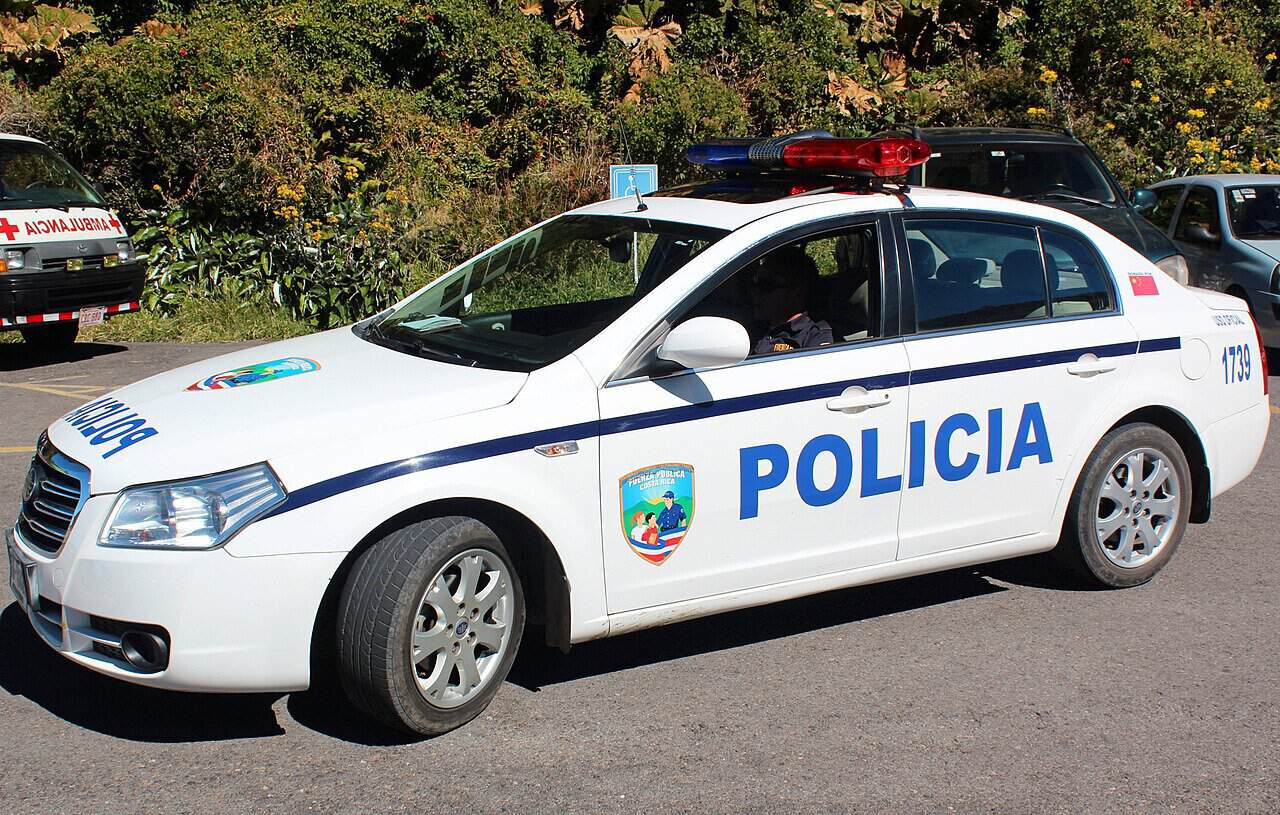
Costa Rica’s public security strategy is running into a basic problem: police do not have enough working vehicles to patrol the country. Security Minister Gerald Campos acknowledged that the Ministry of Public Security has about 1,500 mobile units out of service, while many of the roughly 2,000 vehicles that remain in operation also have mechanical problems.
The shortage affects the Fuerza Pública, Costa Rica’s main national police force, at a time when the country is facing sustained pressure from organized crime, drug trafficking and street violence. Internal ministry transport figures show 1,495 mobile units listed as unavailable because of missing parts, lack of funds, age, vandalism, obsolescence, vehicles reaching the end of their useful life or units already considered scrap. About 92% of those inactive vehicles belong to the Fuerza Pública.
The numbers leave more than 17,000 police officers with just over 2,000 vehicles to cover the country, or roughly one vehicle for every nine officers. The shortage limits the ability of police to respond quickly, move between communities, maintain patrol presence and reinforce high-risk areas when emergencies break out.
Campos said the government is working through several channels to rebuild the fleet. One is an international donation from Japan, which is expected to include Toyota Land Cruiser vehicles. The minister did not specify how many units Costa Rica would receive through that donation.
A second path is a direct purchase of 350 new patrol vehicles. Campos said the ministry had already selected one of two bidders and that the chosen offer represented savings of about $14,000 per vehicle compared with the competing proposal.
The third option is a broader project financed through the Central American Bank for Economic Integration. According to the minister, the government is finalizing plans to add about 1,700 more units, with the goal of reaching roughly 2,100 new cars and motorcycles for police use.
The scale of the problem has built over several years. Between 2022 and 2024, Costa Rica received fewer than 300 new police vehicles, even as the existing fleet continued to age. By comparison, 1,028 vehicles were added between 2018 and 2021, and 1,510 were added between 2014 and 2017.
The shortage is not only a purchasing problem. Between 2022 and 2024, official police vehicles were involved in at least 4,100 traffic accidents. Twenty-six units suffered damage close to a total loss, according to ministry insurance-claims figures. Those accidents also led to more than 6,000 disciplinary proceedings, with 864 sanctions, two dismissals and nearly 1,000 cases that moved into judicial processes.
Budget execution has also come under scrutiny. From 2022 to 2024, the ministry budgeted ₡9.106 billion for maintenance and repairs of the vehicle fleet but spent ₡6.195 billion. A similar gap appeared in the budget for spare parts and accessories, where more than ₡8.053 billion was allocated and just over ₡6 billion was used.
Costa Rica’s police fleet is repaired through the ministry’s own vehicle maintenance shop and through outside workshops contracted under public procurement rules. But officials have repeatedly pointed to the slowness of government purchasing, the difficulty of obtaining parts and the age of the fleet as reasons why vehicles can remain sidelined for long periods.
The shortage comes as President Laura Fernández’s administration has made public security one of its central promises. Fernández took office in May pledging a harder line against organized crime and named Campos, a former justice minister and longtime judicial investigator, to lead the Ministry of Public Security.
For communities already dealing with robberies, drug activity and slow police response, the vehicle deficit puts a practical limit on those promises. More officers, new security laws and tougher rhetoric all still depend on whether police can get to the scene when calls come in.