
On a modified bicycle that serves as a wheelchair, Teodardo Debardet returns home after receiving a humanitarian aid package sent by the United States to victims of Hurricane Melissa, which struck eastern Cuba last year. Despite the oil blockade and the tightening of economic sanctions against Cuba, Washington continues to provide assistance to Melissa’s victims through the Catholic NGO Caritas.
Debardet lives in Hongolosongo, a place near the town of El Cobre, in the eastern province of Santiago de Cuba. The package he has just received contains rice, beans, oil and canned goods, as well as hygiene products and chlorine tablets to purify water. An amputee who lost his legs in a work accident, and with only two fingers on each hand because of an illness, he slowly makes his way toward his wooden house.
The hurricane, which hit Cuba with winds of 195 kph in October 2025, tore off his roof and destroyed his bathroom. Despite the hardships, he feels relieved by the donation. “I am very grateful,” he says.
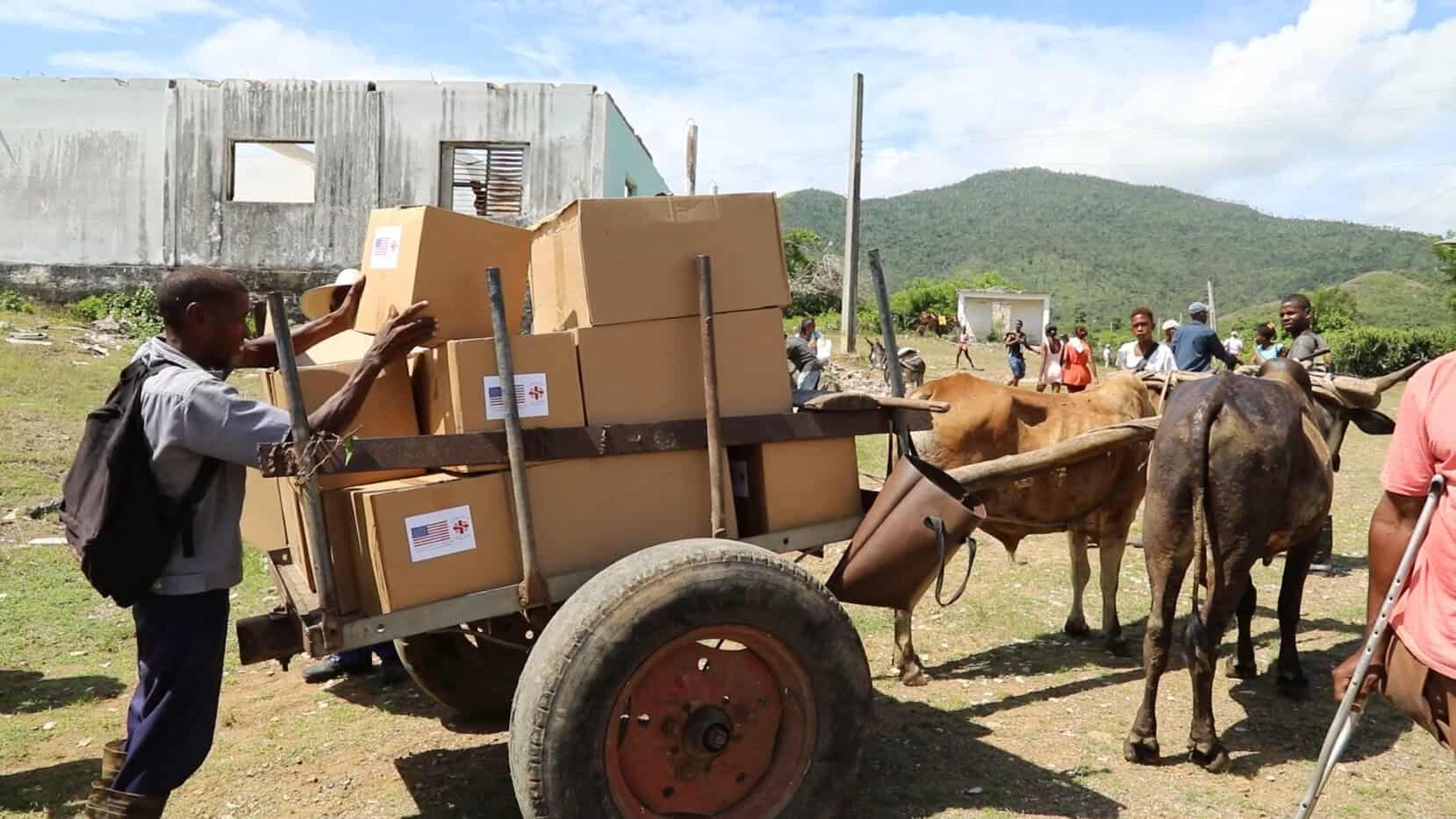
In this rural community of 130 residents, fewer than half of the homes are connected to the electrical grid, and only a minority have access to running water. Many still have not repaired their roofs. Caritas serves as a humanitarian intermediary with Washington, which does not want to deliver the aid directly to the communist government.
The Catholic NGO has already distributed nearly all of the $3 million in aid sent at the beginning of the year, out of a total $9 million pledged. Washington has also proposed an additional $100 million in aid for the island, of which $60 million would be distributed by Caritas and $40 million by other nongovernmental organizations.
Havana has said it is reviewing the offer and its terms, without confirming whether it will accept it. Cuban President Miguel Díaz-Canel has said that lifting the U.S. embargo, in place since 1962, would be more useful than sending humanitarian aid. “It is a little difficult for us because we have to find transportation, get fuel, and see who can take us there,” says Katia Simón, the Caritas coordinator in El Cobre.
When gasoline and diesel are scarce, the cargo is transported by ox cart. It is always well received when it arrives, especially when the NGO accompanies the deliveries with medical consultations, haircuts and recreational activities for children. “We welcome this aid, wherever it comes from. If it is from the people of the United States, that is fine,” says Osmany Vedey, 63.
In the months after the hurricane, the United Nations, the European Union, China, Mexico, Venezuela and other countries in the region sent aid. Facing the same transportation difficulties because of the fuel shortage, the United Nations is continuing its assistance program for hurricane victims.