

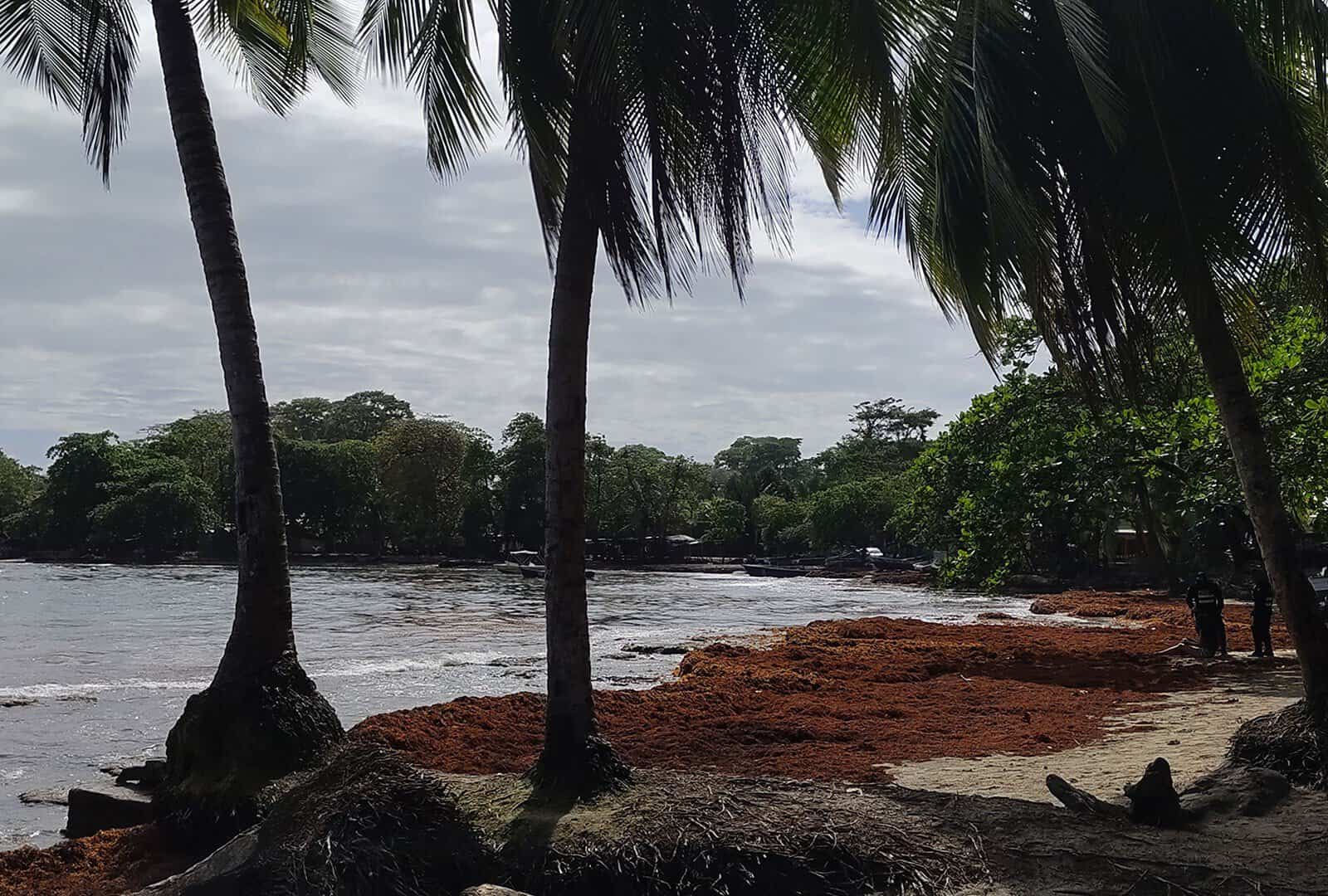
The Center for Marine Science and Limnology Research (Cimar-UCR) reported that sargassum is breaking arrival records in Costa Rica’s Caribbean region. Cimar researchers Cindy Fernández and Mariana Viales explained that this year has seen an unusual season, particularly in the northern Caribbean.
“This year, we can say it broke records. Every year, the amount of sargassum is increasing throughout the Caribbean, and Costa Rica is no exception,” explained Fernández. The UCR maintains a program known as the Caribbean Observer Network, which includes the Border Police, officials from the Barra del Colorado National Wildlife Refuge, the Tortuguero Ecological Integrity Monitoring Program, and local residents, who have documented the situation through photos and videos.
According to experts, the main sightings have been reported in Tortuguero, Barra del Colorado, and Isla Calero, near the border with Nicaragua. Loggerhead turtle strandings have also been recorded in the Southern Caribbean, although in smaller numbers. Fernández noted that some beaches near Manzanillo have seen large accumulations at specific times. However, the Northern Caribbean currently accounts for the highest number of sightings.
Likewise, the behavior of the sargassum this year caught the researchers’ attention because the season has not subsided as expected. As they noted, the peak period usually occurs between March and May. However, in 2026, surges were recorded starting in February, and the phenomenon remains active.
“This year, it seems to have deviated from the pattern again. Now there isn’t even a pattern,” they said. They pointed out that the phenomenon can no longer be understood solely as an isolated or entirely seasonal event. Fernández explained that historically, sargassum came from the Sargasso Sea in the North Atlantic.
“Now a patch has formed, a belt of sargassum in the South Atlantic. It used to be seasonal; now it’s completely permanent,” she noted. This mass of algae contracts and expands depending on various environmental conditions. Although sargassum is not toxic, there have been reports of discomfort in areas where large amounts have accumulated.
Viales explained that during a recent visit to downtown Limón, some people mentioned possible adverse effects on children and dogs. “They told us that a lot of it had been washing up on the nearby beaches and that they had already noticed that children and dogs were experiencing allergic reactions,” Viales said.
However, this should be understood as a community report and not as a health confirmation. The specialists explained that problems can arise when there are very large accumulations of decomposing sargassum. Fernández emphasized that sargassum does not pose a risk in and of itself when it washes up fresh on the beach.
“Sargassum isn’t toxic. In fact, the seaweed is helping us to some extent because it’s cleaning the ocean,” she explained. However, when it accumulates in large quantities and begins to decompose, it can release gases and cause respiratory problems or allergies in some people. For that reason, experts recommend avoiding large, decomposing piles of seaweed.
“The seaweed isn’t the disease; it’s a symptom of a disease afflicting our oceans,” Fernández added. Researchers are also studying potential uses for sargassum, such as making paper or other materials. However, they cautioned that any use must be preceded by testing.
One of the main concerns is the possible presence of heavy metals accumulated in the algae. “Whenever you want to use sargassum for something, you have to test for heavy metals; it may even contain lead, so it must be handled with great care,” Fernández warned. Cimar is currently working to establish a network of observers in Caribbean communities, from Gandoca to Barra del Colorado.
The goal is for people to report when sargassum arrives, in what quantities, and on which beaches. With this information, the researchers hope to identify patterns and move toward future forecasts of sargassum blooms in Costa Rica. The team also prepares a quarterly bulletin





