

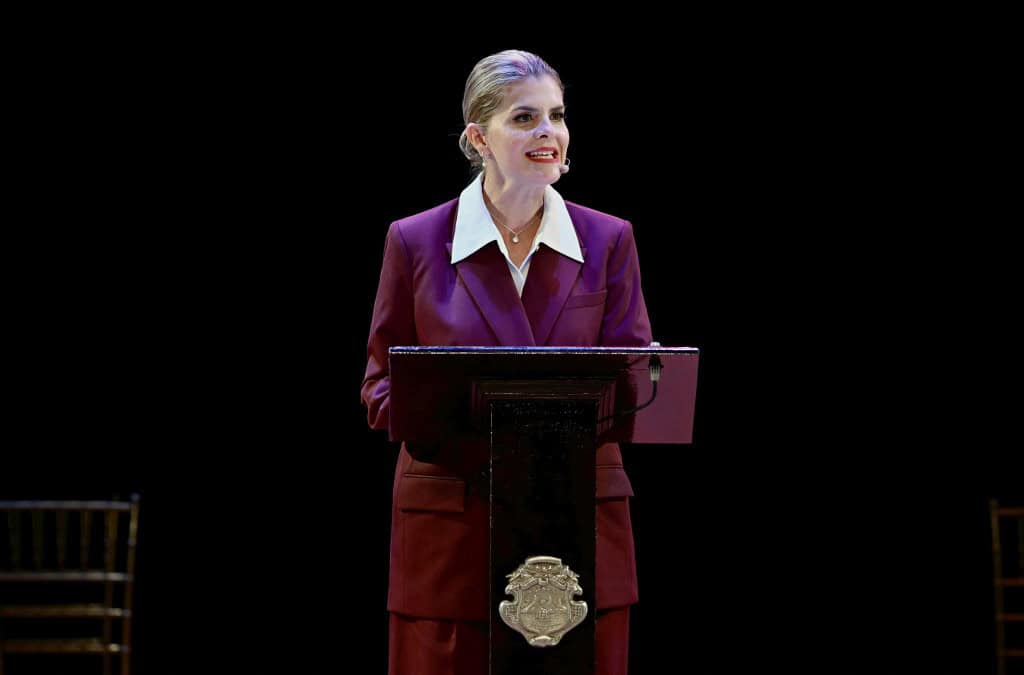
Laura Fernández will be sworn in today as our new president, opening a four-year term shaped by promises of tougher security policies, closer alignment with outgoing President Rodrigo Chaves and a level of legislative power few recent Costa Rican administrations have enjoyed.
The inauguration will take place at the National Stadium in San José, with the formal transfer of power scheduled for 11 a.m. after a cultural program. Delegations from 71 countries and 18 international organizations are expected to attend, including leaders and representatives from the United States, Spain, Israel, Guatemala, Honduras, Panama, Chile and the Dominican Republic.
Fernández, a 39-year-old political scientist and former minister under Chaves, won the February 1 election in the first round after campaigning as the candidate of continuity. Her Partido Pueblo Soberano also secured 31 of the 57 seats in the Legislative Assembly, giving the incoming government an outright majority but not the 38 votes needed for deeper constitutional changes. Reuters reported that it is the first time since 1990 that one party has won both the presidency and control of the legislature in Costa Rica.
That majority gives Fernández a strong opening position. Ordinary legislation, appointments and budget priorities will be far easier to move than they were for Chaves, who governed most of his term with limited support in Congress. More ambitious reforms, especially those touching the courts or constitutional structure, will still require votes from outside her party.
The biggest sign of continuity came before the inauguration. Fernández named Chaves as both minister of the Presidency and minister of Finance, keeping the outgoing president at the center of the new administration. The Associated Press reported that the appointment gives Chaves a major role in Fernández’s government while also extending his immunity amid pending investigations, which Chaves has denied and described as politically motivated.
For supporters, the arrangement keeps a popular political project in place. For critics, it raises questions about how much power will rest with Fernández and how much will remain with Chaves. The former president leaves office with a confrontational style that reshaped Costa Rican politics, especially through attacks on traditional parties, judges, prosecutors and parts of the press.
Security is expected to dominate the first months of the new government. Fernández campaigned on a hardline approach to crime at a time when drug trafficking and violence have become central concerns for voters. She has backed tougher criminal penalties, emergency measures in high-crime areas and the completion of a maximum-security prison inspired by El Salvador’s model.
Her victory also places Costa Rica more firmly inside the region’s growing conservative bloc. Fernández has praised elements of Nayib Bukele’s security strategy in El Salvador, while Chaves strengthened ties with Washington during his final stretch in office. The incoming administration is expected to maintain that line, including cooperation with the United States on migration and security.
The inauguration also comes during a tense moment for press freedom. The United States recently revoked visas for several board members of La Nación, one of Costa Rica’s most influential newspapers and a frequent target of Chaves’ criticism. The U.S. State Department has not publicly explained the decision, while press advocates and opposition figures have raised concerns about political pressure on critical media.
Fernández inherits a country still widely known for stability, tourism and democratic institutions, but facing sharper political polarization, rising security concerns, infrastructure problems and pressure over public services. Costa Rica also remains one of Latin America’s more unequal economies, despite gains in poverty reduction during the Chaves administration.
Her first test will be how she uses the power voters handed her. With a legislative majority, a loyal cabinet and Chaves inside the government, Fernández starts with advantages most Costa Rican presidents have lacked. The question now is whether that power will be used to move long-stalled policy proposals through the system or to push our country into a deeper fight over the balance between security, executive authority and democratic checks.





