

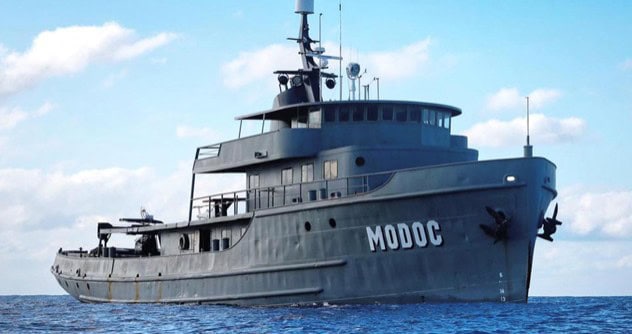
A former U.S. military vessel built during World War II is now anchored in Costa Rica’s South Pacific, where it has taken on a very different mission: helping protect marine life from illegal fishing.
The MODOC, a 1944 vessel originally built for the United States Navy at Levingston Shipyard in Orange, Texas, is now used as a floating operations center by Earthrace Conservation. The organization purchased the former Navy and U.S. Coast Guard ship in 2019 and converted it into a conservation vessel for patrols, surveillance and support work in protected areas.
Today, the ship remains based in the waters of southern Costa Rica, supporting marine and land-based operations with the National System of Conservation Areas, known as SINAC, and Costa Rican authorities. Its crew assists with patrols in areas such as Isla del Caño, Corcovado, Santa Rosa and waters around the Osa Peninsula, where illegal fishing, poaching and illegal mining have put pressure on protected ecosystems.
At the center of the operation is New Zealander Pete Bethune, founder of Earthrace Conservation and a longtime figure in international anti-poaching and anti-illegal fishing campaigns. His background includes high-profile operations against whaling in Antarctica with Sea Shepherd in 2009 and 2010. Earthrace says Bethune was imprisoned in Japan for five months after boarding a Japanese security vessel during that campaign.
Bethune’s work in Costa Rica grew out of a relationship with former Environment Minister Carlos Manuel Rodríguez. Earthrace says its patrol model in Costa Rica is based on a partnership in which the nonprofit provides vessels, crew, technology and surveillance support, while government officials retain authority over enforcement decisions.
The MODOC crew does not have jurisdiction in Costa Rica. Its role is to support park rangers and other officials by providing transportation, food, rest space, drones, boats and photographic evidence. On patrols, Costa Rican rangers lead any official action, including coordination with prosecutors or decisions over warnings, seizures or arrests.
That distinction matters. Earthrace’s work is not a private policing operation. It is a support system for government patrols in remote areas where official resources are often stretched thin.
The latest concern involves the use of live bait by longline fishing boats in coastal waters. Costa Rican law prohibits the use of live bait to target species such as sailfish and marlin within the first 30 nautical miles, a rule tied to conservation and the country’s sportfishing economy.
Recent monitoring by Earthrace found widespread signs of illegal activity. A study based on inspections of longline fishing gear reported that 77% of observed hooks used live bait, while all inspected lines showed some form of irregularity. The work focused heavily on Costa Rica’s Pacific coast, including the southern region near Golfo Dulce and the Osa Peninsula.
Teletica reported a similar finding from a recent MODOC inspection, noting that 7 out of 10 hooks reviewed were using live bait inside the coastal zone where the practice is prohibited.
For conservation groups, the concern goes beyond a technical violation. Live bait can make longline fishing more effective, increasing the risk that sailfish, marlin, turtles and other vulnerable species are caught. The issue also carries an economic angle for coastal communities that depend on sportfishing tourism, particularly in destinations such as Puerto Jiménez and Quepos.
Earthrace’s patrols often take place at night, when illegal fishing is more likely to occur. The MODOC provides a platform for rangers and volunteers to move through remote waters, document suspected violations and gather evidence that can later be used by Costa Rican authorities.
The organization’s work also extends inland. Its crews have supported operations in national parks, including Corcovado and Santa Rosa, against poaching and illegal mining. The team includes Appa, a search dog trained by the U.S. military and used during ground operations.
For Costa Rica, the MODOC represents an unusual conservation tool: a World War II-era ship repurposed for modern environmental enforcement. Its presence also points to a larger problem. The country has strong environmental laws and a global reputation for conservation, but enforcement in remote marine areas remains difficult, especially when authorities face limited patrol resources and competing security demands.
In the South Pacific, where biodiversity, sportfishing and coastal livelihoods overlap, that gap can be costly. The MODOC’s mission is to help close it, one patrol at a time