

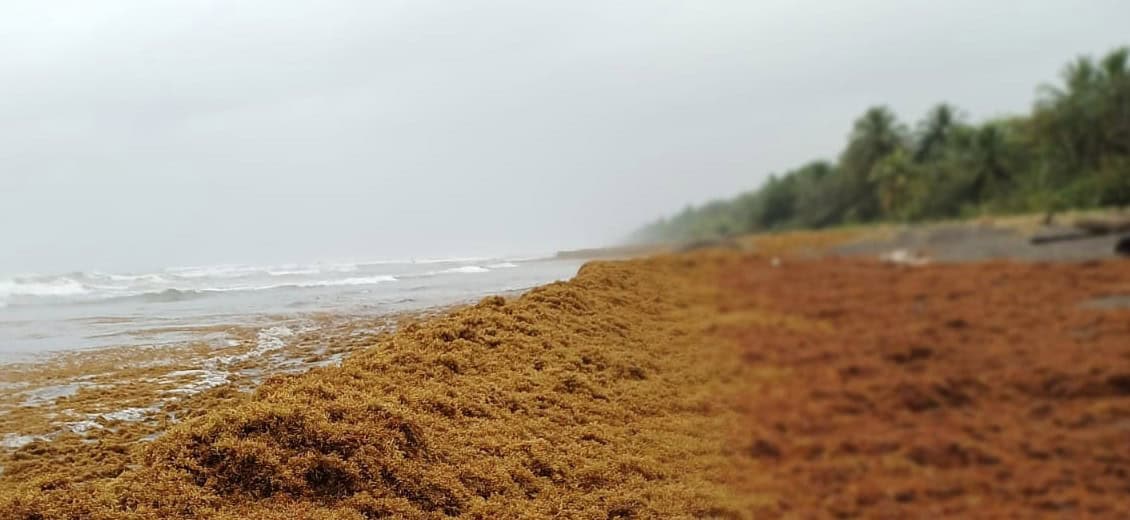
The Ministry of Environment and Energy (MINAE) has informed the public about the presence and increasing accumulation of sargassum along Costa Rica’s northern Caribbean coast. MINAE provided the details through the National System of Conservation Areas (SINAC), the Tortuguero Conservation Area (ACTO) and its Ecological Integrity Monitoring Program.
Sargassum is a genus of floating seaweed. The massive influx into the Caribbean has been documented since 2011. It affects the coasts of Mexico, Central America and several Caribbean islands. The species most commonly associated with these events are Sargassum natans and Sargassum fluitans. Both have air vesicles that allow them to float and form extensive surface masses known as the Great Atlantic Sargassum Belt.
Following the passage of tropical wave number 15, the Monitoring Network issued an early warning about the possible arrival of sargassum in areas of the southern Caribbean, including Manzanillo and Puerto Viejo. In the northern Caribbean, particularly in Tortuguero National Park and surrounding areas, reports began earlier this week. They indicate a progressive increase in accumulation.
Reports have been received from the Border Police post in Portillos, the town of Tortuguero and along the coastline of Tortuguero National Park. According to preliminary records, this may represent one of the largest accumulations recently reported in the northern Caribbean region.
Since 2019, the Tortuguero Conservation Area has maintained ongoing coordination with academic institutions and regional monitoring networks, particularly the National University and the Caribbean Sargassum Monitoring Network, under a collaborative research framework.
In addition, since 2023, systematic marine surveys conducted to monitor aquatic mammals have incorporated the documentation of the location, extent and dynamics of offshore sargassum masses. These records help track the distance of the sargassum belt from the coast, seasonal patterns and the influence of wind and ocean currents.
Although sargassum plays an important ecological role by providing habitat and food for various marine species, excessive accumulation in coastal areas can generate environmental, social and economic impacts. Large quantities on beaches may affect tourism and alter coastal dynamics, while offshore masses can reduce sunlight penetration and influence marine ecosystems.
The phenomenon is considered dynamic and natural. Due to its magnitude and extent, no direct removal actions are being undertaken within the protected area. The sargassum material historically tends to decompose, dry out from solar exposure or reincorporate into the sea through wave and current action.
Ongoing monitoring and research aim to generate technical information to support future management decisions and explore sustainable use alternatives. The institution will continue to monitor the situation in the northern Caribbean and inform the public about any changes in the behavior of this phenomenon.





