
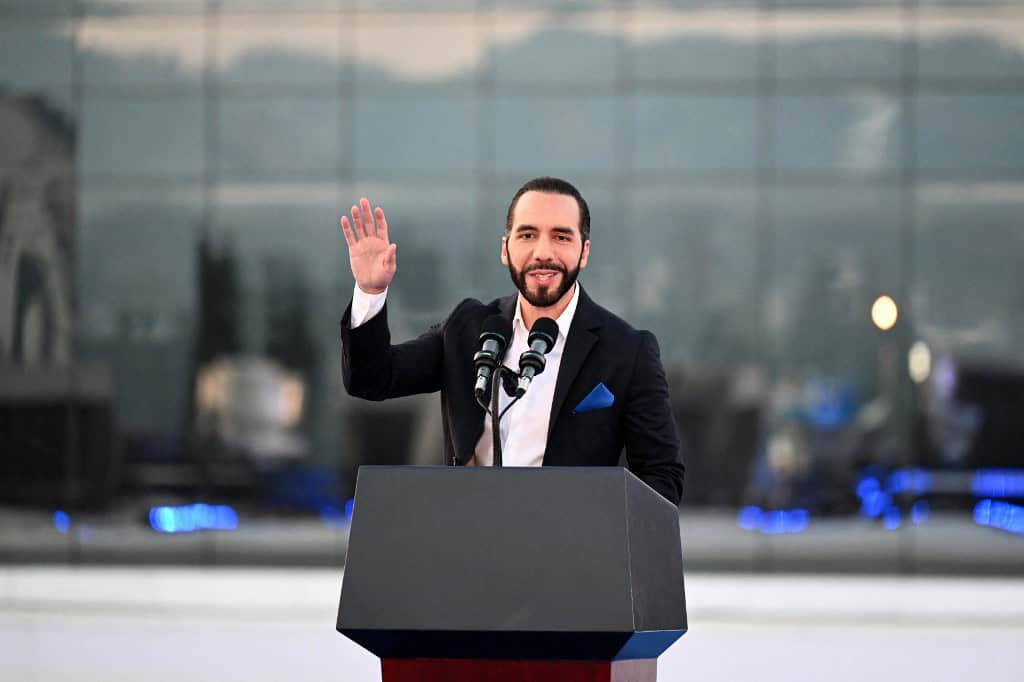
No one was surprised. El Salvador’s President, Nayib Bukele, is now officially cleared for indefinite reelection. Congress, firmly under his control, paved the way with a constitutional reform that consolidates his total power.
Critics see it as a fatal blow to democracy; supporters view it as necessary to prevent a return to gang violence. Here are five key points explaining how the self-proclaimed “cool dictator” got here:
1. Public Fatigue
Bukele represents a rejection of the traditional right- and left-wing parties that failed to solve the country’s deep problems: poverty and gangs, said political analyst Ricardo Navarro.
“Gangs extorted everyone. People were tired and disillusioned with previous governments. It was always the same people, and that allowed him to win in 2019 with 52% of the vote. There was exhaustion,” Navarro noted.
The Mara Salvatrucha and Barrio 18 gangs controlled 80% of the territory, and the homicide rate was 51 per 100,000 inhabitants in 2018.
According to an investigation by El Faro, Bukele allegedly struck a deal with the gangs, offering money and benefits for imprisoned gang members in exchange for reducing killings and urging communities to vote for him. The president has vehemently denied this.
2. Congress, the Key
When Bukele took office, Congress was hostile to him. In 2020, he stormed parliament with soldiers, demanding approval of a loan for his security policy. For Celia Medrano, an international public policy consultant, this was “the clearest example of the militarization of politics” that strengthened his grip on power.
A skilled marketer with a powerful media machine, Bukele’s party won a congressional majority in 2021, enabling him to replace judges and prosecutors who opposed him. Since then, not a single bill he has submitted has been rejected.
“He has eliminated political opposition with a combination of legal maneuvers, military intimidation, media control, and popular policies like gang crackdowns,” noted the Washington Office on Latin America (WOLA).
3. State of Emergency
After 87 killings in a single weekend in March 2022, Bukele declared a “war” on gangs and imposed a state of emergency under which 88,000 alleged gang members and collaborators were arrested.
According to the government, homicides fell to 1.9 per 100,000 inhabitants in 2024. But NGOs like Amnesty International, Human Rights Watch (HRW), and Cristosal denounce torture and thousands of arbitrary arrests.
“The state of emergency allowed him to boost his popularity while also creating a threat against anyone who dares to dissent,” said HRW’s Juan Pappier. A June poll from the Central American University (UCA) showed that 60% of Salvadorans support the state of emergency.
“There were too many gang members, and this president put them in their place. His reelection would be good,” said 70-year-old lottery vendor Federico Quintanilla. “Talking about popular support… when six out of ten Salvadorans fear expressing their opinion about the government, is nothing but fiction,” countered Medrano, citing another UCA statistic.
4. Unconstitutional Reelection
Although the Constitution once prohibited reelection, judges appointed by Bukele’s party reinterpreted the law, clearing the way for his candidacy. At the height of his popularity, he was reelected in February 2024 with 85% of the vote, crushing the opposition and gaining near-total control of the state. Of 60 lawmakers, 57 are aligned with him.
“This is where years of gradual constitutional manipulation lead to the dismantling of democracy. By capturing institutions, silencing critics, and rewriting the Constitution, he has created an authoritarian electoral system,” said WOLA.
A few months ago, Congress passed a fast-track process to reform the Constitution, which was applied on Thursday.
5. Trump, the Friend
Donald Trump’s return to power gave Bukele a new boost. He demonstrated his loyalty to the U.S. president by holding 252 Venezuelans deported by Washington in detention for four months.
“He knows Trump won’t impose limits and is fully willing to turn a blind eye to the destruction of Salvadoran democracy,” said Pappier. For Cristosal’s director, Noah Bullock, “Bukele feels shielded by his relationship” with Trump.
Emboldened by that relationship, the government has arrested human rights defenders this year and forced journalists, activists, and NGOs like Cristosal into exile.