
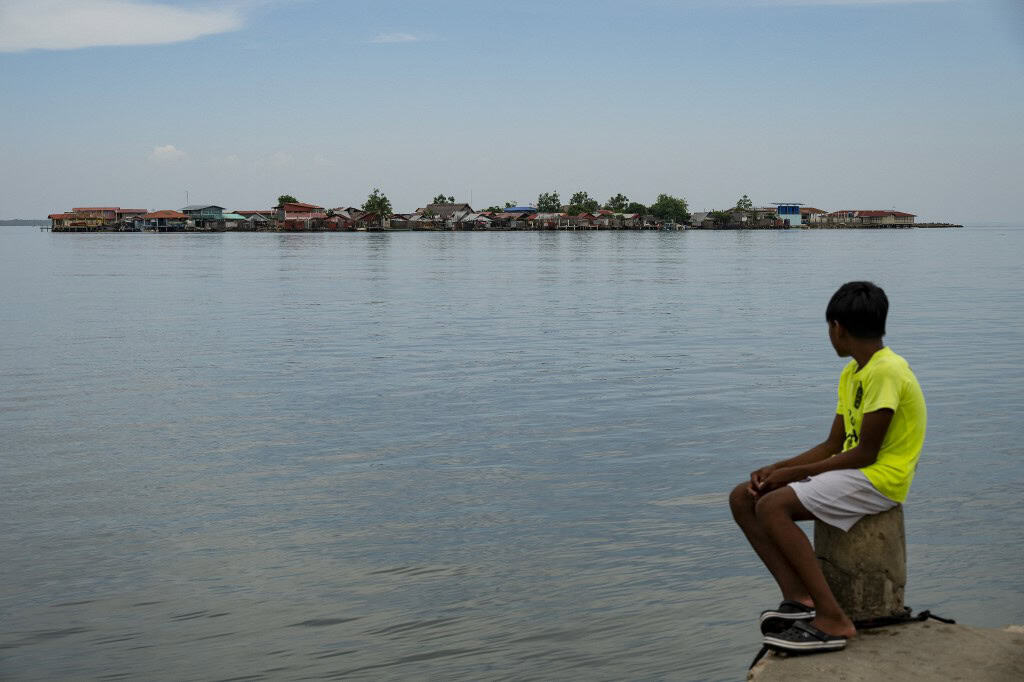
The laughter of children running through the alleys of Gardí Sugdub is no longer heard. Everything changed a year ago when nearly all of the island’s Indigenous inhabitants fled this tiny Panamanian Caribbean island that is slowly being swallowed by the sea.The calm now contrasts sharply with the bustle of last June, when around 1,200 Guna people were transported by boat to a new life on the mainland—one of Latin America’s first planned climate change-related migrations.
Delfino Davies, who runs a small museum on the island filled with spears, clay pots, and animal bones, he said that what followed the exodus was “sadness.” “There were no more friends, no more kids playing—the place fell quiet like a dead island.”Only dusty desks and empty classrooms remain at the school. Many wooden and cane homes are now padlocked.
“Empty. No one’s here. Sometimes I feel sad when I’m alone,” says Mayka Tejada, 47, from the tiny store where she still sells plantains, clothes, toys, notebooks, and gourds. Like Davies and about 100 others, Tejada chose to stay behind. But her mother and two children, aged 16 and 22, moved to one of the 300 homes built by the Panamanian government in the new settlement of “Isber Yala”—15 minutes away by boat and another 5 by road.
Once packed onto its 400-by-150-meter plot, Gardí Sugdub is one of 49 inhabited islands among the 365 that make up the Guna Yala archipelago—also known as San Blas—which scientists say will disappear before the end of the century.
I Will Die Here
In the dim light of her hut with a dirt floor, 62-year-old Luciana Pérez threads yellow beads into a necklace. The air smells of the smoldering embers she uses to cook medicinal herbs. “I was born in Gardí and I will die here. Nothing is sinking. Scientists don’t know—only God does,” she says. She isn’t afraid. Every December since she was a child, she’s seen strong waves flood the island homes.
According to Steven Paton of the Smithsonian Tropical Research Institute, sea levels could rise by 80 centimeters by the end of the century as temperatures rise 2.7°C above pre-industrial levels. “Most Guna Yala islands are only about 50 cm above sea level. They simply won’t hold. They’ll be underwater,” he said.
Davies, now 53, recalls helping his father as a child to haul rocks, debris, and coral to reinforce the island’s shore and hold back the sea. “Moving people from an island to somewhere else shows the reality the planet must now face,” said Ana Toni, Executive Director of COP30.
Always the Sea
Rain fell earlier in the day, leaving puddles along Gardí Sugdub’s dirt paths. In Isber Yala—“land of loquats” in the Guna language—the streets are paved and lined with sidewalks. The 40-square-meter concrete-and-zinc homes, painted cream and yellow, come with toilets instead of shared latrines, and a patch of land for planting. They’re organized in blocks, 2 km from the coast.
“We were so cramped before. I had to get water in a little boat. Now it comes for one hour in the morning and I can fill my buckets. Plus, I have electricity 24/7,” said 75-year-old retired teacher Magdalena Martínez, who now lives there with her granddaughter. Tejada’s children don’t regret leaving the island. “I miss them, but they’re happy. They have a place to play soccer and take walks,” she says, embroidering Guna molas as she waits for customers.
Not everything has been resolved. The school moved to Isber Yala, but the dilapidated health clinic—with no running water—remains on the island. “People used to walk here. Now they must travel by land and sea. Consultations have dropped,” says 46-year-old doctor John Smith. Some residents have one foot in both places. Others return to check on homes they locked or lent to islanders from elsewhere.
This week will bring more movement. Seven jugs of chicha (fermented corn drink) are ready to celebrate the first anniversary in Isber Yala. Martínez is excited for the celebration—but her smile fades for a moment. Though she might not live to see it, she reflects: “The islands will disappear because the sea will reclaim its territory.”
That same sea, she says, is what she misses the most.