

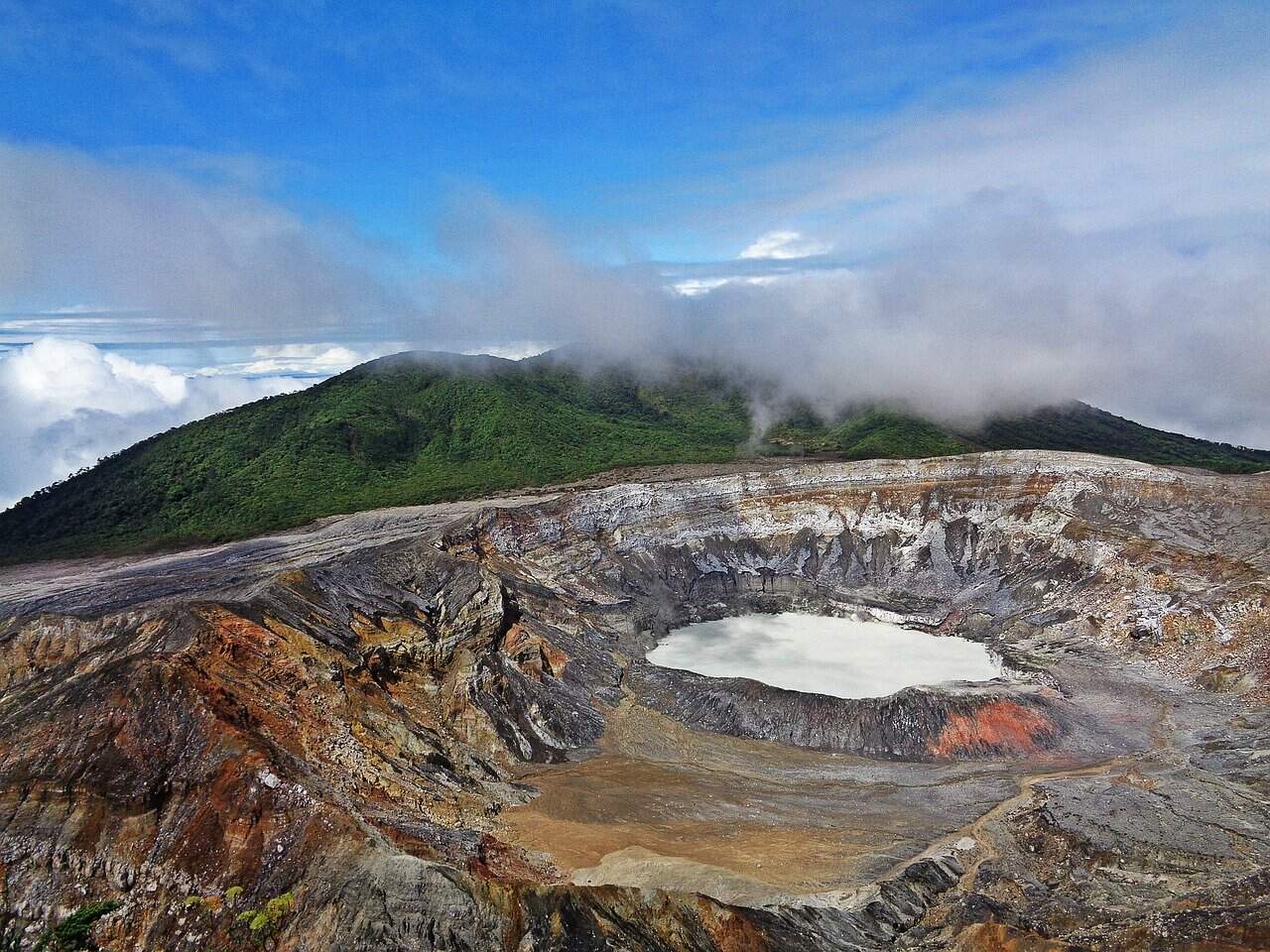
Poás Volcano shows signs of a slight decrease in its eruptive activity after three weeks of frequent eruptions and ash and gas emissions, according to the Volcanological and Seismological Observatory (OVSICORI). According to volcanologist Geoffroy Avard, a downward trend in the energy of the explosions has been observed since Friday.
“There is a slight trend of decreasing eruptive amplitude. That is to say, we see that the acoustic pulses have lower amplitude, which suggests that the volcano is beginning to decrease its eruptive activity a little,” he explained. This does not imply that the volcano’s activity has completely ceased. According to the expert, on Monday, the volcano continued to exhibit frequent eruptive pulses every one or two minutes.
Avard stated that these events are probably associated with ash and rock fragment ejections, as has occurred in previous weeks. Ash emission has been constant, and there have been reports of ash fall to the south and southwest of the volcano, although it has not been visually confirmed due to weather conditions.
Cantons like Grecia, in the province of Alajuela, face toxic air levels and acid rain. Last week, experts from OVSICORI and the Atmospheric Chemistry Laboratory of the UNA installed a gas and particle meter in the community of San Luis de Grecia. The effects of these volcanic materials are already being felt by the residents of San Luis, who reported irritated eyes, conjunctivitis, itchy skin, sore throat, runny nose, and cough—symptoms related to the inhalation of gases and particles. Even dogs and other domestic animals sneeze or cough when exposed to gas or ash, which are highly irritating.
OVSICORI experts point out that despite the slight drop in activity, the behavior of the volcano may continue to be unpredictable. “This process of stopping the eruptive activity can be very progressive, very slow, and chaotic, with occasional increases and significant dangers,” they said. Authorities are constantly monitoring the volcano’s behavior. For the time being, the volcano remains at alert level 3, which indicates caution.





